



Of the three regional Federal Reserve surveys released to date, all are in expansion.
Analyst Opinion of Richmond Manufacturing
The important Richmond Fed subcategories significantly accelerated. This was a stronger report than last month.
There were no market expectations from Nasdaq / Econoday. The actual survey value was 20 [note that values above zero represent expansion].
Fifth District manufacturing expanded at a slower pace in July, according to results of the most recent survey from the Federal Reserve Bank of Richmond. The composite manufacturing index fell from 21 in June to 20 in July, but it remained in solid expansionary territory. This decrease resulted from a decrease in the employment and shipments indexes, as the other component (new orders) held steady. Firms were optimistic in July, expecting to see robust growth across most indicators in the coming months.
Manufacturing employment growth slowed in July, as the employment index fell from 23 in June to 22 in July. Firms continued to struggle to find workers with the skills they needed and expect this struggle to continue in the next six months.
Manufacturing firms reported that the gap between growth in prices paid and prices received narrowed in July, although both increased. Respondents expect growth in prices received to continue to accelerate in coming months but anticipate a slowing in growth of prices paid.

Summary of all Federal Reserve Districts Manufacturing:
Richmond Fed (hyperlink to reports):

z richmond_man.PNG
Kansas Fed (hyperlink to reports):

z kansas_man.PNG
Dallas Fed (hyperlink to reports):

z dallas_man.PNG
Philly Fed (hyperlink to reports):

z philly fed1.PNG
New York Fed (hyperlink to reports):

z empire1.PNG
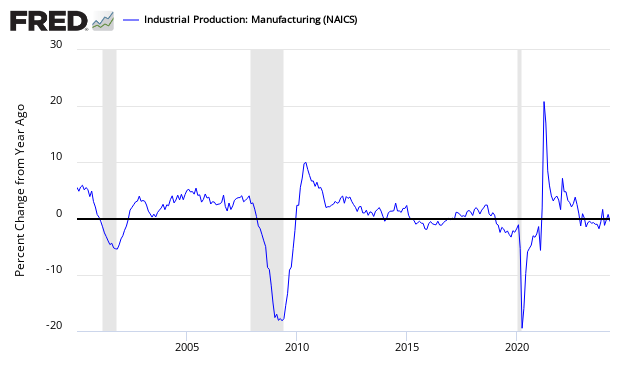
Federal Reserve Industrial Production – Actual Data (hyperlink to report):
Holding this and other survey’s Econintersect follows accountable for their predictions, the following graph compares the hard data from Industrial Products manufacturing subindex (dark blue bar) and US Census manufacturing shipments (lighter blue bar) to the Richmond Fed survey (darkest bar).

In the above graphic, hard data is the long bars, and surveys are the short bars. The arrows on the left side are the key to growth or contraction.
include(“/home/aleta/public_html/files/ad_openx.htm”); ?>


