


 Written by Steven Hansen
Headline data for truck shipments showed an improvement in April 2018.
Analyst Opinion of Truck Transport
I tend to put heavier weight on the CASS index which continues to show strong rate of growth improvement year-over-year. Part of the problem with ATA data is its poor presentation and lack of transparency.
It should be pointed out that the trucking movements are improving YoY.
ATA Trucking
American Trucking Associations’ advanced seasonally adjusted (SA) For-Hire Truck Tonnage Index increased 2.2% in April after easing 1% in March. In April, the index equaled 112.5 (2015=100), up from 110.1 in March.
Said ATA Chief Economist Bob Costello:
Truck freight tonnage remains robust. And I don’t think we’ve even seen the traditional spring freight season yet. People are just getting around to buying grills, lawn mowers, and yard tools. Plus, the produce season was also delayed due to a cold snap in early spring. Longer-term, strength in consumption, factory output, and construction should keep truck freight tonnage solid for the quarters ahead.
ATA Truck tonnage this month

z truck.jpg
Compared with April 2017, the SA index surged 9.5%, which was the largest year-over-year increase since October 2017. Year-to-date, compared with the same four months last year, tonnage increased 8%, far outpacing the annual gain of 3.8% in 2017.
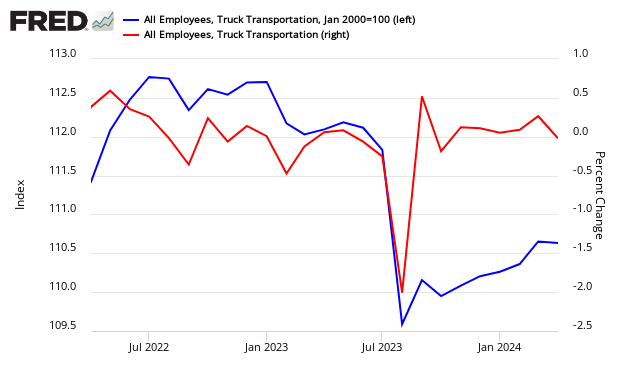
Econintersect tries to validate ATA truck data across data sources. It appears this month that jobs growth says the trucking industry employment levels were improved month-over-month. Please note using BLS employment data in real time is risky, as their data is normally backward adjusted (sometimes significantly). ATA revised the March decline slightly from the originally reported 1.1% to 1%.
source: ATA
CASS FREIGHT INDEX REPORT
Volume Strong, Pricing Even Stronger – Capacity Still Tight but Less Tight
Both the Shipments and Expenditures Indexes extended their run into positive territory. They are still displaying accelerating strength on top of increasingly difficult comparisons, but while capacity is tight it is slightly less tight. That said, demand is still exceeding capacity in most modes by a significant amount. In turn, pricing power has erupted in those modes to levels that spark overall inflationary concerns in the broader economy. As we explained in previous months, we do not fear long-term inflationary pressure as technology provides multiple ways to ever-increase asset utilization and price discovery in all parts of the economy, especially in transportation. In fact, we are seeing early signs that ELDs (Electronic Logging Devices) initially hurt the capacity/utilization of truckers, especially small truckers, but those truckers most adversely effected are now beginning to get some of the loss in utilization back.
Shipments first turned positive eighteen months ago, while expenditures turned positive fifteen months ago. The current level of volume and pricing growth is signaling that the U.S. economy is not only growing, but that level of growth is expanding. The 10.2% YoY increase in the April Cass Shipments Index is yet another data point confirming that the strength in the U.S. economy continues to accelerate. This level of percentage increase is usually only attained when emerging from a recession, not when comping against already strong statistics.

z truck1.PNG
Source: http://www.cassinfo.com/Transportation-Expense-Management/Supply-Chain-Analysis/Cass-Freight-Index.aspx
include(“/home/aleta/public_html/files/ad_openx.htm”); ?>


