


 Written by Jill Mislinski
The latest Conference Board Consumer Confidence Index was released this morning based on data collected through May 18. The headline number of 117.9 was a decrease from the final reading of 119.4 for April, a downward revision from 120.4. Today’s number was below the Investing.com consensus of 119.8.
Here is an excerpt from the Conference Board press release.
“Consumer confidence decreased slightly in May, following a moderate decline in April,” said Lynn Franco, Director of Economic Indicators at The Conference Board. “However, consumers’ assessment of present-day conditions held steady, suggesting little change in overall economic conditions. Looking ahead, consumers were somewhat less upbeat than in April, but overall remain optimistic that the economy will continue expanding into the summer months.”
Putting the Latest Number in Context
The chart below is another attempt to evaluate the historical context for this index as a coincident indicator of the economy. Toward this end, we have highlighted recessions and included GDP. The regression through the index data shows the long-term trend and highlights the extreme volatility of this indicator. Statisticians may assign little significance to a regression through this sort of data. But the slope resembles the regression trend for real GDP shown below, and it is a more revealing gauge of relative confidence than the 1985 level of 100 that the Conference Board cites as a point of reference.

On a percentile basis, the latest reading is at the 88th percentile of all the monthly data points since June 1977, down from the 90th percentile the previous month.
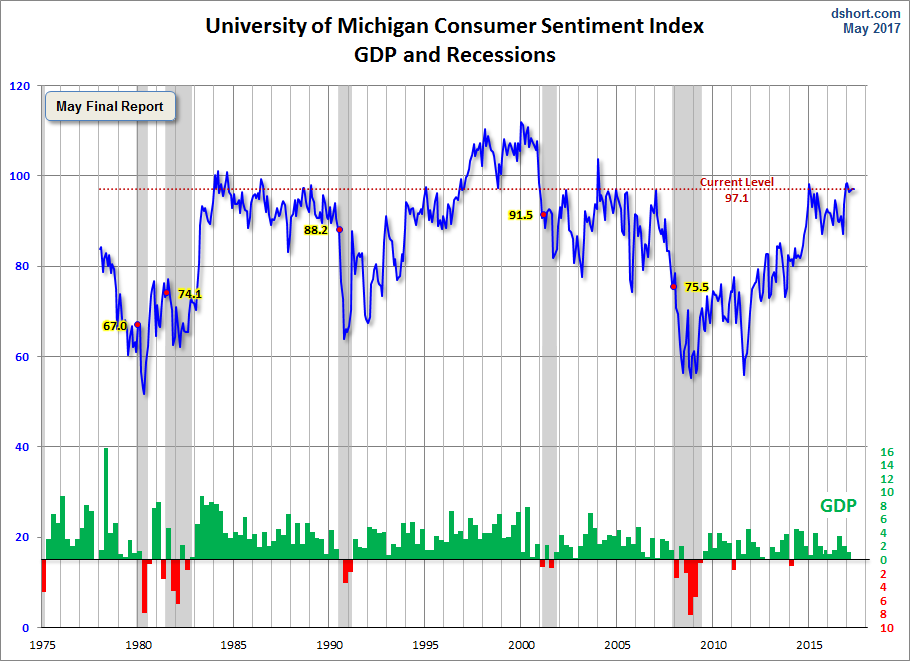
For an additional perspective on consumer attitudes, see the most recent Reuters/University of Michigan Consumer Sentiment Index. Here is the chart from that post.
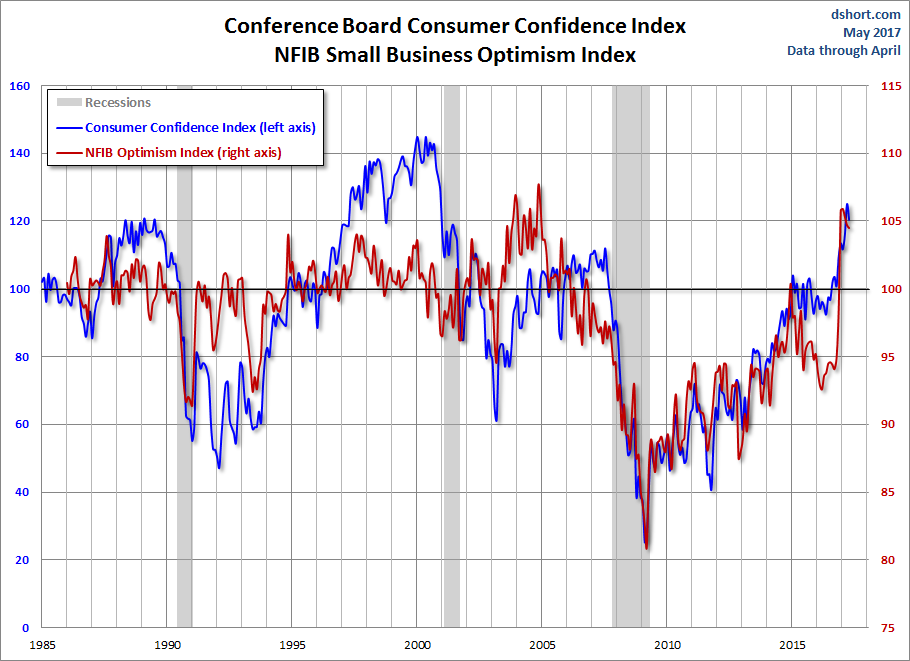
And finally, let’s take a look at the correlation between consumer confidence and small business sentiment, the latter by way of the National Federation of Independent Business (NFIB) Small Business Optimism Index. As the chart illustrates, the two have tracked one another fairly closely since the onset of the Financial Crisis, although a spread appeared in the second half of 2015 and continued into 2016.
include(“/home/aleta/public_html/files/ad_openx.htm”); ?>


