



The year-over-year rate of growth relative to the previous month of the US Coincident Index marginally declined, but year-over-year growth improved. A comparison of this US Coincident Index with the Aruoba-Diebold-Scotti business conditions index, Conference Board Coincident Index, ECRI’s Coincident Index, and the Chicago Fed National Activity Index follows.
Analyst Opinion of the Current Status of the Coincident Indicators
The reality is that most of the economic indicators have moderate to significant backward revision – but this month it seems the majority rear view mirror says the USA economy is slowing, flat or improving. Out of this group of coincident indicators discussed in this post, only ECRI and the Aruoba-Diebold-Scotti business conditions index have no backward revision – and both have a good track record of seeing the economy accurately in almost real time.
For April, it show that the economy is on an improving trend line.
Economic indicators that coincide with economic movements are coincident indicators. Coincident indicators by definition do not provide a forward economic view. However, trends are valid until they are no longer valid, making the trend lines on the coincident indicators a forward forecasting tool.
Excerpt from Philly Fed Report for the United States Coincident Index
[click graph below to enlarge]The Federal Reserve Bank of Philadelphia has released the coincident indexes for the 50 states for April 2017. Over the past three months, the indexes increased in 46 states and decreased in four, for a three-month diffusion index of 84. In the past month, the indexes increased in 41 states and decreased in nine, for a one-month diffusion index of 64. For comparison purposes, the Philadelphia Fed has also developed a similar coincident index for the entire United States. The Philadelphia Fed’s U.S. index rose 0.8 percent over the past three months and 0.3 percent in April.

z philly coincident.PNG
In the graph below, the blue line shows the year-over-year growth rate of the US Concident Index, while the darker blue line shows the month-over-month change. The year-over-year trend is down.

Aruoba-Diebold-Scotti Business Conditions Index

Per the Philly Fed:
The Aruoba-Diebold-Scotti business conditions index is designed to track real business conditions at high frequency. Its underlying (seasonally adjusted) economic indicators (weekly initial jobless claims; monthly payroll employment, industrial production, personal income less transfer payments, manufacturing and trade sales; and quarterly real GDP) blend high- and low-frequency information and stock and flow data. Both the ADS index and this web page are updated as data on the index’s underlying components are released.
The average value of the ADS index is zero. Progressively bigger positive values indicate progressively better-than-average conditions, whereas progressively more negative values indicate progressively worse-than-average conditions. The ADS index may be used to compare business conditions at different times. A value of -3.0, for example, would indicate business conditions significantly worse than at any time in either the 1990-91 or the 2001 recession, during which the ADS index never dropped below -2.0.
The vertical lines on the figure provide information as to which indicators are available for which dates. For dates to the left of the left line, the ADS index is based on observed data for all six underlying indicators. For dates between the left and right lines, the ADS index is based on at least two monthly indicators (typically employment and industrial production) and initial jobless claims. For dates to the right of the right line, the ADS index is based on initial jobless claims and possibly one monthly indicator.
Conference Board’s Coincident Index (red line):

z conference.png
ECRI’s USCI (U.S. Coincident Index):

z ecri_coin.png
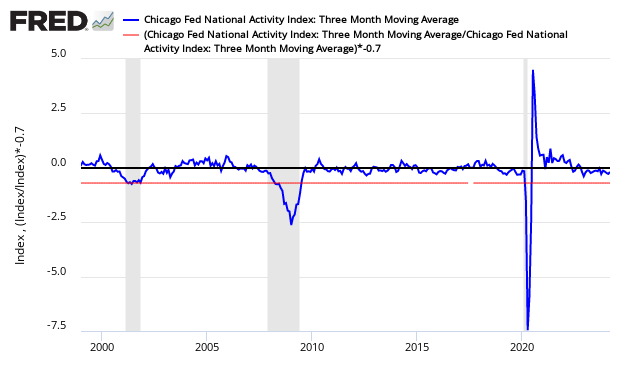
Chicago Fed National Activity Index (CFNAI)
Summary
Note that the release dates vary with some indices with May data, others with March or April. Even so, generally the coincident indices are showing weak growth except for the CFNAI which is showing stronger than average growth (however the CFNAI is subject to significant backward revision): Econintersect‘s analysis of the coincident indices is that:
- The Philly Fed US Coincident index shows the annual rate of growth although improving this month is showing weak growth.
- The Aruoba-Diebold-Scotti business conditions shows above average business conditions.
- The rate of growth of the Conference Board Coincident Index is stable with slow growth.
- ECRi’s Coincident Index’s rate of growth marginally improved and remains in an improving trend.
- The CFNAI rate of growth is well above the historical trend rate of growth (zero line) – and is generally trending showing improvement.
include(“/home/aleta/public_html/files/ad_openx.htm”); ?>


