



Of the four regional Federal Reserve surveys released to date, three are in expansion and one is in contraction.
There were no market expectations from Bloomberg. The actual survey value was 10 [note that values above zero represent expansion].
Fifth District manufacturing activity improved in July, according to the most recent survey by the Federal Reserve Bank of Richmond.* New orders and shipments increased this month, while backlogs flattened. Employment rose modestly, while firms continue to report wage increases. Prices of raw materials and finished goods rose at a slower pace in July, compared to last month.
Manufacturers looked for better business conditions during the next six months. Firms expected moderate growth in shipments and in the volume of new orders in the six months ahead. In addition, survey participants anticipated increased capacity utilization and expected backlogs to rise. Expectations were for little change in vendor lead times during the six months ahead.
Survey participants’ outlook for the months ahead included mild growth in the number of employees. Future wage increases were more prominent in the July expectations index. Firms expected faster growth in prices paid, however, anticipating somewhat slower growth in prices received.
Current Activity
Overall, manufacturing activity increased in July. The composite index for manufacturing climbed 20 points to a reading of 10. Additionally, the indicators for shipments and new orders increased this month. Those indexes ended at readings of 7 and 15, respectively. The orders backlog index flattened in July, the index moved up 13 points to end at 1. The manufacturing employment index rose modestly this month. That indicator gained five points to end at 6.
The capacity utilization index advanced 14 points in July, pulling the index up to a reading of 3. Vendor lead time lengthened this month, with that indicator moving up eight points to end at 10. Finished goods inventories rose across fewer firms compared to a month ago; that index moved down 11 points, ending at a reading of 15. Growth in raw materials inventories continued in July, however that indicator lost three points to end the survey period at 23.
Summary of all Federal Reserve Districts Manufacturing:
Richmond Fed (hyperlink to reports):

z richmond_man.PNG
Kansas Fed (hyperlink to reports):

z kansas_man.PNG
Dallas Fed (hyperlink to reports):

z dallas_man.PNG
Philly Fed (hyperlink to reports):

z philly fed1.PNG
New York Fed (hyperlink to reports):

z empire1.PNG
Federal Reserve Industrial Production – Actual Data (hyperlink to report):
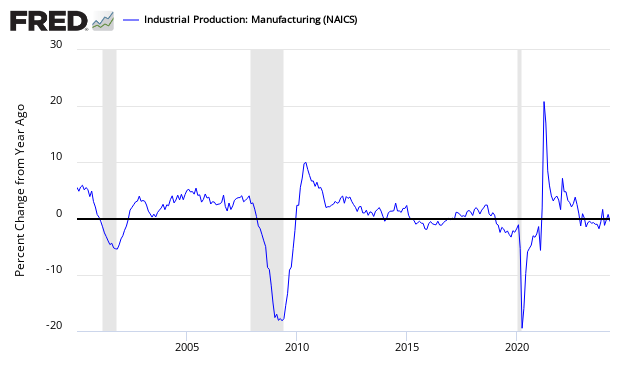
Holding this and other survey’s Econintersect follows accountable for their predictions, the following graph compares the hard data from Industrial Products manufacturing subindex (dark blue bar) and US Census manufacturing shipments (lighter blue bar) to the Richmond Fed survey (darkest bar).
Comparing Surveys to Hard Data:

z survey1.png
In the above graphic, hard data is the long bars, and surveys are the short bars. The arrows on the left side are the key to growth or contraction.
include(“/home/aleta/public_html/files/ad_openx.htm”); ?>


