



Of the four Federal Reserve districts which have released their June manufacturing surveys – three are in expansion, one in contraction. A complete summary follows.
There was no market expectations from Bloomberg, and the reported value was -7.0. From the Dallas Fed:
Texas factory activity declined again in June, according to business executives responding to the Texas Manufacturing Outlook Survey. The production index, a key measure of state manufacturing conditions, posted a second consecutive negative reading but rose from -13.1 to -7.0, suggesting the pace of contraction eased somewhat from May.
Other measures of current manufacturing activity also reflected continued declines this month. The new orders index held steady at -14.2, while the growth rate of orders index fell four points to -18.6. The capacity utilization and shipmentsindexes remained negative for a second month but edged up, coming in at -9.3 and -8.6, respectively.
Perceptions of broader business conditions stayed pessimistic in June. The general business activity index has been negative since January 2015 and came in at -18.3 this month, up slightly from its May reading. The company outlook index posted a seventh consecutive negative reading but rose 5 points to -11.0.
Labor market measures indicated a sixth month of contraction in a row in June. The employment index fell to -11.5, its lowest reading since November 2009. The decline in the index was largely due to a falloff in the share of firms adding to headcounts. Only six percent of firms noted net hiring in June, down from 16 percent last month and well below the 18 percent noting net layoffs. The hours worked index edged down one point to -12.8, signaling continued contraction in workweek length.
Price pressures were mixed, and wages continued to rise. Input costs rose for a third month in a row, as the raw materials prices index held steady at 12.6. Selling prices continued to decline, with the finished goods prices index edging down to-5.2 in June. Meanwhile, the wages and benefits index stayed positive and relatively unchanged at 21.6, suggesting a continued rise in compensation.
Expectations regarding future business conditions improved in June. The index of future general business activity bounced back to a positive reading of 2.6 after dipping below zero last month. The index of future company outlook also ticked up, coming in at 7.9. Most indexes for future manufacturing activity pushed further into positive territory in June.
Source: Dallas Fed
Summary of all Federal Reserve Districts Manufacturing:
Richmond Fed (hyperlink to reports):

z richmond_man.PNG
Kansas Fed (hyperlink to reports):

z kansas_man.PNG
Dallas Fed (hyperlink to reports):

z dallas_man.PNG
Philly Fed (hyperlink to reports):

z philly fed1.PNG
New York Fed (hyperlink to reports):

z empire1.PNG
Federal Reserve Industrial Production – Actual Data (hyperlink to report):
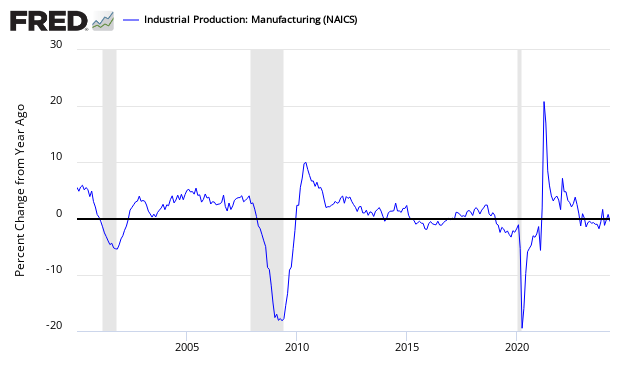
Holding this and other survey’s Econintersect follows accountable for their predictions, the following graph compares the hard data from Industrial Products manufacturing subindex (dark blue bar) and US Census manufacturing shipments (lighter blue bar) to the Dallas Fed survey (light blue bar).
Comparing Surveys to Hard Data:

z survey1.png
In the above graphic, hard data is the long bars, and surveys are the short bars. The arrows on the left side are the key to growth or contraction.
include(“/home/aleta/public_html/files/ad_openx.htm”); ?>


