


by Doug Short and Steven Hansen
According to the BLS, the Consumer Price Index (CPI-U) year-over-year inflation rate was 0.5% – almost no inflation. The year-over-year core inflation (excludes energy and food) rate grew 0.1% to 2.0 %, and now is at the target set by the Federal Reserve. Does this green light movement of the federal funds rate by the FOMC?

The market expected (from Bloomberg):
| month over month change | Consensus Range | Consensus | Actual |
| CPI-U | -0.1 % to 0.2 % | +0.0 % | +0.0 % |
| CPI-U less food and energy | 0.1 % to 0.2 % | +0.2 % | +0.2 % |

As a generalization – inflation accelerates as the economy heats up, while inflation rate falling could be an indicator that the economy is cooling. However, inflation does not correlate well to the economy – and cannot be used as a economic indicator.
There were few major influences on this month’s CPI. Energy was mixed.
The Consumer Price Index for All Urban Consumers (CPI-U) was unchanged in November on a seasonally adjusted basis, the U.S. Bureau of Labor Statistics reported today. Over the last 12 months, the all items index increased 0.5 percent before seasonal adjustment.
The indexes for energy and food declined in November, offsetting an increase in the index for all items less food and energy and resulting in the seasonally adjusted all items index being unchanged. The energy index fell 1.3 percent, with all of the major component indexes declining except electricity. The food index fell 0.1 percent, as the index for food at home fell 0.3 percent, with five of the six major grocery store food group indexes declining.
The index for all items less food and energy rose 0.2 percent in November, the same increase as in September and October. The indexes for shelter, medical care, airline fares, new vehicles, and tobacco were among the indexes that rose in November. In contrast, the indexes for recreation, apparel, household furnishings and operations, and used cars and trucks all declined.
The all items index rose 0.5 percent over the last 12 months; this is the largest 12 month increase since the 12-month period ending December 2014. The food index rose 1.3 percent over the span, while the energy index declined 14.7 percent. The index for all items less food and energy rose 2.0 percent, its largest 12-month increase since the 12 months ending May 2014.
Historically, the CPI-U general index tends to correlate over time with the CPI-U’s food index. The current situation is putting an upward pressure on the CPI.
CPI-U Index compared to the Food sub-Index of CPI-U

Notice the gap in the above graphic between the CPI and Food – historically this gap has always closed when the knock-on effect from higher food prices into other CPI components moderates.
The Federal Reserve has argued that energy inflation automatically slows the economy without having to intervene with its monetary policy tools. This is the primary reason the Fed wants to exclude energy from analysis of consumer price increases (the inflation rate).

In the above chart – the green boxes are significant elements moderating inflation, while the red boxed items are significant elements fueling inflation.
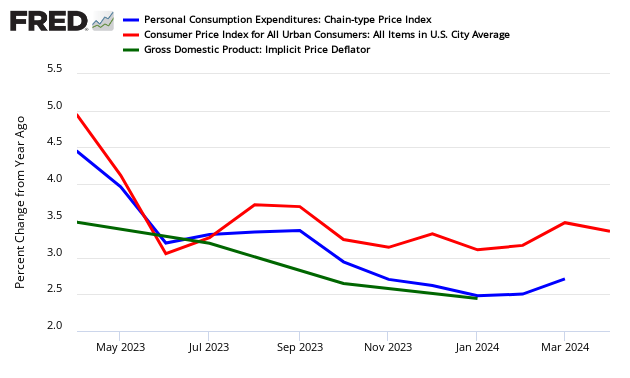
The graph below looks at the different price changes seen by the BEA in this PCE release versus the BEA’s GDP and BLS’ Consumer Price Index (CPI).
Year-over-Year Change – PCE’s Price Index (blue line) versus CPI-U (red line) versus GDP Deflator (green line)
Detailed Analysis
The first chart is an overlay of Headline CPI and Core CPI (the latter excludes Food and Energy) since the turn of the century. The highlighted two percent level is the Federal Reserve’s Core inflation target for the CPI’s cousin index, the BEA’s Personal Consumptions Expenditures (PCE) price index.
Federal Reserve policy, which in recent history has focused on core inflation measured by the core PCE Price Index remains below the Federal Reserve target range of 2 percent – even though the CPI core inflation rate is now at the target.

The next chart shows both series since 1957, which was the first time the government began tracking the core inflation metric.

In the wake of the Great Recession, two percent has been the Fed’s target for core inflation. However, at their December 2012 FOMC meeting, the inflation ceiling was raised to 2.5% while their accommodative measures (low Fed Funds Rate and quantitative easing) were in place. They have since reverted to the two percent target in their various FOMC documents.
Caveats on the Use of the Consumer Price Index
Econintersect has performed several tests on this series and finds it fairly representative of price changes (inflation). However, the headline rate is an average – and will not correspond to the price changes seen by any specific person or on a particular subject.
Although the CPI represents the costs of some mythical person. Each of us need to provide a multiplier to the BLS numbers to make this index representative of our individual situation. This mythical person envisioned spending pattern would be approximately:

The average Joe Sixpack budgets to spend his entire paycheck or retirement income – so even small changes have a large impact to a budget.
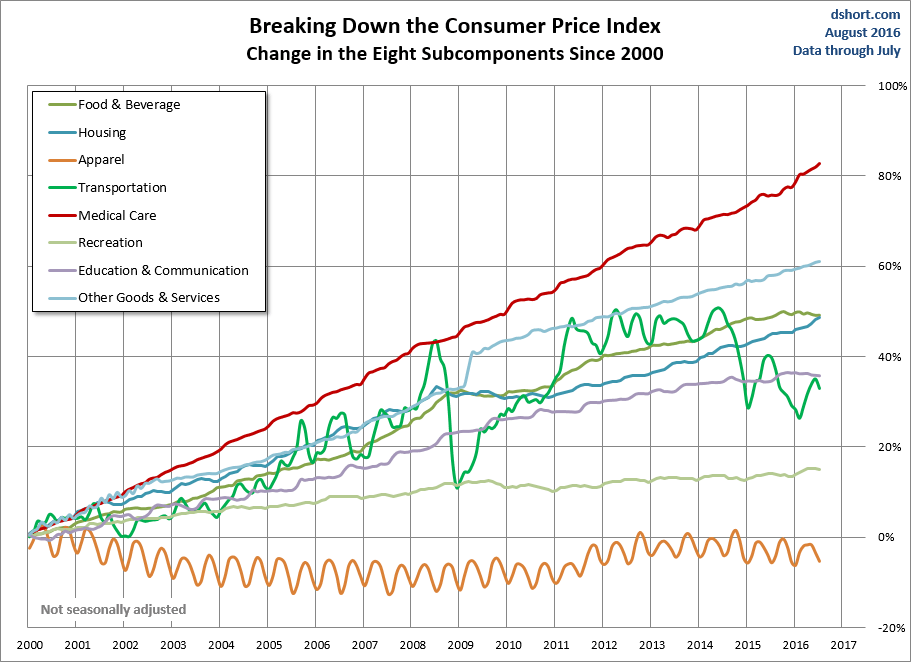
The graph above demonstrates that fuel costs, medical care, and school costs are increasing at a much faster pace than the headline CPI-U.
The Bureau of Labor Statistics (BLS) has compiled CPI data since 1913, and numbers are conveniently available from the FRED repository (here). Long-term inflation charts reach back to 1872 by adding Warren and Pearson’s price index for the earlier years. The spliced series is available at Yale Professor (and Nobel laureate) Robert Shiller’s website. This look further back into the past dramatically illustrates the extreme oscillation between inflation and deflation during the first 70 years of our timeline. Click here for additional perspectives on inflation and the shrinking value of the dollar.

The chart below (click here for a larger version) includes an alternate look at inflation *without* the calculation modifications the 1980s and 1990s (Data from www.shadowstats.com).

Because of the nuances in determining the month-over-month index values, the year-over-year or annual change in the Consumer Price Index is preferred for comparisons.
Econintersect has analyzed both food and energy showing that food moves synchronously with core.
include(“/home/aleta/public_html/files/ad_openx.htm”); ?>


