



Of the three regional Federal Reserve surveys released to date, all are in contraction.
The market expected values (from Bloomberg) from 2 to 5 (consensus 3) with the actual survey value at -0.5 [note that values above zero represent expansion].
Fifth District manufacturing activity slowed in September, according to the most recent survey by the Federal Reserve Bank of Richmond. Order backlogs and new orders decreased, while shipments declined. Average wages continued to increase at a moderate pace this month, however manufacturing employment grew mildly. Prices of raw materials and prices of finished goods rose, although at a slightly slower pace compared to last month.
Manufacturers anticipated improved business conditions during the next six months. Producers expected faster growth in shipments and in the volume of new orders. Additionally, survey participants expected order backlogs to grow and anticipated increased capacity utilization. Expectations were for longer vendor lead times during the next six months.
Firms expected faster growth in the number of employees and looked for average wages to grow more quickly in the months ahead. In addition, survey participants looked for moderate growth in the average workweek. Looking ahead, manufacturers anticipated faster growth in prices paid and prices received.
Current Activity
Overall, manufacturing conditions weakened in September. The composite index for manufacturing decreased to a reading of −5, following last month’s reading of 0. The index for shipments remained negative, only gaining one point to end at −3. Additionally, the volume of new orders decreased this month. At an index of −12, the September indicator lost 13 points from last month’s reading of 1. Manufacturing employment increased mildly this month. The indicator added two points, ending at a reading of 3.
Capacity utilization decreased this month. The index fell 14 points from August’s reading to finish at a reading of −19. Additionally, backlogs softened further this month, pulling the index down nine points to finish at −24. Vendor lead time lengthened. The index moved down only two points to a reading of 7. Finished goods inventories rose at a slightly slower rate than a month ago. The index lost three points to end at 21. Raw materials inventories also rose at a slower rate this month. That gauge lost two points to end at 22.
Read entire source document from Richmond Fed
Summary of all Federal Reserve Districts Manufacturing:
Richmond Fed (hyperlink to reports):

z richmond_man.PNG
Kansas Fed (hyperlink to reports):

z kansas_man.PNG
Dallas Fed (hyperlink to reports):

z dallas_man.PNG
Philly Fed (hyperlink to reports):

z philly fed1.PNG
New York Fed (hyperlink to reports):

z empire1.PNG
Federal Reserve Industrial Production – Actual Data (hyperlink to report):
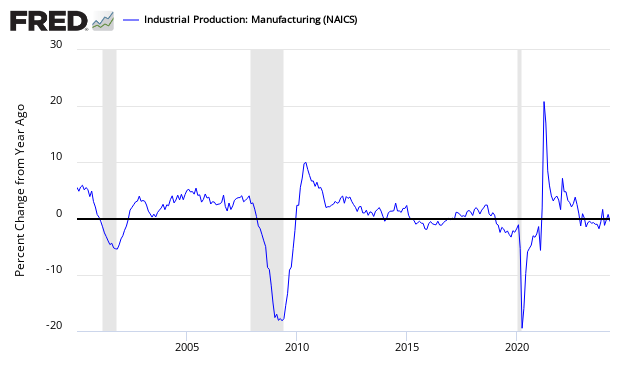
Holding this and other survey’s Econintersect follows accountable for their predictions, the following graph compares the hard data from Industrial Products manufacturing subindex (dark blue bar) and US Census manufacturing shipments (lighter blue bar) to the Richmond Fed survey (darkest bar).
Comparing Surveys to Hard Data:

z survey1.png
In the above graphic, hard data is the long bars, and surveys are the short bars. The arrows on the left side are the key to growth or contraction.
include(“/home/aleta/public_html/files/ad_openx.htm”); ?>


