


from the Congressional Budget Office
The federal government ran a budget deficit of $195 billion for the first four months of fiscal year 2015, CBO estimates—$12 billion more than the shortfall recorded in the same span last year. Revenues and outlays were both 8 percent higher than they were at this time a year ago. If lawmakers enact no further legislation affecting spending or revenues, the federal government will end fiscal year 2015 with a deficit of $468 billion, or 2.6 percent of gross domestic product (GDP), CBO estimates, down from a deficit of $483 billion, or 2.8 percent of GDP, in 2014. (For more details about CBO’s most recent budget projections, see The Budget and Economic Outlook: 2015 to 2025.)

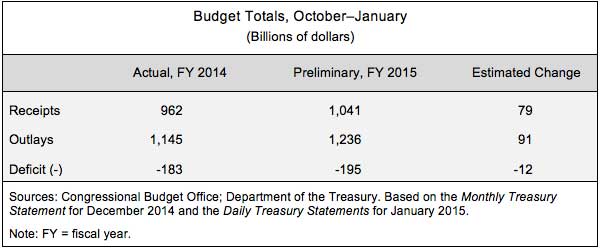
Total Receipts: Up by 8 Percent in the First Four Months of Fiscal Year 2015
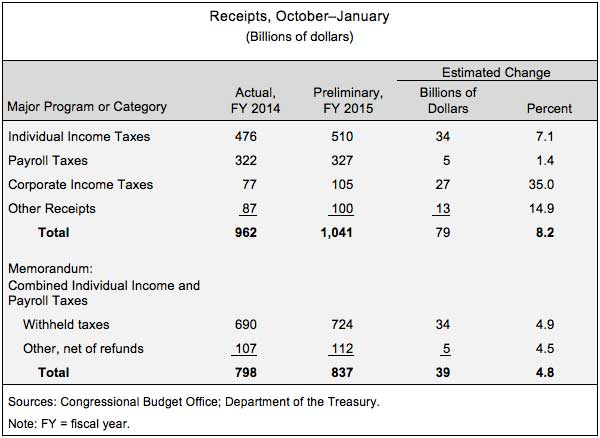
Receipts through January totaled $1,041 billion, CBO estimates—$79 billion more than the amount collected in the same period last year. The largest increases in receipts were in the following categories:
- Individual income taxes and payroll (social insurance) taxes together rose by $39 billion (or 5 percent).
- An increase of $34 billion (or 5 percent) in the amounts withheld from workers’ paychecks accounted for the bulk of that gain. Growth in wages and salaries probably explains that increase.
- Nonwithheld receipts, largely from the last quarterly payments of estimated taxes for 2014, which were due in January, rose by $15 billion (or 14 percent).
- That increase was partially offset by larger refunds of individual income taxes. Refunds were $6 billion more this year because the tax-filing season began earlier. The Internal Revenue Service began accepting returns on January 21 this year; last year, returns were not accepted until January 31.
- Receipts from unemployment insurance taxes were down by $4 billion, in part because some of the receipts that ordinarily come in at the end of January were received this year at the beginning of February.
- Corporate income taxes rose by $27 billion (or 35 percent), largely reflecting growth in estimated payments for tax year 2014 that were made by most corporations in December. That uptick in receipts probably does not, however, reflect a corresponding increase in taxable profits. Rather, the size of those payments was most likely boosted by the expiration of a number of tax provisions that reduced firms’ tax liabilities; although those provisions were ultimately extended retroactively for 2014, that extension was enacted (in Public Law 113-295) just days after the due date for estimated payments. CBO expects that many companies will receive larger refunds or make smaller payments when they file their 2014 tax returns in coming months as they account for the retroactively extended provisions.
Total Outlays: Up by 8 Percent in the First Four Months of Fiscal Year 2015
Outlays for the first four months of fiscal year 2015 were $1,236 billion, $91 billion more than they were during the same period last year, CBO estimates. That increase would have been slightly smaller if not for a shift in the timing of certain payments from February to January (because February 1 fell on a weekend in both 2014 and 2015). Without those timing shifts, CBO estimates, spending would have risen by $88 billion. (The discussion below reflects adjustments to account for the timing shifts.)
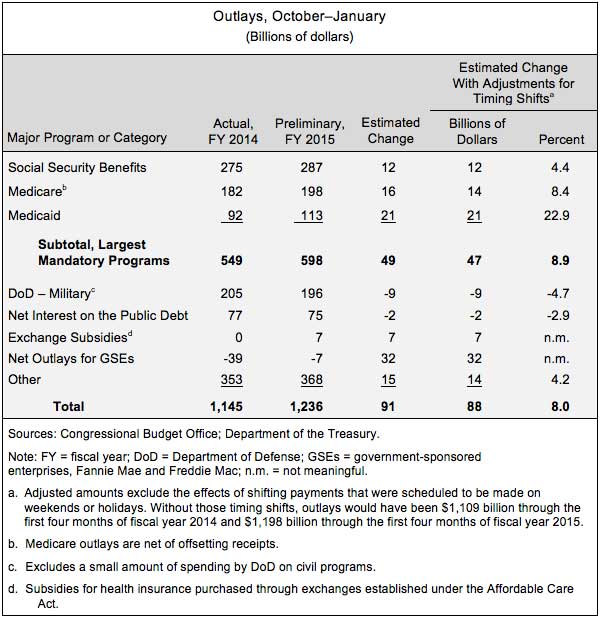
Outlays increased for several major categories of spending:
- Outlays rose for each of the three largest mandatory programs: Medicaid, by $21 billion (or 23 percent), largely because some of the provisions of the Affordable Care Act did not take effect until January 2014; Medicare, by $14 billion (or 8 percent), primarily because of a large payment made to prescription drug plans in November 2014 to account for unanticipated spending increases in calendar year 2014; and Social Security benefits, by $12 billion (or 4 percent).
- Much of the increase in outlays occurred because payments to the Treasury from the government-sponsored enterprises Fannie Mae and Freddie Mac were $32 billion lower in December 2014 than they were in December 2013, when Freddie Mac made a onetime payment of about $24 billion after a revaluation of certain tax assets significantly increased its net worth. (Those payments are recorded in the budget as offsetting receipts, which are treated as reductions in outlays.)
- Outlays for a number of other programs and activities grew by smaller amounts.
Those increases during the first four months of fiscal year 2015 were partially offset by reductions in spending for some other major programs, including the following:
- Total spending for military activities of the Department of Defense fell by $9 billion (or 5 percent).
- Outlays for unemployment benefits declined by $8 billion (or 39 percent), mostly because fewer people have received those benefits since the Emergency Unemployment Compensation program expired at the end of December 2013.
- For a number of other programs and activities, spending declined by smaller amounts.
Estimated Deficit in January 2015: $19 Billion
The federal government incurred a deficit of $19 billion in January 2015, CBO estimates, compared with a $10 billion deficit in January 2014. Because February 1 fell on a weekend in 2014 and 2015, certain payments that ordinarily would have been made in February of those years were instead made in January. Furthermore, certain payments that are due January 1, New Year’s Day, are always made in December of the previous year. Without those shifts in the timing of payments, the federal government would have realized a $1 billion surplus in January 2015 and an $8 billion surplus in January 2014.
CBO estimates that receipts in January totaled $302 billion—about $6 billion (or 2 percent) more than those in January of last year. Individual income taxes and payroll taxes together increased by $4 billion (or 1 percent). Withheld and nonwithheld taxes from those sources grew by $4 billion (or 2 percent) and $8 billion (or 10 percent), respectively. But the net increase in receipts was small because refunds of individual income taxes also rose by $5 billion, CBO estimates, and receipts from unemployment insurance taxes were down by $3 billion.
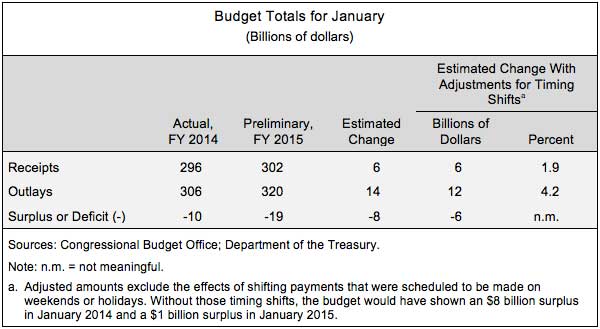
Total spending in January 2015 was $320 billion, CBO estimates—$14 billion more than outlays in the same month in 2014. If not for the effects of timing shifts, outlays in January would have been $12 billion higher than they were in the same month last year. (The year-over-year changes for January discussed below reflect adjustments to account for those shifts.) Among the larger changes in outlays, compared with those of last year, were the following:
- Spending for two of the government’s largest entitlement programs increased by a total of $8 billion: Medicaid, by $5 billion (or 21 percent) and Social Security, by $3 billion (or 5 percent).
- Outlays for both student loans and international assistance were up by $3 billion.
- Subsidy payments for health insurance purchased through exchanges created under the Affordable Care Actincreased outlays by $2 billion. Those subsidies first began in January 2014; payments in January 2015 were $2 billion, whereas they were only $40 million in January 2014.
- Spending for military activities of the Department of Defense decreased by $9 billion (or 18 percent).
Actual Surplus in December 2014: $2 Billion
The Treasury Department reported a surplus of $2 billion for December—about $1 billion less than CBO estimated, on the basis of the Daily Treasury Statements, in the Monthly Budget Review for December 2014.
This document was prepared by Nathaniel Frentz, Dawn Sauter Regan, Joshua Shakin, and Adam Wilson.
include(“/home/aleta/public_html/files/ad_openx.htm”); ?>


