


from The Conversation
— this post authored by Matt Williams, The Conversation, with contributions from Morgan Marietta, University of Massachusetts Lowell, Nomi Stolzenberg, University of Southern California, and Steven K. Green, Willamette University
The Supreme Court wrapped up its latest term on July 1, 2021, with a couple of final opinions.

Please share this article – Go to very top of page, right hand side, for social media buttons.
It was the first session with Justice Amy Coney Barrett sitting on the bench. Her appointment – replacing Ruth Bader Ginsburg, who died in September 2020 – tipped the balance further in favor of conservative-leaning justices, who now hold a 6-3 majority in the highest court of the land.
Religion proved a throughline for the session. Legal arguments over the extent to which First Amendment rights protect faith-based groups in the public sphere were among the first heard back in November, with a ruling on the matter coming down in mid-June. In between, the justices were called upon to decide whether religious freedoms should trump health concerns during the pandemic, among other issues.
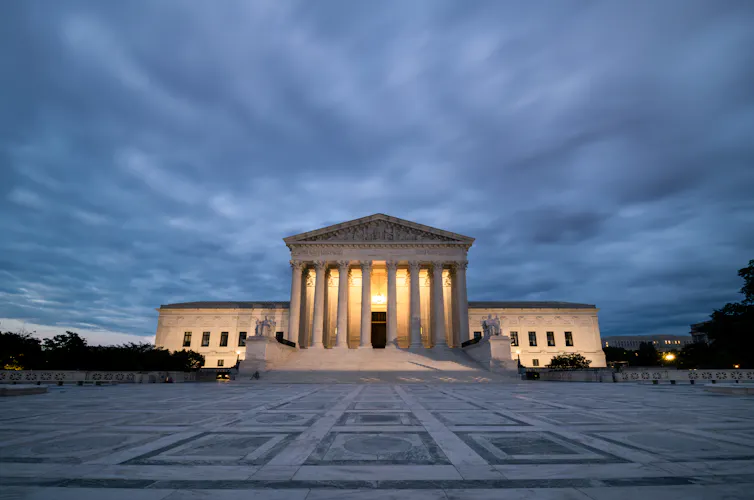
Illuminating recent Supreme Court rulings. Geoff Livingston via Getty Images
These rulings tended to fall in favor of religious liberty. Legal experts writing for The Conversation were on hand to help explain what it all means.
1. A verdict that hints at more to come?
Getting a unanimous verdict on a contentious issue is no mean feat. But it was achieved in the case of Fulton v. City of Philadelphia, in which the justices agreed 9-0 that the city was wrong to end its relationship with a Catholic adoption agency that refused to work with same-sex couples.
It was a narrow ruling that, initially at least, will only affects only the specific case brought to the court. To the disappointment of some conservatives, it didn’t deliver an immediate, dramatic expansion of religious rights.
But constitutional law expert Morgan Marietta argues it is nonetheless consequential. “It means that any unequal treatment of religious groups will be regarded as a violation of the First Amendment, even if it comes at the expense of the dignity of LGBTQ citizens,” he writes.
And, Marietta adds, it could nod toward a greater victory for the religious right further down the track: “It suggests that when the broader question of whether religious groups have the right to discriminate does come before the justices, they will likely uphold religious liberty over gay rights.”
2. Continuing a winning streak
The verdict in the Fulton case should come as no real surprise. As Steven Green, professor of law at Willamette University, writes, the Supreme Court has tended to look favorably on faith-based arguments in recent years. He notes that since George W. Bush appointed John Roberts as chief justice in 2005, “the justices have ruled in favor of religious claimants 81% of the time.”
This winning streak extended into the pandemic with majority rulings in which the Supreme Court struck down restrictions on religious services imposed to lower the risk of COVID-19’s spread.
Green points out that the court is essentially saying religious entities have to be treated as favorably as the most essential service in the pandemic when deciding if they should remain open. At the same time, such entities have been given the go-ahead to “discriminate against customers or employees in a way the essential services cannot,” according to Green.
“It is,” Green concludes, “the legal equivalent of having your cake and eating it, too.”
Read more: How the Supreme Court found its faith and put ‘religious liberty’ on a winning streak
3. Religious identity and ideology
The backdrop to these rulings is a shift to the right – both religiously and politically – in the makeup of the Supreme Court in recent decades. Nomi Stolzenberg, professor of law at University of Southern California, took a deep look at the history of religious identity at the Supreme Court.
[Get the best of The Conversation, every weekend. Sign up for our weekly newsletter.]
She explains that religion has “always played a strong role” in shaping the composition of the Supreme Court. But the nature of that influence has changed over time. Whereas until the 1980s it was denominational in nature – that is to say, focus was on the faiths that justices ascribe to – it is now ideological:
“In recent decades it has been shaped by conservatives of different faiths, construed as part of a mythical Judeo-Christian tradition, coalescing around a common agenda,” Stolzenberg writes.
Read more: Religious identity and Supreme Court justices – a brief history
Editor’s note: This story is a roundup of articles from The Conversation’s archives.
Matt Williams, Religion & Ethics Editor, The Conversation
This article is republished from The Conversation under a Creative Commons license. Read the original article.


