


from The Conversation
— this post authored by Cornell William Clayton and Michael Ritter, Washington State University
Arizona may keep two voting laws that Republicans say protect election integrity and Democrats believe will make it harder for some residents to cast ballots.

Please share this article – Go to very top of page, right hand side, for social media buttons.
That’s the United States Supreme Court’s decision in Brnovich v. Democratic National Committee, one of the decade’s most important voting rights cases.
One Arizona law challenged in the case, H.B. 2023, makes it a felony for anyone other than a family member, caregiver or postal worker to collect and deliver ballots. The other requires ballots to be cast in the assigned precinct where a voter lives. If a person votes at the wrong polling place, Arizona election officials will reject their ballot.
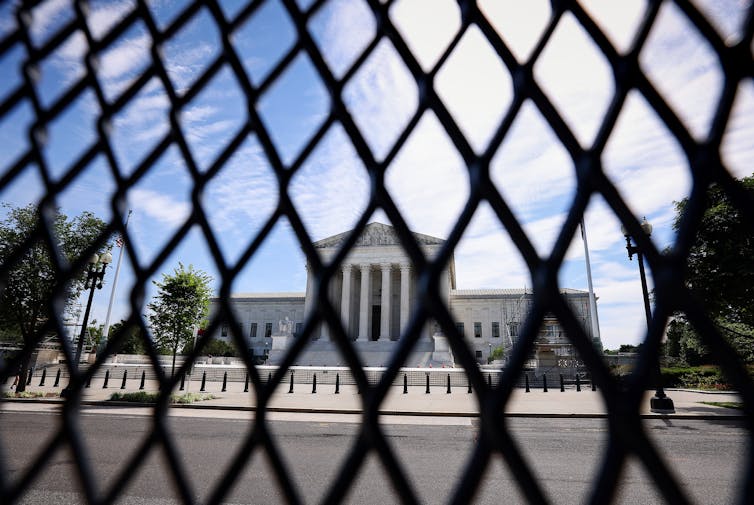
The Supreme Court waited until the final day of its 2020-2021 term, July 1, 2021, to issue two controversial decisions, including one that may dramatically limit voting rights in the US. Kevin Dietsch/Getty Images
The Democratic National Committee argued at the Supreme Court that both Arizona rules disproportionately hurt minority voters. The majority of justices, split 6-to-3 along ideological lines, disagreed.
“Voting necessarily requires some effort and compliance with some rules,” Justice Samuel Alito wrote for the court’s majority on July 1, 2021. Merely making it more “inconvenient” for certain groups to vote does not violate federal law, according to the court.
The ruling will have national consequences. Arizona is one of 14 states restricting third-party ballot collection. It is one of 26 that require in-precinct voting.
The Supreme Court’s decision makes it more difficult to legally challenge such laws, which, according to our research on elections, significantly affect voting, particularly among racial minorities and the poor.
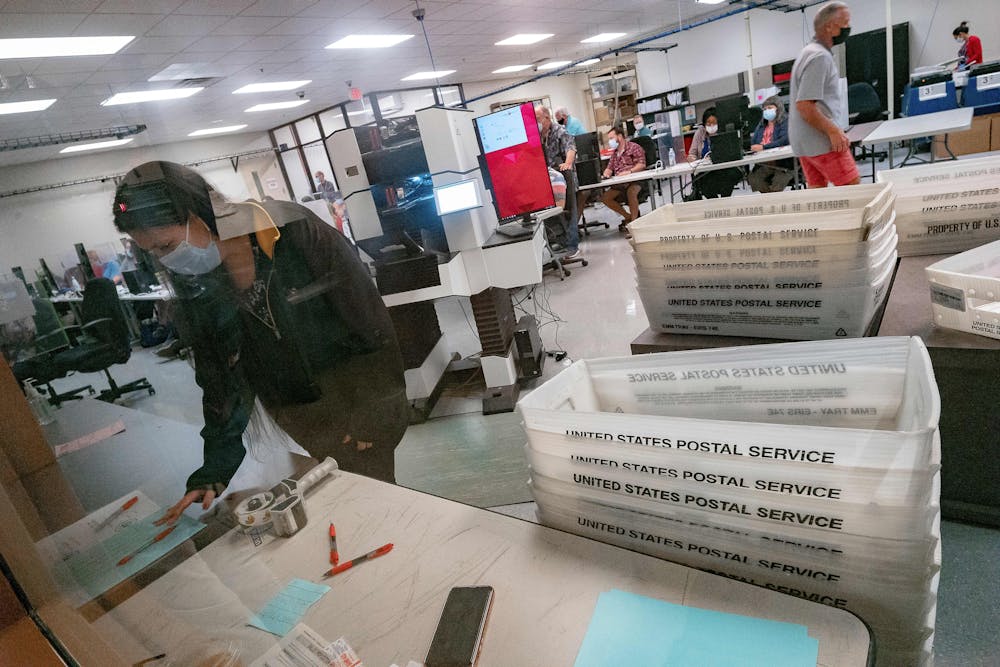
The Maricopa County Election Department counts ballots in Phoenix on Nov. 5, 2020. Olivier Touron/AFP via Getty Images
From Arizona to the Supreme Court
In Arizona, nearly 80% of voters in 2018 cast their ballots by mail. But mail service is not always available in rural areas of the state where many Hispanic and Native Americans live. Only 18% of Native Americans in the state, for example, have access to home mail delivery.
The Tohono O’odham reservation, which covers an area larger than Rhode Island and Delaware, has no home delivery and only one post office. These rural voters often rely on friends or get-out-the-vote workers to deliver their ballots to polling stations.
The burdens on rural and tribal voters were cited in a 2016 lawsuit filed by the Democratic National Committee to block the Arizona ballot collection ban and out-of-precinct vote restriction. The Democratic National Committee claimed both policies violated Section 2 of the federal Voting Rights Act, which prohibits practices that “result in a denial or abridgment of the right (to vote) on account of race or color.”
The lawsuit, which was supported by Arizona’s Democratic secretary of state, also argued that the ballot collection ban purposely targeted minority voters. That would violate the 15th Amendment to the U.S. Constitution, which prohibits states from intentionally denying the right to vote on account of race.
Arizona’s Republican attorney general and the state’s Republican Party argued the laws were race-neutral restrictions that do not impede Arizonans’ equal opportunity to vote and were enacted to safeguard election integrity.
The case reached the Supreme Court after an appeal process in which the full Arizona Ninth Circuit Court ultimately determined that the state’s ballot collection ban violated both Section 2 of the Voting Rights Act and the 15th Amendment because minority voters were more likely than nonminorities to rely on others to return their ballots. And the law could not be credibly defended as an election integrity measure because judges saw no evidence that third-party ballot collection led to vote fraud in the past.
The appeals court also found that the out-of-precinct policy violated Section 2 of the Voting Rights Act. Arizona officials frequently changed polling places in urban counties, so voters there easily made mistakes. In 2016, 3,709 out-of-precinct Arizona ballots were rejected, and minority voters were twice as likely as whites to have their ballots discarded in that process.

Post offices are few and far between in rural Arizona. Joe Sohm/Visions of America/Universal Images Group via Getty Images
The justices’ reasoning
In deciding against Arizona in 2020, the Ninth Circuit Court relied on a “results test.” This means that a law does not require proof of an intent to discriminate to be struck down. Judges ask only whether the law disproportionately affects historically disadvantaged groups.
In overturning the Ninth Circuit, the Supreme Court concluded the Arizona laws did not intentionally discriminate and rejected the logic of the “results test.”
Section 2 of the Voting Rights Act still prevents states from enacting voting rules that purposely discriminate. But proving intentional discrimination is much more difficult than showing a law disproportionately impacts minority voting.
The three liberal justices on the court, led by Justice Elena Kagan, dissented.
The “Court has (yet again) rewritten – in order to weaken – a statute that stands as a monument to America’s greatness, and protects against its basest impulses,” Kagan wrote.
Electoral consequences
The Brnovich ruling means Arizona’s voting restrictions stand. It also gives other states greater latitude when adopting similar rules and limits the federal government’s ability to police restrictive voting practices.
Since the 2020 presidential election, legislators in at least 48 states have introduced 389 so-called “election integrity” bills placing new restrictions on voting. Of these, 22 have been enacted.
For example, Georgia’s March 2021 election law imposes new limits on the use of absentee ballots, makes it a crime for outside groups to provide food and water to voters waiting at polling stations and hands greater control over election administration to the Republican-led state legislature.
On June 25 the U.S. Department of Justice sued Georgia, arguing these rules violated Section 2 of the Voting Rights Act and that Georgia’s law is intended to discriminate.
Before 2013, states with a history of racial discrimination needed federal approval before enacting new voting laws, under Section 5 of the Voting Rights Act. But in 2013, the Supreme Court in Shelby County v. Holder – an Alabama voting rights case – dismantled these procedures.
As a “preclearance” state, Arizona was previously blocked by the federal government from enacting voter restrictions like H.B. 2023. Other former preclearance states that have passed restrictive laws since 2013 include Georgia, Texas and Florida.
Since Shelby County v. Holder, voting rights advocates have had to rely on a different part of the Voting Rights Act – Section 2 – to block these restrictive voting laws. Brnovich v. DNC was the first Supreme Court test of this strategy.
The court’s decision severely cripples it, further eroding the Voting Rights Act. Attention now shifts to Congress to see whether it will respond.
This is an updated version of an article originally published June 8, 2021.
Cornell William Clayton, C.O. Johnson Distinguished Professor of Political Science, Washington State University and Michael Ritter, Assistant Professor of Political Science, Washington State University
This article is republished from The Conversation under a Creative Commons license. Read the original article.


