


from The Conversation
— this post authored by Craig Jones, Newcastle University
When we think of war, we might think of soldiers on the front line – or those pulling the trigger – as the ones responsible for the death or injuries of those they are targeting. But my research suggests that over the past few decades an unlikely profession has become deeply involved in the conduct of war: lawyers.

Please share this article – Go to very top of page, right hand side, for social media buttons.
Legal advisers (also called military lawyers) are trained as soldiers and are also qualified lawyers. It’s a military lawyer’s job to interpret the myriad rules of war, weigh the legal risk of a proposed action and provide preferably pithy advice and a range of lawful options for military activities to harried commanders. This could include guidance on the type of weapons that should be used, the timing of an attack to reduce the risk of casualties, or whether commanders should hold off and wait for more intelligence before proceeding.
State militaries have employed lawyers for decades – even centuries. But since the start of the “war on terror” in 2001, military lawyers have played an increasingly vital role in deciding who lives and who dies in modern conflict zones.
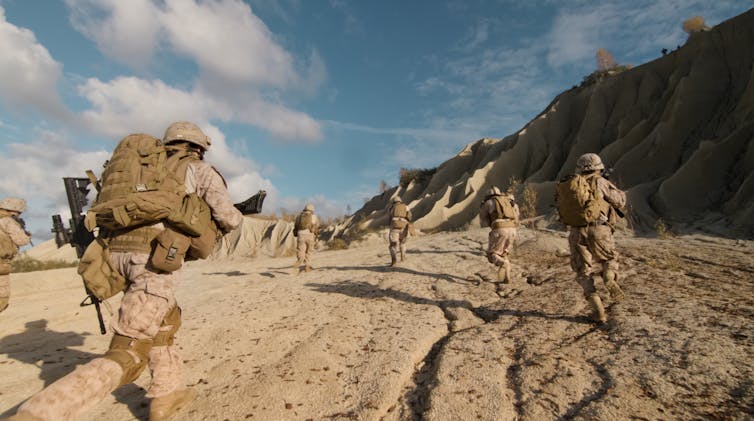
I spent several years interviewing military lawyers at various locations in the Middle East, Europe and North America – from military bases, bustling cafes and even their own homes and gardens. They spoke candidly about how commanders had come to rely on their legal advice in lethal military operations, but also about their unease as lawyers in wielding this newfound power and the impact it has on their mental health.
Legal advisers told me how they often find themselves in situations where they are called into operations rooms in the middle of the night, asked to rapidly review the situation and give their bottom line.
One described being “the sole remaining impediment to a sentence of death“. And although military lawyers receive specific training before being assigned to roles, my research suggests it’s not always sufficient to prepare them for the highly stressful work of effectively advising on who should live and who should die in war zones.
‘Getting humans to kill’
Legal advisers are not decision-makers: their job is to advise. It remains the responsibility of military commanders to decide, for example, whether or not a strike goes ahead. But from my research, it seems that in many instances, commanders sometimes look to lawyers for something approximating permission, or even psychological and moral support, as well as for legal advice.
One military lawyer described to me how his advice seemed to have an “almost divine power” that could cause commanders to hesitate or to depart from their intuition. Another lawyer wrote about the reality of the power he holds:
I, as the legal advisor, am being asked by the commander whether he may legally kill these humans. I am the judge – he the jury and executioner.
Another lawyer disclosed to me that he felt “more like a chaplain than a lawyer” because commanders came to him not only for legal advice but also for moral absolution. While another lawyer told me that his legal support was a vital component in “getting human beings to … kill other human beings in the name of the state”.
Advice under pressure
The US first pioneered the use of legal advisers in aerial targeting operations in the early 1990s. But now many other nations, including Israel, the UK, Australia, Canada, France and the Netherlands, along with other NATO member states, regularly consult legal experts before, during and after launching military strikes.
My research focuses specifically on the US and Israel and looks at the extent to which legal advisers are involved in various stages of aerial targeting – known colloquially as the “kill chain” – a process whereby a target is identified, tracked and ultimately killed or destroyed.
In recent decades, as surveillance technologies have become more sophisticated and widespread, the kill chain has been compressed. A process that once took several weeks (and sometimes months) can take place, in theory, in hours and minutes. This means that military lawyers often operate in high-pressure environments – where there is no real time for deliberation or second opinions.
And sometimes military lawyers and commanders get it wrong. Like in 2016, when heavily armed US aircraft repeatedly fired on a hospital run by aid organisation Médecins Sans Frontières in Afghanistan thinking it was an enemy building. Or in 2002, when the Israel Air Force killed thirteen civilians in Gaza, including eight children, with a one-tonne bomb meant for a single military leader. On another occasion in Gaza, more than 20 members of one family were killed in a single strike.
In fact, a study by the non-profit organisation Human Rights Watch found that time-sensitive targeting operations tend to cause more civilian casualties than pre-planned operations – where more time is available for decision making.
The wrong target

Basim Razzo. Basim Razzo, Author provided
I wanted to learn more about the real-world consequences of aerial targeting and legal advice. What did it look like on the ground to those beneath the barrage of bombs? So as part of my research, I also spoke to several people who had lost family members and their homes as a result of military airstrikes.
In one well-documented strike in Mosul, Iraq, in 2015, an innocent civilian, Basim Razzo, lost his whole family to a military strike orchestrated by the US and executed by the Dutch Air Force as part of the war against Islamic State.
The US military claimed the “target” was an Islamic State compound producing car bombs, but in reality, it was two homes – one where Basim lived with his wife, Mayada, and daughter, Tuqa, and adjacent, another where his brother, Mohannad, lived with his wife, Azza, and son, Najib. Basim was the sole survivor and following lengthy investigations the US military offered him US$15,000 (£10,600) as compensation – which he refused.
I spoke to Basim in April 2019, over three and a half years later. He told me how difficult day-to-day life still was. He suffers from chronic pain and has had several surgeries. He’s unable to work and earn a living because of his ongoing injuries, and he grieves the loss of his family.
As Basim put it, “there are no words to describe what happened to me”. Five years after the attack and still unable to walk or work, the Dutch government eventually made a “voluntary offer” of compensation to Basim, which he accepted.
Haunted by advice
Given the implications of their work, accounts are beginning to emerge – perhaps unsurprisingly – that some military lawyers are haunted by moral injury and post-traumatic stress disorder (PTSD).
Then there’s also the issue that when military lawyers give advice that commanders don’t want to hear, they are often told to “stay in their lane”. As one lawyer told me, his advice should “maximise the space for the commander to make a decision” – but sometimes that advice goes unheard.
And herein lies the problem, the boundaries of the law, porous though they are, might temporarily demarcate the space of allowable violence, but it is not always helpful for navigating right from wrong – particularly when it concerns the decision to end human life.
Craig Jones, Lecturer in Political Geography, Newcastle University
This article is republished from The Conversation under a Creative Commons license. Read the original article.


