


by Miles Kimball, Confessions of a Supply-Side Liberal
The Covid-19 Pandemic may have sped up technological progress and thereby productivity growth. In addition to the technology for vaccine discovery and production, the Pandemic seems to be speeding up the transition to a larger share of online purchases and a larger share of in-person purchases being made with credit or debit cards instead of cash. In addition, a much larger share of business meetings and doctor visits are being done by video chat. And the shift to at-home viewing of TV shows and movies has been pushed forward.

Please share this article – Go to very top of page, right hand side, for social media buttons.
Sarah Chaney Cambon’s April 4, 2021 Wall Street Journal article “U.S.’s Long Drought in Worker Productivity Could Be Ending” explains the importance of productivity growth, gives a bit of the history of productivity growth, and gives examples of the better ways of doing things that represent technological progress that fuels productivity growth.
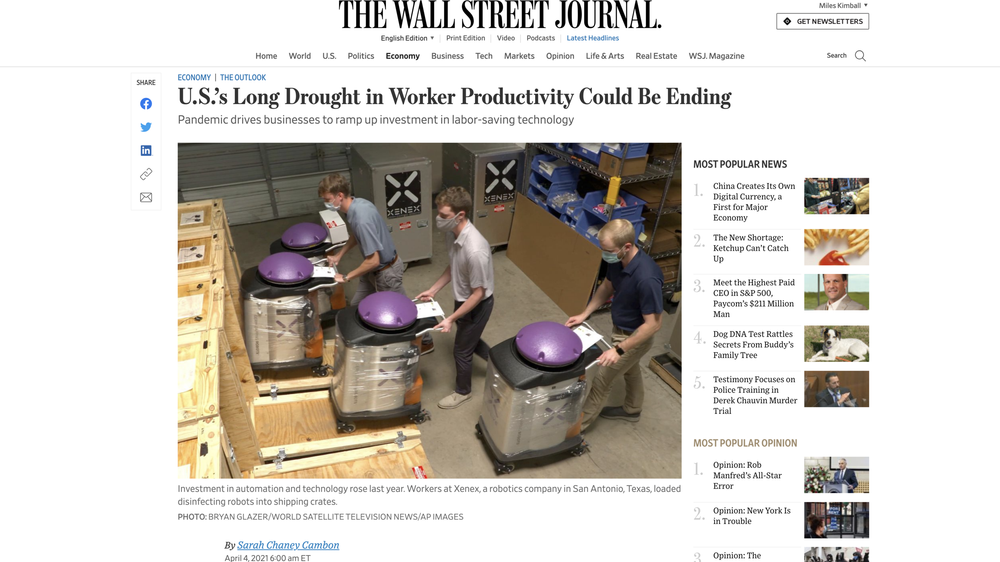
Link to the article shown above
Unless noted otherwise, all quotations below are from that article.
The Importance and History of Productivity Growth:
On the importance of productivity growth, Sarah writes:
… productivity … is defined as output per hour worked. Stronger productivity growth is key to the economy’s long-term success. Economic growth depends on the number of workers and how much they produce. …
Higher productivity growth should also put more money into people’s pockets because wages are tied to how much workers produce.
Here is Sarah’s nutshell history of productivity growth since soon after World War II:
Productivity growth tends to move in multiyear trends, reflecting shifts in the structure of the economy. Excluding farms and government, it grew 2.8% a year from 1949 until the oil shock of 1973, then slowed to 1.4% from 1974 to 1995, sped up to 3% from 1996 to 2005 with the spread of computers and the internet, then slowed again, to 1.4% between 2006 and 2019. Last year it accelerated to 2.4% in the fourth quarter of 2020 from the same period a year earlier, although that was because the coronavirus triggered steep job losses in lower-wage sectors that tend to be less productive.
Some Paths to Productivity Improvement
On how productivity is improving, one salient fact at the macroeconomic level is that technological progress – and therefore productivity growth – are just as much a matter of adoption as it is of invention. By helping to overcome resistance to adoption, the Pandemic also points out how resistance to adoption of new technologies by consumers and by businesses can slow down technological progress. Sarah quotes Constance Hunter, chief economist at KPMG as saying:
The pandemic shocked older people into using technology and has shocked the economy in general into adopting technology.
What are some key examples of doing things in a better, often more efficient way?
More Online Purchases:
Sarah refers to Robert Gordon giving the idea that:
A shift toward e-commerce should push up productivity by eliminating workers needed in bricks-and-mortar stores
Doctor Visits by Video Chat:
Healthcare could see a burst in productivity after Covid-19 subsides. At Stanford Health Care CardioClick Clinic based in Stanford, Calif., virtual consultations surged during the pandemic. Patients could hop on a video call to discuss their diet, exercise and sleep patterns with a medical expert.
Video visits at the cardio clinic last about 22 minutes, whereas in-person visits tend to last three times as long. Video consultations are also much more likely to end on time …
Reducing the Waste of Excessive Commuting and Business Travel:
With the adoption of Zoom and Microsoft Teams, videoconferencing can replace some business conferences. As a result, workers won’t lose productive work hours traveling long distances. They will also have more energy to engage because they no longer have to deal with the hassle of daily commutes. Remote work could deliver a one-time 4.7% lift to productivity after the pandemic, though a large share of the growth will stem from shortened commutes that government productivity data won’t fully capture, according to a working paper from Stanford University’s Nicholas Bloom and co-authors.
I want to highlight Nicholas Bloom’s point that although our lives could become a lot better if we can commute less, standard government statistics don’t count commuting hours as part of the cost of production. So they miss this improvement.
The More Distant Future:
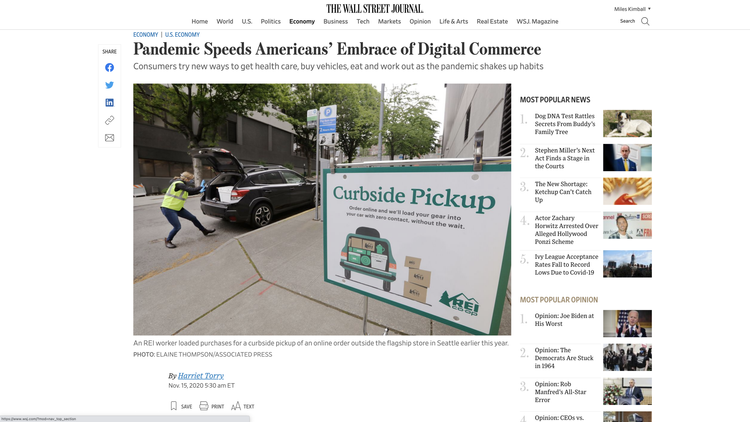
Many of these trends can be considered part of what Joel Mokyr calls “dematerialization” and Alan Greenspan talked about as GDP getting lighter in weight. Greg Ip’s December 26, 2020 Wall Street Journal article “Covid-19 Propelled Businesses Into the Future. Ready or Not” has an interesting quotation from Joel Mokyr:
Mr. Mokyr cautioned dematerialization can’t continue indefinitely: “Diminishing returns works here as well. We can mimic reality, but we are not digital creatures ourselves, and…, our evolutionary background will continue to demand physical experiences.
Although Joel Mokyr is right that human beings are not now digital creatures, we may well be digital creatures in the future, opening up many more opportunities for technological progress. The possible future of humanity becoming digital beings is an emerging theme on this blog. (See the links collected in my post “Embodiment.”)

Link to the article just above
Conclusion:
The future of technology is inherently hard to see; if we could see all the details of a technology, we would already have that technology. And people have a hard time guess which kinds of progress will be easy and which kinds of progress will be hard. We don’t have a lot of flying cars, but we do have wonders of computer technology and genetic technology.
It is probably easier to guess the rate of adoption of a technology that has already been worked out. Hence, technological progress at the macroeconomic level should be somewhat predictable during the period between invention and widespread adoption.
One area of technology that is understudied is technology based on social science. There is a chance, for example, that even leaving aside drugs, improvements in psychology could make our lives a lot better. On that, see the links at the bottom of “Elizabeth Bernstein on Getting Better Sleep.” And improvements in knowledge about diet and health might do as much as hardcore medical advances to improve human health. See “Miles Kimball on Diet and Health: A Reader’s Guide.”
Link to the article just above
.
This article appeared on Confessions of a Supply Side Liberal 08 April 2021.
.


