


from The Conversation
— this post authored by Veronika Dolar, SUNY Old Westbury
Many economists would agree that the official U.S. unemployment rate is an inadequate measure of actual labor market conditions.

Please share this article – Go to very top of page, right hand side, for social media buttons.
Although this is one of the most cited pieces of data on the economy as a whole, not many people understand how this indicator is calculated and who is and – more importantly – who isn’t included in it. The latest data, which found that joblessness fell from 6.7% in December to 6.3% in January, shows why.
As a labor economist, I believe it’s important for more Americans to take a closer look under the hood to get a more accurate view of U.S. unemployment.
Vanishing act
The unemployment rate that newspapers commonly cite is known as the U-3. But one of its biggest shortcomings is that it doesn’t include people who have given up looking for work.
To see this, let’s examine the latest figures. At first glance, the drop in the unemployment rate of 0.4 percentage point seems like good news. A rise or fall of just 0.1 percentage point in the rate translates roughly to 160,000 people, which is equivalent to the population of a medium-sized U.S. city, so that would suggest over 600,000 people were no longer unemployed.
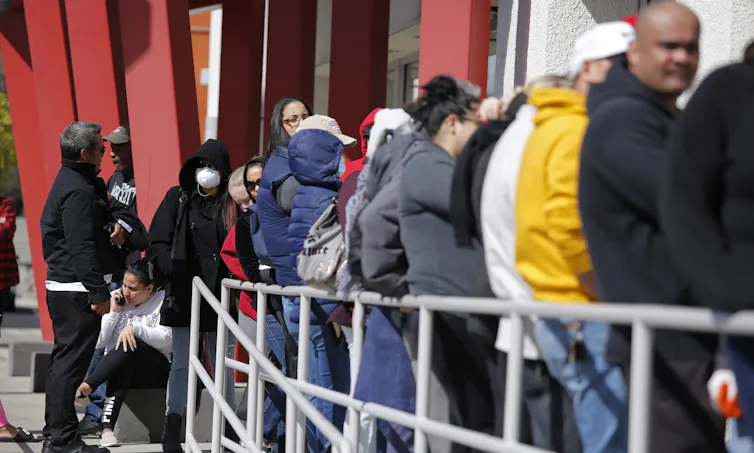
The number of people seeking jobless benefits has soared during the pandemic. AP Photo/John Locher
But the rate didn’t fall because more people, on net, found jobs. It fell because over 400,000 people “vanished” from the labor force – the vast majority of them women. The data show that yes, about 606,000 people were no longer considered unemployed in January, but only 201,000 people actually found jobs.
This is because to be classified as unemployed by the Bureau of Labor Statistics a person must be without a job, currently available to work and actively looking for work in the previous four weeks. This excludes a lot of people who used to be gainfully employed but essentially got discouraged. In total, there were about 4.4 million fewer people in the labor force last month compared with a year earlier. That gives us a participation rate of 61.4% – the lowest it’s been since 1975, excluding the worst months during the pandemic.
But even as the issue excludes some people who arguably should be included, the rate also includes people it probably shouldn’t, such as people who worked for no pay and part-time workers working as little as a few hours a week.
A search for solutions
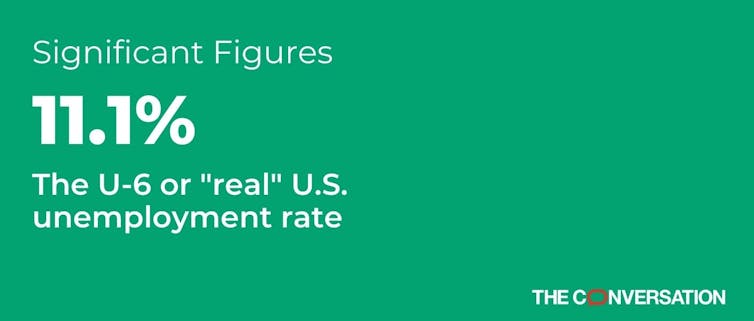
Fortunately, there is a published version of the unemployment rate intended to address some of these issues. It’s called the U-6, or the “real” unemployment rate by the media, and shows joblessness was 11.1% in January. That represents a difference of over 7 million jobs.

But even that one may be underestimating the true depths of unemployment because it assumes furloughed workers are employed and the self-employed are never without a job.
A 2019 paper aimed to remedy these issues by classifying part-time workers as “62.7% employed” and those who have been furloughed as unemployed. It tries to incorporate the self-employed by assuming they are unemployed at the same rate as of the rest of the work force. The resulting unemployment rate is not updated, but would put joblessness at 24.4% just after the peak of the COVID-19 crisis in May – compared with 13.3% according to U-3 and 21.2% for U-6.

Correctly estimating how many people are without work is hard. Besides these issues, rates that appear in headlines obscure significant variations such as race, education level and gender.
Finding a way to accurately reflect what’s really going on in the economy is pivotal to making good policy and fueling a recovery that lifts all boats.
[Deep knowledge, daily. Sign up for The Conversation’s newsletter.]
Veronika Dolar, Assistant Professor of Economics, SUNY Old Westbury
This article is republished from The Conversation under a Creative Commons license. Read the original article.


