


from The Conversation
— this post authored by Thomas A. Russo, University at Buffalo, The State University of New York
As restaurants and bars reopen to the public, it’s important to realize that eating out will increase your risk of exposure to the new coronavirus.

Please share this article – Go to very top of page, right hand side, for social media buttons.
Two of the most important public health measures for keeping illnesses to a minimum are nearly impossible in these situations: First, it’s hard to eat or drink while wearing a face mask. Second, social distancing is difficult in tight spaces normally filled with back-to-back seating and servers who weave among the busy tables all evening long.
So, what should you look out for, and how can you and the restaurant reduce the risk? Here are answers to a few common questions.
How far apart should tables and bar stools be?
There is nothing magical about 6 feet, the number we often hear in formal guidance from government agencies. I would consider that the minimum distance required for safe spacing.
The “6-foot” rule is based on old data about the distance droplets can spread respiratory viruses. These droplets tend to settle out of the air within 6 feet, but that isn’t always the case. Aerosols can spread the virus over larger distances, though there remains some uncertainty about how common this spread is. Particles generated by sneezes or someone running can travel up to 30 feet.
Talking alone has been shown to generate respiratory droplets that could be infectious.
If there is a fan or current generated in a closed space such as a restaurant, particles will also travel farther. This was shown in a paper from China: People in a restaurant downwind of an infected person became infected even though the distance was greater than 6 feet.
The closer the distance and the greater the time someone is exposed to a person who is infectious, the greater the risk.
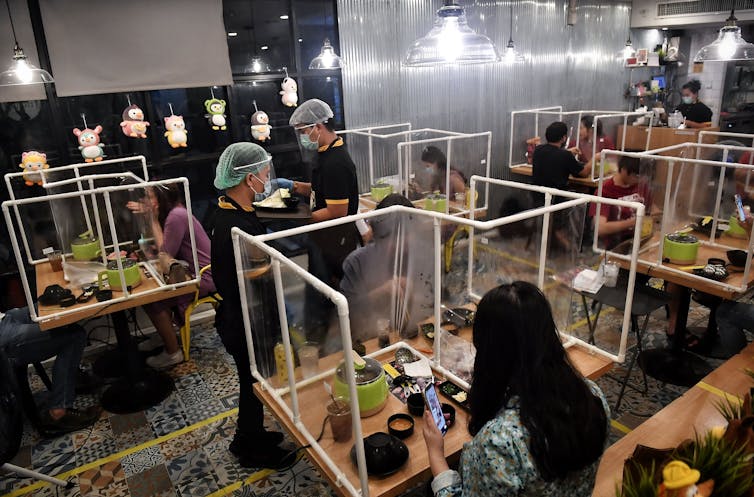
A restaurant in Bangkok created plastic partitions and moved its tables farther apart to separate guests in a normally tight space. Lillian Suwanrumpha/AFP/Getty Images
If the servers wear masks, is that enough?
If servers wear masks, that will afford a layer of protection, but customers eating and talking could still spread the virus.
One way to mitigate that risk in this imperfect situation, at least from a public health point of view, would be to have tables surrounded by protective barriers, such as plexiglass or screens, or put tables in separate rooms with doors that can be closed. Some states are encouraging restaurants to limit each table to only one server who delivers everything.
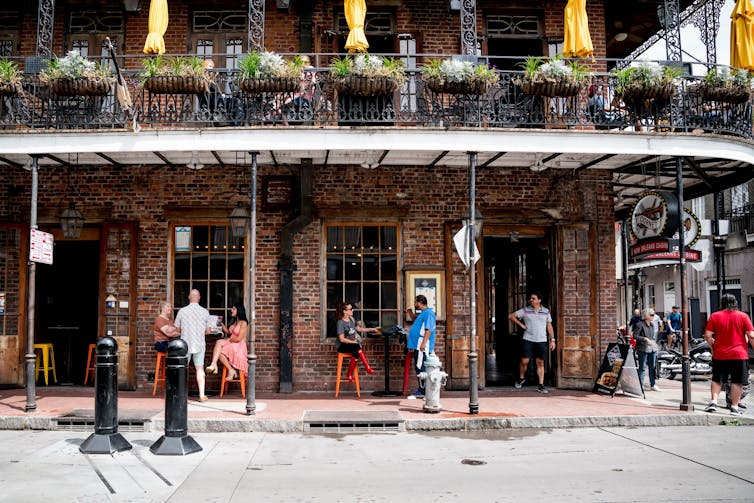
Guests filled the street seating and balcony at a restaurant on Bourbon Street on May 16, 2020, as New Orleans began lifting some restrictions following two months of closures over the coronavirus. Claire Bangser/AFP/Getty Images
Restaurants could also screen guests before they enter, either with temperature checks or questions about symptoms and their close contacts with anyone recently diagnosed with COVID-19. It’s controversial, but restaurants in California have tried it. Washington state tried to require restaurants to record visitors’ contact information in case an outbreak is discovered, but it pulled back to only recommend doing so.
It’s easier to screen employees. In fact, guidelines from the Centers for Disease Control and Prevention recommend restaurants have employee screening in place before they reopen. But while screening employees for possible infection could decrease risk, it’s important to remember that people can be infectious six days before they develop symptoms. That is why masks, eye protection, social distancing and hand hygiene are critical measures for preventing infection.
Should I ask for disposable utensils and wipe everything down?
Regular dishwashing of plates, glasses and utensils, and laundering of napkins and tablecloths, will inactivate the virus. No need for disposables here.
The table should also be cleaned and disinfected between uses and marked as sanitized.
Menus are a bit more problematic, depending on the material. Plastic menus could be disinfected. Disposable menus would be more ideal. Remember, even if someone touches a surface that has infectious virus, as long as they don’t touch their mouth, nose or eyes they should be safe. So, when in doubt, wash your hands or use hand sanitizer.
Can I get the virus from food from the kitchen?
The risk of becoming infected with the new coronavirus from food is very low.
This is a respiratory virus whose primary mode of infection is accessing the upper or lower respiratory tract through droplets or aerosols entering your mouth, nose or eyes. It needs to enter the respiratory tract to cause infection, and it cannot do this by way of the stomach or intestinal tract.
The virus also is not very stable in the environment. Studies have shown it loses half its viral concentration after less than an hour on copper, three and a half hours on cardboard and just under seven hours on plastic. If food were to be contaminated during preparation, cooking temperature would likely inactivate much if not all of the virus.
The use of masks and maintaining good hand hygiene by food preparers should significantly reduce the risk of food contamination.
Is outdoor seating or a drive-through any safer?
Vulnerable people may want to pass on dine-in options and focus on pickup or perhaps outside dining if the conditions are appropriate.
Drive-up windows or carry-out are probably the safest; transient interaction with one individual when everyone is wearing masks is a lower-risk situation.
Overall, outside dining is safer than indoor dining with everything else being equal on a nonwindy day due to the larger air volume. Maintaining eye protection via glasses and intermittent mask use between bites and sips would further decrease the risk.
You might also be interested in other parts of this series:
- How do you stay safe now that states are reopening? An expert explains how to assess risk when reconnecting with friends and family
- Here’s how to stay safe while buying groceries amid the coronavirus pandemic
- How can you be safe at pools, beaches or parks? A doctor offers guidance as coronavirus distancing measures lifted
- Should you fly yet? An epidemiologist and an exposure scientist walk you through the decision process
[The Conversation’s newsletter explains what’s going on with the coronavirus pandemic. Subscribe now.]

Thomas A. Russo, Professor and Chief, Infectious Disease, Department of Medicine, University at Buffalo, The State University of New York
This article is republished from The Conversation under a Creative Commons license. Read the original article.


