


from The Conversation
— this post authored by Gwilym David Blunt, City, University of London
Recent developments in the politics of the coronavirus pandemic have shown that threats to our liberty are not always what they seem.

Please share this article – Go to very top of page, right hand side, for social media buttons.
Over the past few weeks, armed protestors have occupied public spaces in the US, demanding an end to lockdown rules, and protests have occurred in major British cities. The issue of whether the government can expect you to wear a face mask has been co-opted into a “culture war”.
These protesters claim lockdowns are intolerable violations of their freedom. The problem is that this argument relies on a facile conception of liberty. They should be looking instead at the many examples of people in power bending the rules.
The COVID-19 pandemic has revealed that many of those in power believe themselves to be above the law. That jeopardises liberty in a far more profound way than being instructed to wear a face mask.
In the UK, Prime Minister Boris Johnson’s top adviser Dominic Cummings has admitted to travelling across the country by car to stay on his parents’ property during the nationwide lockdown. This was after his wife had been showing symptoms. Upon arrival, he too began experiencing symptoms – although neither have ever been tested for COVID-19. The couple later took a drive to the picturesque town of Barnard Castle, a journey that ran counter to advice on self-isolation.
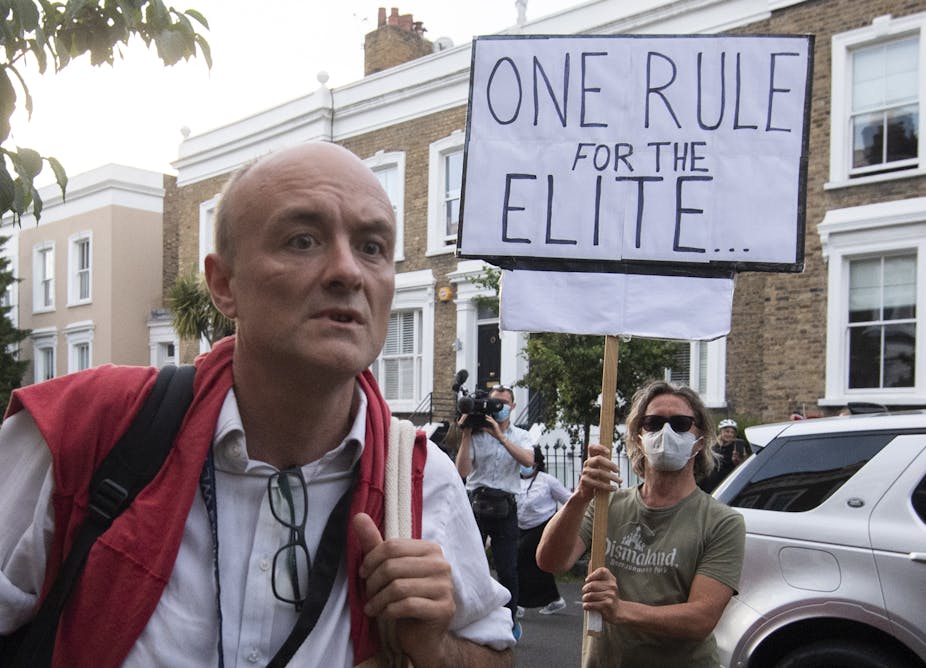
Dominic Cummings. the UK PM’s adviser, is greeted by protestors as he leaves home in London. EPA/Facundo Arrizabalaga
Public incredulity over Cummings’ actions turned into palpable anger when Johnson defended him for following his “instincts”. At a time when many Britons would have loved to follow their instincts but followed the government instructions, this message from the prime minister sounded to some like the rules apply only when he says so and he is free to make exceptions for those close to him.
In the US, Donald Trump has undermined the lockdown rules put in place by state governors – particularly if they are Democrats – declaring that:
“when somebody’s the president of the United States, the authority is total, and that’s the way it’s got to be”.
Total authority?
The claim was backtracked when people across the political spectrum reminded him of the constitutional constraints on his office. However, the leitmotif of the Trump administration is his belief that the law is synonymous with the private will of the president.
These are the acts that really reveal the tenuous state of liberty in different parts of the world.
What is liberty?
The core message of the critics of lockdown policies is that any restriction of liberty is a violation of liberty. This aligns with what the philosopher Isaiah Berlin called the “negative conception” of liberty; we are free when we are not subjected to interference. If the state forbids you from doing something, your freedom is diminished. This is contrasted with the “positive conception” of liberty, which is understood to be the realisation of “self-mastery”. This is, according to Berlin, “a monstrous impersonation” of freedom. We see in Berlin the fears of the 20th century where totalitarian projects appealed to the freedom of a nation, race or class while demolishing the liberty of the individual.
But an alternative way of thinking about liberty is to think of it not as the absence of interference, but the absence of arbitrary interference. A free citizen who lives in a state in which the laws are publicly known, impartially enforced, and usually where the authors of the law are subject to democratic constraint can feel assured that those with power cannot arbitrarily interfere without consequences. They are not above the law.
If those who hold power are able break the law with impunity, then the liberty of all citizens is compromised. They would be in the same position as a slave, as they would be subject to whatever whim happened to catch the fancy of those with power.

Protestors in Michigan have the wrong target in mind. EPA
Protestors who have called lockdown policies “tyranny” are operating under a reductive understanding of liberty. The state is preventing them from doing something and therefore their liberty is being violated. But they are wrong, so long as lockdown policies are publicly known, impartially enforced, and democratically constrained.
The genuine threat to liberty exposed by the coronavirus pandemic is that some of those who hold power believe that they ought to be above the law, above scrutiny, and above accountability. The actions of Trump, Johnson and Cummings may delight their base, but their supporters should bear in mind that a favoured slave is no less a slave.
Get the latest news and analysis, direct from the experts in your inbox, every day. Join hundreds of thousands who trust experts by subscribing to our newsletter.
Gwilym David Blunt, Lecturer in International Politics, City, University of London
This article is republished from The Conversation under a Creative Commons license. Read the original article.


