


from The Conversation
— this post authored by Chen Reis, University of Denver and Lynn Lieberman Lawry, Uniformed Services University of the Health Sciences
How is the COVID-19 crisis impacting the most vulnerable among us?

Please share this article – Go to very top of page, right hand side, for social media buttons.
Tens of millions of Americans fit that description – the poor, the homeless, immigrants, the detained and incarcerated, the precariously employed and the uninsured. Nearly one-quarter of adult Americans do not have access to medical benefits, paid sick leave or access to medical care.
Already, the virus has revealed the faults, cracks and inequities in the U.S. health care system. As scholars in humanitarian aid, we’re keenly attuned to these inequities. Here’s a look at the challenges the U.S. faces to protect the health of everyone in our communities.
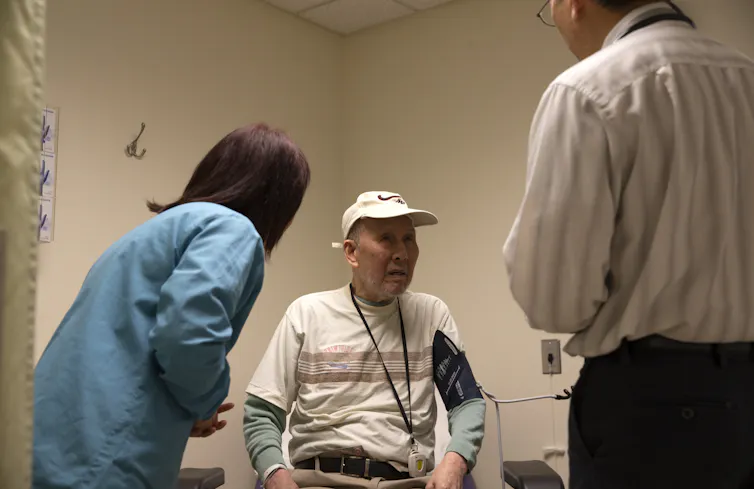
The nonprofit International Community Health Services medical clinic in Seattle provides care for uninsured people. Photo by Karen Ducey/Getty Images
1. Mental health
Approximately 20% of U.S. adults have a mental health condition. More than 4 million endure serious mental illness. COVID-19 has the potential to make things much worse; isolation exacerbates depression and anxiety. Those with mental health issues who are self-isolating may find it difficult to get proper medication and therapy. As a result, some may turn to alcohol or drugs to self-medicate. Not only does this hurt the individual, it greatly increases the risk of violence in the home.
2. Domestic violence
Intimate partner violence, pervasive in the U.S., touches 1 in 4 women and 1 in 9 men. Studies suggest that a crisis only increases its incidence and severity. Often, the increases last well beyond the crisis. In China, there’s evidence that intimate partner violence went up when COVID-19 forced people to stay at home.
Then there’s an added risk factor: guns. COVID-19 brought with it a jump in the number of gun purchases. Studies show gun ownership is a key factor in deadly domestic violence; the risk of homicide goes up 500%. On average, 600 women are shot to death by a partner each year, and gun-related domestic killings rose more than a quarter between 2010-2017, a significant increase after four decades of decline.
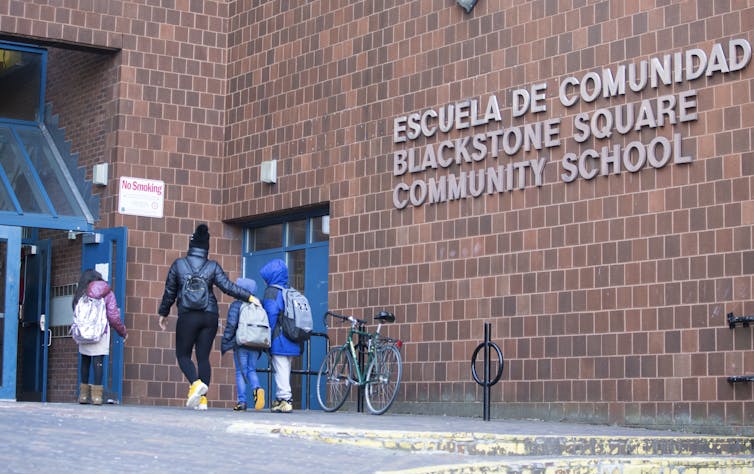
School closings, though necessary, can create problems for families. Getty Images / Boston Globe
3. Child abuse
In the U.S., up to 4 million children receive services for child abuse every year. Every day, five children die from abuse and neglect. Social isolation, economic fallout, closing schools and the stress resulting from families constantly in close quarters puts them at even higher risk. And with more guns in homes, the number of children killed by firearms will likely go up. It’s already the second-leading cause of death for them.
There are also millions of low-income children that face school closures. Many of them are without home computers, so unlike most of their classmates, they can’t do the online assignments. Other children, enrolled in Individualized Education Programs, are also often left behind, both in online and home-school scenarios.
4. Pregnant women
When emergencies occur, the needs of pregnant women suffer. Call it the “tyranny of the urgent,” and it is not a uniquely American problem. During the COVID-19 outbreak in China, and the earlier Ebola pandemic in Africa, maternity care sometimes ceased altogether. In other cases, pregnant women were moved out to make room for pandemic patients.
In the U.S., as hospital resources are diverted, women who miscarry in early pregnancy may face delays, even for emergency procedures, with Black and Native American women particularly at risk. The U.S. already has the highest maternal mortality rate of any high-income country in the world.
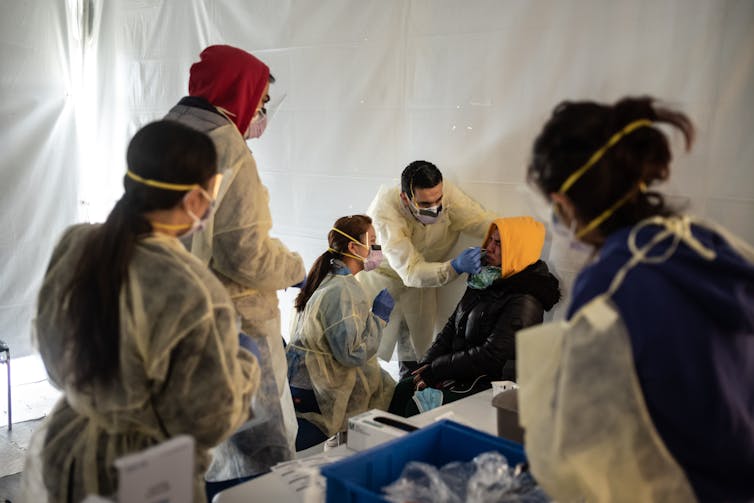
With the coronavirus, hospitals may struggle to provide ongoing services for other patients. Getty Images / Misha Friedman
What can people do?
People can work within their communities to identify needs. That includes, along with our neighborhoods, our virtual, religious and professional communities. One approach that’s working in remote African communities – called Champion Communities – targets the needs of the most vulnerable. The program can be adapted in the U.S. to provide online tools (like Google forms) to collect information on needs and resources. Social media – like neighborhood-focused apps, messaging groups on text, WhatsApp and FB Messenger – can also be used to check on the most vulnerable; #ittakesavillage is being used on social media to highlight these efforts.
And a footnote: Every telemedicine call should screen for intimate partner violence and child abuse. Every call needs to record the presence of firearms in the house. Providers, in cooperation with intimate partner violence and child abuse help lines, need to come up with protocols for identifying and safely checking in on those at risk. During this crisis, the coronavirus is not the only thing we have to fear.
[Deep knowledge, daily. Sign up for The Conversation’s newsletter.]
Chen Reis, Associate Clinical Professor and Director, Humanitarian Assistance Program, University of Denver and Lynn Lieberman Lawry, Associate Professor of Preventive Medicine and Biostatistics, Uniformed Services University of the Health Sciences
This article is republished from The Conversation under a Creative Commons license. Read the original article.
.


