


from The Conversation
— this post authored by Joel Michael Reynolds, University of Massachusetts Lowell
The U.S. hit a terrible and entirely preventable milestone this week: Measles cases are at a 25-year high.

Please share this article – Go to very top of page, right hand side, for social media buttons.
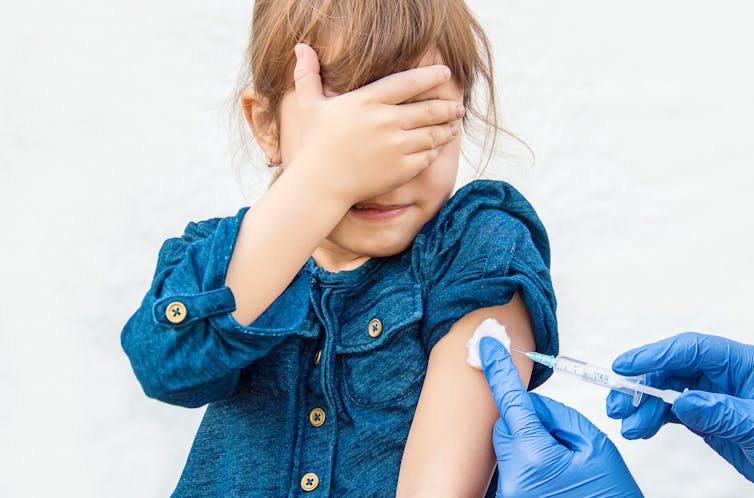
Several parents do not want their children vaccinated, for religious or other reasons. Tatevosian Yana/Shutterstock
This alarming statistic is not due to changes in public health policy or medical practice, but the rise of the anti-vax movement. Researchers who study the beliefs of parents who refuse to have their children vaccinated have found they have both religious and political motivations.
As a bioethicist who investigates how cultural and societal values impact medical care, I consider the position of anti-vaxxers to be morally indefensible.
Here are three reasons why.
1. Failure to contribute to the public good
Public goods benefit everyone. Take the example of roads, clean drinking water or universal education. Public health – the health of the overall population as a result of society-wide policies and practices – also falls into this category.
Many ethicists argue that it is unfair to take advantage of such goods without doing one’s own part in contributing to them.
Years of research involving hundreds of thousands of people have proven vaccines to be safe and effective. One reason why they are so effective – to the point of complete eradication of certain diseases – is because of what scientists call “herd immunity.”
What this means is that once a certain percentage of a population becomes immunized against a disease through public health programs, it provides general protection for everyone. Even if a few people get sick, the disease won’t spread.
The way herd immunity works is that those who aren’t vaccinated automatically benefit from the group-level protection. This, I argue, is unfair. For if everyone acted in that way, herd immunity would disappear.
Indeed, this is exactly what happened in California, where measles made a comeback because so many parents chose not to vaccinate their children.
These parents not only failed in their duty to contribute to the public good, they also actively undermined it, hurting others and also costing the economy millions of dollars.
2. Impact of health choices on the vulnerable

People with weakened immune systems are likely to get sick more easily. Kaspars Grinvalds/Shutterstock.com
Viruses do not affect everyone equally. Oftentimes, it is the elderly, infants and people with weakened immune systems who are most at risk.
In my family, my brother, Jason, often had to be rushed to a hospital as he would easily catch a bug. So, when we had visitors, my family would inquire if they could let us know if they were sick.
Often the answers were not truthful. Some would say, “I just have allergies,” and some others would be downright offended. My brother would end up catching the germs and more than once, nearly lost his life due to their lack of concern for his health.
Ethicists like Robert Goodin have long argued for special obligations towards the most vulnerable. We need to be mindful of the impact of individual health choices on others, particularly those most at-risk.
3: Health is communal
Political philosophers like John Dewey have argued that democratic public institutions necessarily rely upon belief in scientific evidence and facts. People can hold different personal beliefs, but there are some truths that are irrefutable, such as the fact that the Earth is round and revolves around the sun.
Anti-science attitudes are dangerous because they undermine our ability to make decisions together as a society, whether about education, infrastructure or health. For example, if too many people treat the scientific consensus on climate change as just “one perspective,” that will hinder our ability to respond to the massive changes already underway. In a similar manner, treating the science on vaccines as just “one perspective” negatively impacts everyone.
In the face of overwhelming scientific evidence concerning the efficacy, safety and importance of vaccines, citizens have a duty to support vaccination and encourage others to do so as well.
At the foundation of each of these duties lies a simple and powerful truth: Health is communal. Health-related ethical obligations do not stop at our own doorstep. To think that they do is both empirically misguided and ethically indefensible.
In order for local and federal government to effectively respond to this public health crisis, it is important to address not just the reasons and beliefs of anti-vaxxers, but also the morals.
This is an updated version of a piece first published on Nov. 19, 2018.
Joel Michael Reynolds, Assistant Professor of Philosophy, University of Massachusetts Lowell
This article is republished from The Conversation under a Creative Commons license. Read the original article.


