


from The Conversation
— this post authored by Lauren Lluveras, University of Texas at Austin
Senate Democrats recently blocked US$13.5 billion in relief for Americans whose lives were disrupted by hurricanes, tornadoes, wildfires, flooding and other natural disasters. The objections had to do with Puerto Rico.

Please share this article – Go to very top of page, right hand side, for social media buttons.
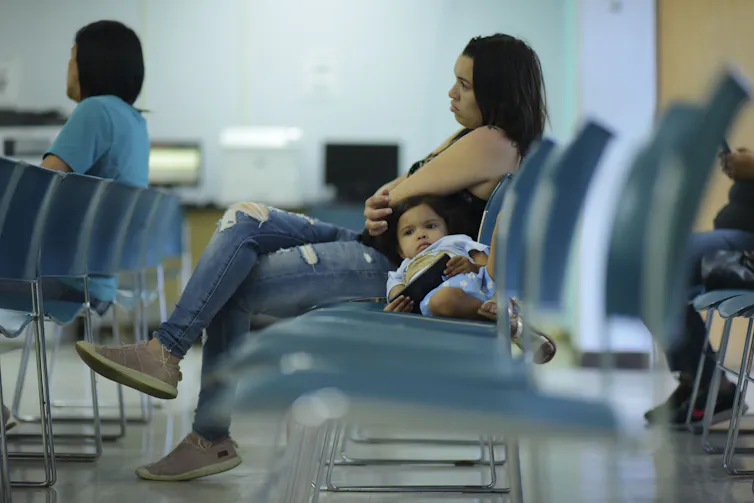
Three-year-old Ailianie Hernandez waits with her mother, Julianna Ageljo, to apply for Puerto Rico’s nutritional assistance program. AP Photo/Carlos Giusti
In addition to aid for Kansas, Missouri, Iowa and Nebraska, this bill included $600 million to cover six months’ worth of nutritional assistance requested by Puerto Rican Gov. Ricardo Rosselló. But Democrats refused to back the bill because it lacked funds that would protect the island from floods and rebuild its electrical grid.
The result is an impasse between a Congress that wants to assist a U.S. territory in distress and a hostile White House. As the daughter of Puerto Ricans who moved to the mainland and a policy analyst of racial inequities, I’m concerned that the Trump administration’s neglect of Puerto Rico is based in racial bias.
Complaints
President Donald Trump has vocally opposed disaster relief for Puerto Ricans almost since Hurricane Maria made landfall in September 2017. Within two weeks of that storm, which killed an estimated 3,000 people, Trump accused Puerto Ricans in a series of tweets of wanting “everything to be done for them.”
Not much has changed. Since January 2019, Trump has reportedly dismissed the need for emergency food aid on the island as “excessive and unnecessary.”
Rosselló responded by urging Trump to stop treating Puerto Ricans as “second-class” U.S. citizens. He seems to have reached a breaking point after avoiding being critical of the president. When CNN asked if he felt working with Trump was like “dealing with a bully,” Rosselló replied:
“If the bully gets close, I’ll punch the bully in the mouth.”
Part of the US
Puerto Rico has been part of the United States since 1898. The island’s residents are U.S. citizens.
Yet Trump has repeatedly ignored these basic facts by asserting that money to aid Puerto Rico takes money away from priorities on the U.S. mainland. He reportedly said in late March that with this aid money:
Some things operate differently in Puerto Rico, though, including the safety net. Puerto Ricans, for example, lack access to the Supplemental Nutrition Assistance Program, the nutritional benefit system formerly known as food stamps and today better known as SNAP. Instead, Puerto Rico operates its own Nutrition Assistance Program, or NAP.
Hurricane Maria did so much damage to Puerto Rico’s economy that nearly 300,000 more Puerto Ricans became poor enough to be eligible for its nutrition assistance – a roughly 30% increase in beneficiaries. Without the additional $1.27 billion in funding that Congress approved in September 2017, the greater need would have meant that everyone getting this help would have had to make do with less, as the cost of this program is generally capped at around $2 billion per year.
Puerto Rico’s nutrition assistance program differs from SNAP in another critical way: The threshold is much lower. Americans in families of three on the mainland can be eligible for food stamps if their income totals $1,732 per month. Puerto Rican families of the same size may not earn more than $4,901 per year – $408 per month – and get their own version of SNAP benefits. Because of this distinction, fewer Puerto Rican families get nutritional assistance benefits than would be the case if they earned the same incomes on the mainland.
The poverty rate in Puerto Rico is nearly 44%, triple the national average poverty rate. That’s especially problematic given that Puerto Rico ranks among the most expensive places in the U.S. to buy groceries.
Slashed benefits
Even before Hurricane Maria struck, the territory’s nutritional benefits program was already failing to meet the nutritional needs of low-income Puerto Ricans amid a prolonged recession.
And once the disaster relief funds Congress appropriated for this purpose ran out in March 2019, Puerto Rico was forced to slash benefits for the 1.35 million people getting nutrition aid.
While nutritional assistance funds should certainly be a high legislative priority, so should protecting Puerto Rico from future floods and fixing the island’s power grid. Puerto Rico experienced an 11-month power outage, the longest blackout in American history and the second-longest in world history after Hurricane Maria.
The House, unlike the Senate, passed a $14.2 billion disaster relief bill in January.
A new House version, about 25% bigger, would cover $17.2 billion in expenditures. As lawmakers entered their two-week spring recess in mid-April without sending legislation to Trump to at least consider signing, Puerto Rico, Iowa and other disaster-struck regions remained in limbo.
Lauren Lluveras, Postdoctoral Fellow at the Institute for Urban Policy Research and Analysis, University of Texas at Austin
This article is republished from The Conversation under a Creative Commons license. Read the original article.


