


from The Conversation
— this post authored by James Dyke, University of Southampton and Tim Lenton, University of Exeter
We will likely never know how life on Earth started. Perhaps in a shallow sunlit pool. Or in the crushing ocean depths miles beneath the surface near fissures in the Earth’s crust that spewed out hot mineral-rich soup. While there is good evidence for life at least 3.7 billion years ago, we don’t know precisely when it started.

Please share this article – Go to very top of page, right hand side, for social media buttons.
But these passing aeons have produced something perhaps even more remarkable: life has persisted. Despite massive asteroid impacts, cataclysmic volcano activity and extreme climate change, life has managed to not just cling on to our rocky world but to thrive.
How did this happen? Research we recently published with colleagues in Trends in Ecology and Evolution offers an important part of the answer, providing a new explanation for the Gaia hypothesis.
Developed by scientist and inventor James Lovelock, and microbiologist Lynn Margulis, the Gaia hypothesis originally proposed that life, through its interactions with the Earth’s crust, oceans, and atmosphere, produced a stabilising effect on conditions on the surface of the planet – in particular the composition of the atmosphere and the climate. With such a self-regulating process in place, life has been able to survive under conditions which would have wiped it out on non-regulating planets.
Lovelock formulated the Gaia hypothesis while working for NASA in the 1960s. He recognised that life has not been a passive passenger on Earth. Rather it has profoundly remodelled the planet, creating new rocks such as limestone, affecting the atmosphere by producing oxygen, and driving the cycles of elements such as nitrogen, phosphorus and carbon. Human-produced climate change, which is largely a consequence of us burning fossil fuels and so releasing carbon dioxide, is just the latest way life affects the Earth system.
While it is now accepted that life is a powerful force on the planet, the Gaia hypothesis remains controversial. Despite evidence that surface temperatures have, bar a few notable exceptions, remained within the range required for widespread liquid water, many scientists attribute this simply to good luck. If the Earth had descended completely into an ice house or hot house (think Mars or Venus) then life would have become extinct and we would not be here to wonder about how it had persisted for so long. This is a form of anthropic selection argument that says there is nothing to explain.
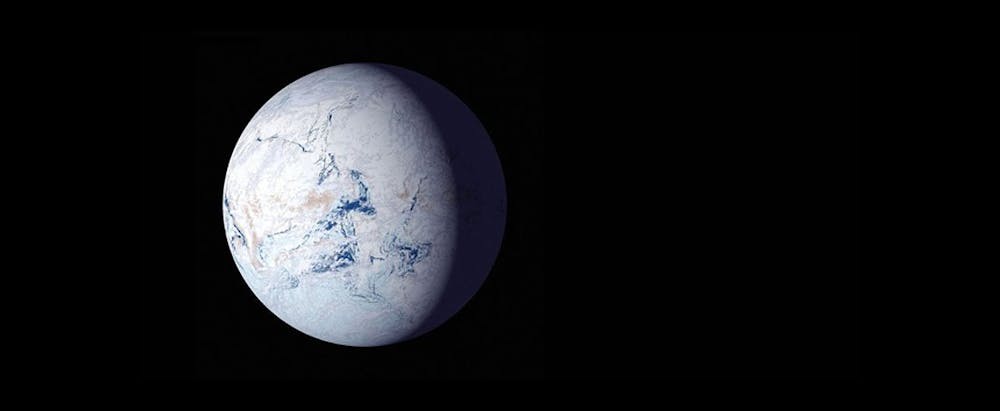
Two billion years ago, before multi-cellular life, the planet went through a ‘snowball’ phase. NASA
Clearly, life on Earth has been lucky. In the first instance, the Earth is within the habitable zone – it orbits the sun at a distance that produces surface temperatures required for liquid water. There are alternative and perhaps more exotic forms of life in the universe, but life as we know it requires water. Life has also been lucky to avoid very large asteroid impacts. A lump of rock significantly larger than the one that lead to the demise of the dinosaurs some 66m years ago could have completely sterilised the Earth.
But what if life had been able to push down on one side of the scales of fortune? What if life in some sense made its own luck by reducing the impacts of planetary-scale disturbances? This leads to the central outstanding issue in the Gaia hypothesis: how is planetary self-regulation meant to work?
While natural selection is a powerful explanatory mechanism that can account for much of the change we observe in species over time, we have been lacking a theory that could explain how the living and non-living elements of a planet produce self-regulation. Consequently the Gaia hypothesis has typically been considered as interesting but speculative – and not grounded in any testable theory.
Selecting for stability
We think we finally have an explanation for the Gaia hypothesis. The mechanism is “sequential selection”. In principle it’s very simple. As life emerges on a planet it begins to affect environmental conditions, and this can organise into stabilising states which act like a thermostat and tend to persist, or destabilising runaway states such as the snowball Earth events that nearly extinguished the beginnings of complex life more than 600m years ago.
If it stabilises then the scene is set for further biological evolution that will in time reconfigure the set of interactions between life and planet. A famous example is the origin of oxygen-producing photosynthesis around 3 billion years ago, in a world previously devoid of oxygen. If these newer interactions are stabilising, then the planetary-system continues to self-regulate. But new interactions can also produce disruptions and runaway feedbacks. In the case of photosynthesis it led to an abrupt rise in atmospheric oxygen levels in the “Great Oxidation Event” around 2.3 billion years ago. This was one of the rare periods in Earth’s history where the change was so pronounced it probably wiped out much of the incumbent biosphere, effectively rebooting the system.
The selection mechanism.
The chances of life and environment spontaneously organising into self-regulating states may be much higher than you would expect. If fact, given sufficient biodiversity, it may be extremely likely. But there is a limit to this stability. Push the system too far and it may go beyond a tipping point and rapidly collapse to a new and potentially very different state.
This isn’t a purely theoretical exercise, as we think we may able to test the theory in a number of different ways. At the smallest scale that would involve experiments with diverse bacterial colonies. On a much larger scale it would involve searching for other biospheres around other stars which we could use to estimate the total number of biospheres in the universe – and so not only how likely it is for life to emerge, but also to persist.
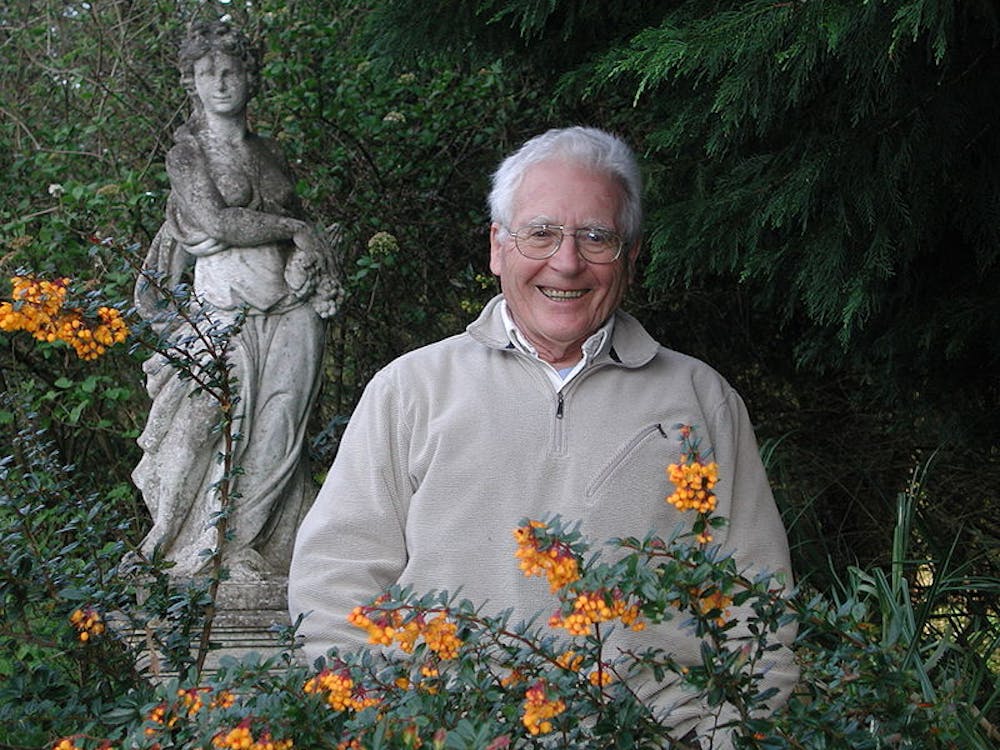
James Lovelock, next to a statue of Gaia, the Greek godess of the Earth. Bruno Comby, Environmentalists For Nuclear Energy, CC BY-SA
The relevance of our findings to current concerns over climate change has not escaped us. Whatever humans do life will carry on in one way or another. But if we continue to emit greenhouse gasses and so change the atmosphere, then we risk producing dangerous and potentially runaway climate change. This could eventually stop human civilisation affecting the atmosphere, if only because there will not be any human civilisation left.
 Gaian self-regulation may be very effective. But there is no evidence that it prefers one form of life over another. Countless species have emerged and then disappeared from the Earth over the past 3.7 billion years. We have no reason to think that Homo sapiens are any different in that respect.
James Dyke, Associate Professor of Sustainability Science, University of Southampton and Tim Lenton, Director, Global Systems Institute, University of Exeter
This article was originally published on The Conversation. Read the original article.


