


from The Conversation
— this post authored by Scott Lucas, University of Birmingham
Under Donald Trump, trying to predict, dissect and understand the US’s attitude to the world has become almost impossible – not that plenty of observers aren’t giving it a go. Tellingly, they’re all coming to different conclusions.

Please share this article – Go to very top of page, right hand side, for social media buttons.
Some see a spiral into outright chaos, citing the strain on crucial alliances, Trump’s strange embrace of Vladimir Putin, and his reckless rhetoric, which sometimes gets to the point of implicitly threatening nuclear war.
Other analysts claim to identify some semblance of order, but they disagree profoundly on what that order is. To some, Trump’s “America First” theme is an isolationist rallying cry, with its implications of economic protectionism and rejection of international agreements; others see an administration even more committed to military intervention than its predecessors. And still others say that for all Trump’s sound and fury, not much has changed – that US foreign policy, for better or worse, is hewing to the same methods and objectives pursued in the Obama era.
So how can we cut through all this noise and really make sense of it all? In the interests of clarity (and perhaps sanity) the first thing is to recognise that there isn’t just one Trump foreign policy. There are several. They frustrate each other with various irreconcilable differences. And collectively, they add up not to a coherent US strategy, nor even an incoherent one, but instead a gaping hole where a strategy should be.
The family-and-friends foreign policy
One key difference from his predecessors is Trump’s promotion in certain areas of a foreign policy set and pursued on an ad hoc basis by his family and their business allies. That approach has radically altered, even dismantled, the longstanding US approach to the Middle East – and in particular to the Israel-Palestine conflict.
Instead of assigning someone with relevant experience to handle what may be the world’s single most intractable dispute, Trump instead tapped his son-in-law, Jared Kushner. Kushner has no grounding in Middle Eastern affairs, nor even in diplomatic negotiations more generally. Having failed to disclose his meetings with foreign officials before Trump became president, he doesn’t even have a full security clearance. And yet Trump reportedly told him, with not a hint of irony:
“If you can’t produce peace in the Middle East, nobody can.”
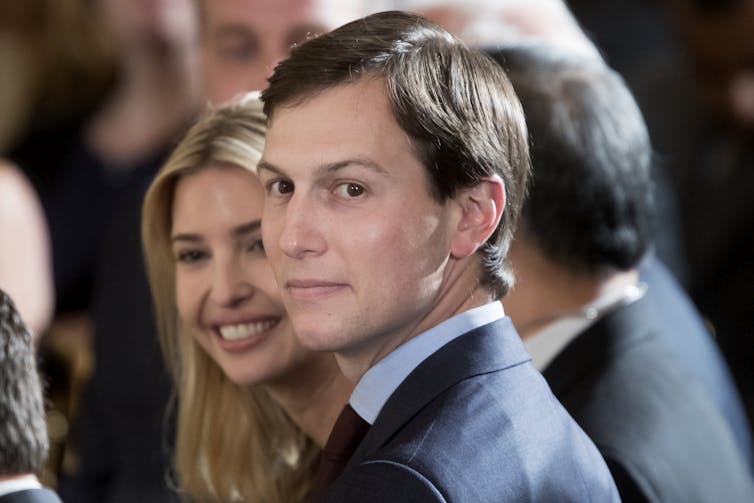
Jared Kushner, anointed healer of the Middle East. EPA/Michael Reynolds
The reckless cronyism doesn’t stop there. To assist Kushner, Trump chose Jason Greenblatt, the executive vice-president and chief legal officer to Donald Trump and The Trump Organisation. The administration’s chosen US Ambassador to Israel, David Friedman, was previously a member of the law firm Kasowitz, Hoff, Benson and Torres – which represents Donald Trump. Along with Kushner, both have helped support (individually or through foundations) Jewish settlements in the West Bank, while the Kushner Company continues to do business in Israel.
With Trump’s family and friends running the show, it seems that American influence in the Middle East writ large is no longer a sure thing. More than a year later, as Saudi Arabia still goes about its deadly business in Yemen, and the Syrian conflict remains intractable, this triad’s chief accomplishment has been to antagonise most of the world and endanger the peace process by having the US recognise Jerusalem as Israel’s capital.
The Twitter foreign policy
Then there are Trump’s tweets, which too often drive the global news cycle at the US’s reputational expense. His 280-character missives can recalibrate America’s foreign policy posture in an instant – whether contradicting his own secretary of state on North Korea, denouncing fellow NATO members, blowing hot and cold over China, or souring the “special relationship” with the UK by deriding the mayor of London and blithely retweeting videos from the far right Islamophobic group Britain First.

What matters here isn’t just the content, but that Trump actually revels in the chaos it creates. As he said in his first speech on foreign policy during the campaign: “We must as a nation be more unpredictable.”
Trump probably did not think of his statement as a reworking of the Nixon-Kissinger “madman” ploy of the 1970s. Nor is he likely to have thought through its effects. What matters, in the end, is capturing the world’s attention and settling petty scores.
The alt-right foreign policy
Before Trump’s ascendancy, the “alt-right” had little direct influence on policy of any kind. But with Trump elected, its leaders suddenly had their foot in the door. Led by hard right White House chief strategist Steve Bannon, they pushed for confrontation with China and detachment from NATO as well as protectionism and departure from international agreements such as the Paris climate agreement. Bannon put himself on a key committee of the National Security Council, along with Fox News commentator-turned-Deputy National Security Adviser K T McFarland.
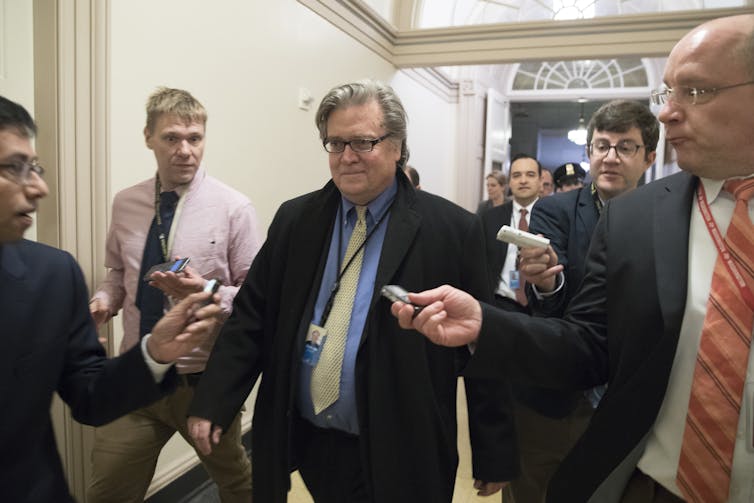
Heart of darkness: Steve Bannon in his White House days. EPA/Michael Reynolds
As 2017 unwound, the the “firebreathers” were eventually checked by pragmatists. General H R McMaster, brought in as National Security Adviser in March, removed Bannon from the National Security Council (he was later fired by Trump altogether). Senior staff Derek Harvey and Ezra Cohen-Watnick were dismissed, as was McFarland.
But one of the alt-right’s polyps is still at the heart of the Trump operation. Stephen Miller, who within two years went from e-mail spammer of Washington journalists to senior White House adviser, is not only the main architect of the crackdown on immigration but also the speechwriter behind Trump’s provocative UN General Assembly debut in September 2017 – an address that railed against “a small group of rogue regimes”, threatened to “totally destroy” North Korea, and called its leader Kim Jong-un “Rocket Man”.
As far as Miller is concerned, it seems, the more incendiary and derisory the US government’s tone, the better – whatever the diplomatic and strategic consequences.
The institutional foreign policy
These competing tendencies are a brutal test for the structures of US foreign policy, and the stewards of those institutions are clearly on high alert.
McMaster, Defence Secretary James Mattis, and Secretary of State Rex Tillerson are all trying to contain Trump and his inner circle. They have championed the US’s traditional alliances, taken charge of operations in areas such as Afghanistan and Syria, toned down Trump’s fire-and-fury threats to North Korea by discreetly encouraging a diplomatic path, and tried to curb some of the family’s inclinations – especially a Saudi-first approach that threatens the security of a key American military base in Qatar.
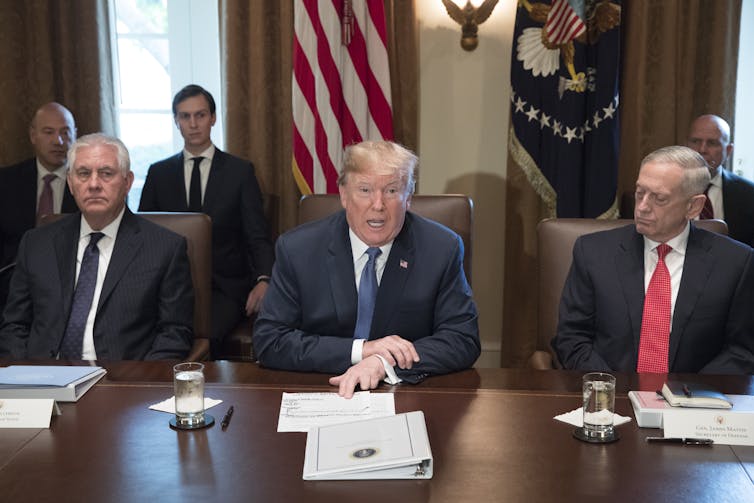
Reigning him in: Rex Tillerson (L) and James Mattis. EPA/Michael Reynolds
But it’s hard to win a fight against true chaos. Kushner and his allies can brief the media against the pragmatists. Trump’s profound impulsiveness can unsettle any plan, especially given his widely reported lack of knowledge. And those who do know what they’re doing are jumping ship: Tillerson has overseen a dramatic depletion of expertise at the State Department, with 12% of foreign service officers departing in just eight months.
America on the sidelines
Amid all the competing philosophies and factions, the only thing that’s certain is unpredictability. The administration has issued a National Security Strategy, but with all the chaos and policy clash the inexpert Trump constantly introduces, any “strategy” is doomed to the paper shredder.
And just as Trump’s agencies try to contain him, other countries try to contain the US by sidelining it. Russia has seized the initiative in Syria; Iran wants it in Iraq; Saudi Arabia pursues it from Yemen to Lebanon; Turkey warns that it may walk away from the Americans altogether, and China increasingly calls the shots in East Asia, from the North Korean problem to the South China Sea and economic development. Even European partners are thinking twice about their reliance on what no longer looks like a dependable superpower.
Meanwhile, US-based analysts scramble to find a framework that can express what’s going on while still conveying some sense of American primacy. “Soft power”, which under Obama became “smart power“, is now proclaimed as “sharp power“. And all the while, US power – if measured in the respect for America at the centre of global affairs – plummets in the opinion polling of peoples across the planet.
In his UN speech in September, Trump declared, “As long as I hold this office, I will defend America’s interests above all else.” It remains to be seen, for all his “American First” front, how his multiple foreign policies are defending those interests.
 On February 21, Scott Lucas will be joining the panel for The Conversation’s joint event with the British Academy, Trump: How to understand an unconventional President. You can watch the discussion live on our Facebook page.
Scott Lucas, Professor of International Politics, University of Birmingham
This article was originally published on The Conversation. Read the original article.


