


from The Conversation
— this post authored by Subramanian Shankar, University of Hawaii
In the United States, inequality tends to be framed as an issue of either class, race or both. Consider, for example, criticism that Republicans’ new tax plan is a weapon of “class warfare,” or accusations that the recent U.S. government shutdown was racist.

Please share this article – Go to very top of page, right hand side, for social media buttons.
As an India-born novelist and scholar who teaches in the United States, I have come to see America’s stratified society through a different lens: caste.
Many Americans would be appalled to think that anything like caste could exist in a country allegedly founded on life, liberty and the pursuit of happiness. After all, India’s atrocious caste system determines social status by birth, compels marriage within a community and restricts job opportunity.
But is the U.S. really so different?
What is caste?
I first realized that caste could shed a new light on American inequality in 2016, when I was scholar-in-residence at the Center for Critical Race Studies at the University of Houston-Downtown.
There, I found that my public presentations on caste resonated deeply with students, who were largely working-class, black and Latino. I believe that’s because two key characteristics differentiate caste from race and class.
First, caste cannot be transcended. Unlike class, people of the “low” Mahar caste cannot educate or earn their way out of being Mahar. No matter how elite their college or how lucrative their careers, those born into a low caste remain stigmatized for life.
Caste is also always hierarchical: As long as it exists, so does the division of people into “high” and “low.” That distinguishes it from race, in that people in a caste system cannot dream of equality.
It’s significant that the great mid-20th-century Indian reformer B. R. Ambedkar called not for learning to “live together as brothers and sisters,” as Martin Luther King Jr. did, but for the very “annihilation of caste.”
Caste, in other words, is societal difference made timeless, inevitable and cureless. Caste says to its subjects, “You all are different and unequal and fated to remain so.”
Neither race nor class nor race and class combined can so efficiently encapsulate the kind of of social hierarchy, prejudice and inequality that marginalized Americans experience.
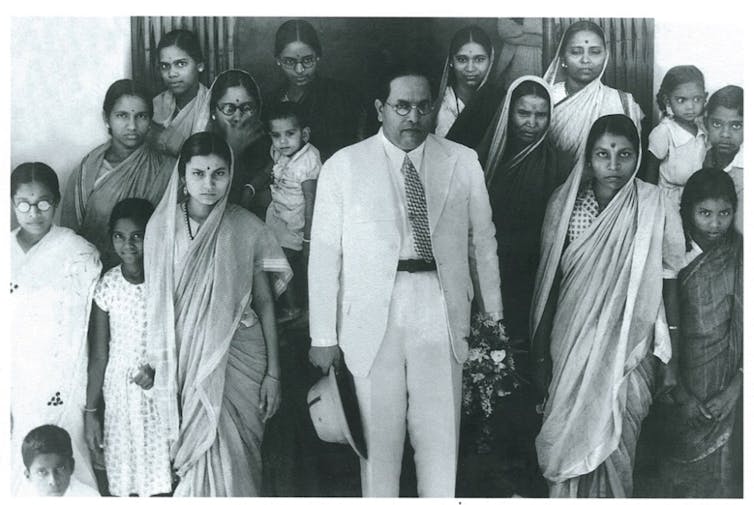
Babasaheb Ambedkar fought for the ‘annihilation of caste’ believing that social equality could never exist within a caste system.
Is America casteist?
In Houston, that sense of profound exclusion emerged in most post-presentation discussions about caste.
As children, the students there noted, they had grown up in segregated urban neighborhoods – geographic exclusion that, I would add, was federal policy for most of the 20th century. Many took on unpayable student loan debt for college, then struggled to stay in school while juggling work and family pressures, often without a support system.
Several students also contrasted their cramped downtown campus – with its parking problems, limited dining options and lack of after-hours cultural life – with the university’s swankier main digs. Others would point out the jail across from the University of Houston-Downtown with bleak humor, invoking the school-to-prison pipeline.
Both the faculty and the students knew the power of social networks that are essential to professional success. Yet even with a college degree, evidence shows, Americans who grow up poor are almost guaranteed to earn less.
For many who’ve heard me speak – not just in Houston but also across the country at book readings for my 2017 novel, “Ghost in the Tamarind” – the restrictions imposed by India’s caste system recall the massive resistance they’ve experienced in trying to get ahead.
They have relayed to me, with compelling emotional force, their conviction that America is casteist.
Caste in the US and India
This notion is not unprecedented.
In the mid-20th century, the American anthropologist Gerald Berreman returned home from fieldwork in India as the civil rights movement was getting underway. His 1960 essay, “Caste in India and the United States,” concluded that towns in the Jim Crow South bore enough similarity to the North Indian villages he had studied to consider that they had a caste society.
Granted, 2018 is not 1960, and the contemporary United States is not the segregated South. And to be fair, caste in India isn’t what it used to be, either. Since 1950, when the Constitution of newly independent India made caste discrimination illegal, some of the system’s most monstrous ritual elements have weakened.
The stigma of untouchability – the idea that physical contact with someone of lower caste can be polluting – for example, is fading. Today, those deemed “low caste” can sometimes achieve significant power. Indian President Ram Nath Kovind is a Dalit, a group formerly known as “untouchable.”
Still, caste in India remains a powerful form of social organization. It segments Indian society into marital, familial, social, political and economic networks that are enormously consequential for success. And for a variety of practical and emotional reasons, these networks have proven surprisingly resistant to change.
Casteist ideologies in America
At bottom, caste’s most defining feature is its ability to render inevitable a rigid and pervasive hierarchical system of inclusion and exclusion.
What working-class Americans and people of color have viscerally recognized, in my experience, is that casteist ideologies – theories that produce a social hierarchy and then freeze it for time immemorial – also permeate their world.
Take, for example, the controversial 1994 “The Bell Curve” thesis, which held that African-Americans and poor people have a lower IQ, thus linking American inequality to genetic difference.
More recently, the white nationalist Richard Spencer has articulated a vision of white identity marked, caste-like, by timelessness and hierarchy.
“‘We hold these truths to be self-evident; that all men are created unequal,’” he wrote in a July 2017 essay for an alt-right website. “In the wake of the old world, this will be our proposition.”
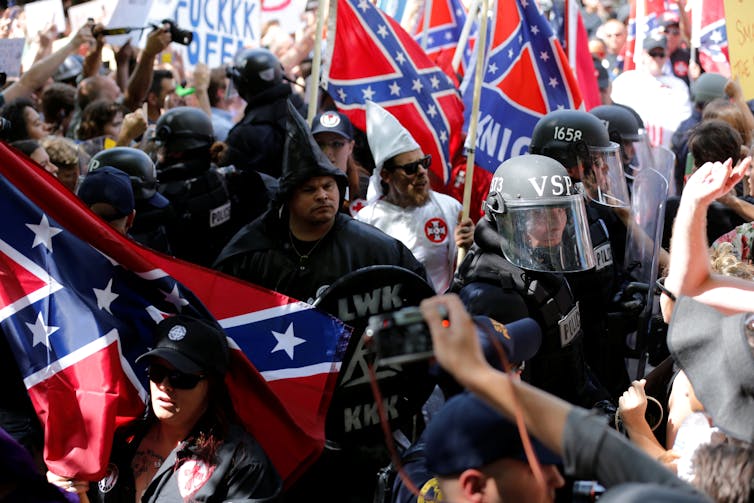
Today’s ‘alt right’ espouses an age-old American social hierarchy and enforces it through violence as needed. Jonathan Ernst/Reuters
Add to these ideological currents the evidence on the race gap in higher education, stagnant upward mobility and rising inequality, and the truth is damning. Five decades after the civil rights movement, American society remains hierarchical, exclusionary and stubbornly resistant to change.
Caste gives Americans a way to articulate their sense of persistent marginalization. And by virtue of being apparently foreign – it comes from India, after all – it usefully complicates the dominant American Dream narrative.
 The U.S. has a class problem. It has a race problem. And it may just have a caste problem, too.
Subramanian Shankar, Professor of English (Postoclonial Literature and Creative Writing), University of Hawaii
This article was originally published on The Conversation. Read the original article.


