


from The Conversation
— this post authored by Steve Fuller, University of Warwick
Eugenics has been science’s toxic brand since the end of World War II. The point was driven home yet again recently when Toby Young, appointee to the UK’s newly established Office of Students, was denounced in the House of Commons for having written favourably of “progressive eugenics“. Young resigned from the post the following day amid complaints about a series of other tweets and comments made in the past.

Please share this article – Go to very top of page, right hand side, for social media buttons.
In one sense, the toxicity of eugenics is of course well deserved. One thinks especially of the Nazi Holocaust, but also of the many, often racially motivated forced sterilisations of people in multiple countries, flying under a range of political banners. In addition, we live in a time when it is politically difficult, at least in avowed democracies, to appear to support any form of “inequality”.
However, this is not the most useful way to think about eugenics, either in terms of its history or its lessons. Historically, eugenics was primarily embraced as part of a “progressive” political agenda across the world – not only in regions under Western imperial rule. As the excellent Oxford Handbook of the History of Eugenics demonstrates, Mexico, Iran and China have been among the most enthusiastic eugenically oriented nations without any trace of white supremacist ideology.
I believe that we should understand eugenics in the context of what the original “progressive eugenicists” were trying to achieve, in spite of their ill-chosen means, because it is not so clear that our own political and, increasingly, personal ambitions are so different from theirs.
Human welfare
Eugenics was originally about forging a certain kind of relationship between science and the state. When Francis Galton coined the term in the 1880s, he wanted to turn science into a vehicle to consolidate the state’s emerging role as not merely keeper of the peace but promoter of human welfare. He meant this in good liberal capitalist fashion as by the state enabling people to show their true potential by relieving any hereditarily transmitted social arrangements that might otherwise block their performance. Our notions of “equal opportunity” derive from this way of seeing things.
Recall that “inheritance” already meant something long before “biology” and “genetics” became the names of sciences. It was a term in the law for the establishment of entitlements, such as property ownership or a seat in the UK House of Lords, a pet peeve of Galton’s. In this spirit, “eugenics” in its original sense aimed to extend the political economy of animal and plant husbandry into the human realm. On this view, traditional societies were seen as “wild”, which certainly fuelled imperialist ambitions of “domestication”. Nevertheless, we still trade on those ideas when uttering such agriculturally inspired phrases as “raising children” and “cultivating human capital”.

Logo from the Second International Eugenics Conference, 1921.
For all its flaws, Galton’s eugenics vision married a statistical imagination with sharp observation and diligent reporting on an unprecedented scale. It arguably remains the foundation of much social research today.
Of course, the judgements and conclusions drawn by Galton and his followers have been contested – and by standards that the eugenicists themselves introduced. That eugenics has been hoist by its own petard over the years suggests that the field is better seen as a scientific research programme blighted by many false theories than a “pseudoscience” in the philosopher of science Karl Popper’s original sense of an unfalsifiable belief.
The welfare state
The most important idea that we continue to honour from eugenics is that of the “welfare state” itself. Its original economic argument was that as the state scientifically determined who is good for which social roles, a national health and education service would be able to deliver the appropriate support, resulting in a maximally productive society. Galton’s coinage of the nature/nurture distinction specifically targeted cases in which native intelligence had been unjustly either retarded or promoted by its environment. The state then must decide whether to change the person’s environment or the person herself.
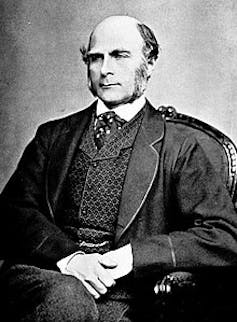
Francis Galton in the 1850s.
The strongest everyday remnant of eugenics is the resonant phrase, “cradle to grave”, which social reformer and eugenics sympathiser William Beveridge used to establish the UK welfare state. It effectively imported the comprehensive way that eugenics thought about social policy into the structures of government. Thus, the state would be involved in the conception of life, the improvement of existing life including its reproductive capacity, as well as the conclusion of life.
The relevant political question here is not whether to accept eugenics – in a sense, those who live in welfare states already do – but the terms of its acceptance. Compared with Galton’s day, the relevant scientific knowledge has increased while the authority of the state has diminished. This combination of factors has resulted in what I have called “bioliberalism”, namely the tendency to devolve matters of life and death to individual discretion. It may or may not be welcomed as the latest phase of “progressive eugenics”, but this is where the policy discussion should begin.
Into modernity?
Contrary to those who regard progressive eugenics as a dark idea, we long ago accepted its central premise that to make people better we may need to make better people, a point that the centre-left UK think-tank Demos made around ten years ago. The question is whether the state or the individual will take the crucial decisions.
To be sure, the sort of eugenic mentality promoted by Galton and Beveridge is far from today’s world of “designer babies” and “gene editing”. The old style eugenicists had relatively little knowledge of genetics but a lot of faith in training, once the genetics was sorted. This helps to explain their strange attraction to both sterilisation policies and educational innovation. Yet, the very people who today quickly decry old style public hygiene sterilisation policies might well accept voluntary antenatal screening and gene therapy. At the same time, faith in the enhancing powers of formal education at various levels has become less secure than ever. People may prefer instead to pop pills and have their brains rewired.
 The bottom line is not that eugenics has become defunct but that people want to be more personally involved in its application. This still leaves open many of the great moral questions that have dogged the field, not least what counts as “progressive” and “regressive”. It also adds new questions, not least to the amount of risk that individuals should be allowed to bear, given the overall social impact of their decisions. But make no mistake, we are still very much within the general world-view that Galton first charted a century and a half ago.
Steve Fuller, Auguste Comte Chair in Social Epistemology, University of Warwick
This article was originally published on The Conversation. Read the original article.


