


from The Conversation
— this post authored by Susan Anderson, Elon University
The tax package pending in Congress includes a provision that would leave churches and other nonprofits, which by law must be nonpartisan, suddenly free to engage in political speech.

Please share this article – Go to very top of page, right hand side, for social media buttons.
This measure, currently only in the House version of the bill, could potentially change charitable life as we know it.
As an accounting professor who teaches nonprofit taxation, I believe that this significant change deserves vigorous public debate and is too big to bury in tax legislation.
Johnson Amendment
Tax law currently bars religious and secular charities alike from engaging in political activity, which the government defines as attempting to influence legislation or intervening in a campaign on behalf of (or in opposition to) specific candidates.
Nonprofits caught breaking this law may pay back taxes or lose their tax-exempt status.
Known as the Johnson Amendment, this provision dates back to 1954, when then-Senator Lyndon B. Johnson led the effort to get this restriction on the books. More nonprofits say they welcome this as a form of protection from political pressure than object to it as a restriction on their rights.
President Donald Trump vowed as a candidate to repeal the Johnson Amendment to give church leaders the ability to speak about politics without penalty. But repealing a law takes an act of Congress and power he lacks.
As a step in that direction, he issued an executive order directing the IRS not to enforce it for religious institutions.
The tax bill’s proposed change would actually repeal the Johnson Amendment, and it would apply to all charitable organizations, including churches and other houses of worship like mosques and synagogues. It came as an unwelcome surprise to most charities, which have been openly rejecting it.
“Charitable nonprofits don’t want to be dragged into the toxic political wasteland,” said Tim Delaney, who leads the National Council of Nonprofits.
If the House language becomes law, political speech by these groups would technically need to meet two requirements. First, charities would be able to make political statements in the ordinary course of business – that is, doing whatever it is they do. For example, a prominent pastor could endorse political candidates during a sermon that’s broadcast or livestreamed.
Second, making such statements must cost no more than an “incremental de minimis amount” – regulatory language that basically translates into “not much.”
In other words, calls to vote for a particular candidate could be printed in flyers as long as those missives were mainly about something else. And nonprofits could endorse candidates on their websites as long as the details do not dominate that digital space. Politicking would be allowed on the sidelines and if it does not consume a large share of a group’s budget.
Where exactly the government would draw a line isn’t clear yet. Most likely, churches wouldn’t be free to mail their congregants straightforward calls to “vote for Jennifer Doe on November 7.” But they might be able to include that language in their monthly newsletters or on a web page about a church supper.
Why bother?
Why lift current restrictions on political speech by charities? The Alliance Defending Freedom, a conservative Christian legal group, argues that the Johnson Amendment unconstitutionally restricts free speech by not allowing nonprofits to speak on big issues that matter to the public.
However, there’s no clear evidence that this is a valid concern. Plenty of pastors already speak out often on policy issues, such as abortion, immigration and income inequality. Some even endorse candidates running for office, according to a 2016 Pew study.
In fact, religious leaders have been reportedly speaking out more because of increasingly lax IRS enforcement of nonprofit political activity starting years before Trump signed his executive order.
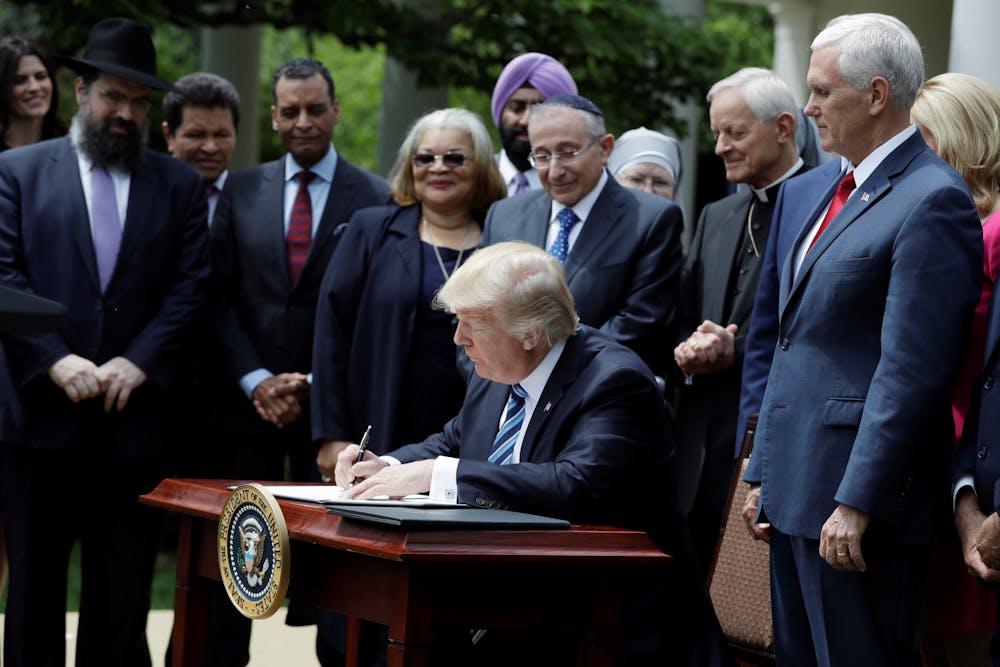
President Donald Trump, shown here signing an executive order on May 4. The order instructed the IRS to use ‘maximum enforcement discretion’ in enforcing a tax code provision barring nonprofits from engaging in political activity. AP Photo/Evan Vucci
Arguments against this change
The Johnson Amendment entangles church and state by requiring the IRS to determine whether speech by 501(c)(3) nonprofits – the kind to which Americans who itemize their returns can make tax-deductible donations – is political or merely issue advocacy.
For example, religious leaders currently can speak about abortion as long as they do not endorse candidates based on their views regarding the procedure. If the proposed tax code amendment becomes law, they would be free to do just that.
Delaney and other nonprofit leaders – including religious ones – say that they would prefer to see partisan politics kept out of charities, churches and foundations. This arrangement, they argue, currently shields them from political pressure from donors, board members or politicians.
There is also a risk that some charities would superficially serve an educational purpose while actually engaging in political activity, according to Roger Colinvaux, a Catholic University law professor who previously served as a lawyer for the Joint Committee on Taxation, a congressional committee with members from both the House and Senate whose staff analyzes tax proposals.
Without restrictions on political speech by churches and secular charities, many experts predict that taxpayers seeking to make political contributions would shift such nondeductible donations from politicians, parties and political organizations to nonpartisan charities.
This would mean potentially billions of dollars in political donations could be written off. And like the tax cuts themselves, this change would come with a price tag.
Rep. John Lewis, a Georgia Democrat, raised questions about the proposed changes to charity tax laws during a congressional hearing.
The House bill would lift this restriction for five years beginning in the 2019 tax year, reducing revenue by approximately US$1.5 billion, according to the Joint Committee on Taxation.
What’s more, contributions to nonprofits for political purposes could be anonymous. While the names of donors who contribute to political campaigns must be disclosed, charitable donations don’t have to revealed.
In other words, donors could make their contributions to nonprofits contingent upon endorsements for candidates without anyone knowing about it if this provision becomes part of the tax code.
What nonprofits say
More than 4,200 religious leaders signed an interfaith petition to keep the Johnson Amendment intact.
At the same time, 5,500 charitable organizations have objected to the proposed revision by signing a letter to that effect.
And a national poll by the Independent Sector, an organization representing charities, foundations and corporations seeking to advance the common good, found that 72 percent of respondents wanted to keep the Johnson Amendment on the books.
The only people who have called for this change are evangelical Christian pastors.
Rushed timetable
Given the pending tax package’s potential to make sweeping changes, the question of whether it makes sense to loosen restrictions on political speech by charitable organizations is getting less attention than it should.
Most Americans do not know what is in this legislation, which Trump wants to sign into law before Christmas on a rushed timetable. If he gets his wish, chances are strong that the debate will follow passage rather than precede it.
 A huge shift like this deserves a real and open debate, not the kind of behind-the-scenes deal-making that apparently went on before House Republicans folded this nonprofit provision into its tax bill.
Susan Anderson, Professor of Accounting, Elon University
This article was originally published on The Conversation. Read the original article.


