


from The Conversation
— this post authored by Lilian Bobea, Bentley University
Three weeks after Hurricane Maria ripped through Puerto Rico, half of the population still lacks fresh water and medicine, and almost 80 percent doesn’t have electricity. The scarce resources arriving from international private sources are quickly running out. Satellite communication remains limited.

Please share this article – Go to very top of page, right hand side, for social media buttons.
Despite this crisis, President Donald Trump’s support for this U.S. territory has been nominal at best. At first, he all but ignored the island’s devastation. Federal help arrived five days after the storm, but then he started blaming residents for their problems. Most recently, Trump threatened to pull federal aid workers out of Puerto Rico.

This attitude is shortsighted. As a Caribbean scholar of security and national defense, I would contend that helping Puerto Rico is actually in the United States’ own best interest. For the island is much more than just a beach destination – it is a crucial piece of modern America’s economic and security apparatus.
Big business
Since World War II, Puerto Rican governments have courted investment by granting fiscal exceptions, concessions and other privileges to mainland American entrepreneurs. It worked: Throughout the 20th century, companies flocked to the island chasing cheap labor and big tax incentives.
In 1976 tax credit Section 936 exempted companies operating on Puerto Rico from federal corporate income tax. This lured many companies to the island, top among them drug manufacturers. Today, American pharmaceutical factories in Puerto Rico produce 13 of the world’s top-selling brand name drugs.
Since Hurricane Maria took out Puerto Rico’s power grid, these facilities have lain dormant, stoking fears that supplies of high-demand drugs may soon run out. Saline solution, produced by Baxter, and Humira, used for rheumatoid arthritis, are among the drugs made in Puerto Rico. Stocks of the blood thinner Xarelto could also be threatened.
Biotech and food manufacturers are among the other industries deploying generators and trying to track down enough workers to get their Puerto Rico operations back up and running. Helping Puerto Ricans would also help these businesses.
Make America safe again
The U.S. has long used the territory of Puerto Rico to serve American geostrategic interests. Seeing its unique Caribbean location as pivotal in defending America’s oceanic “third border,” consecutive U.S. administrations have built large-scale military facilities on the island.
From 1940 to 2003, the U.S. Navy used the Puerto Rican islands of Vieques and Culebra as bombing ranges, testing sites and military training grounds. This wasn’t great for Puerto Ricans, who lost access to huge swaths of their land – some of which remains environmentally contaminated today – but the facilities were critical to American and NATO war efforts, in World War II and beyond.
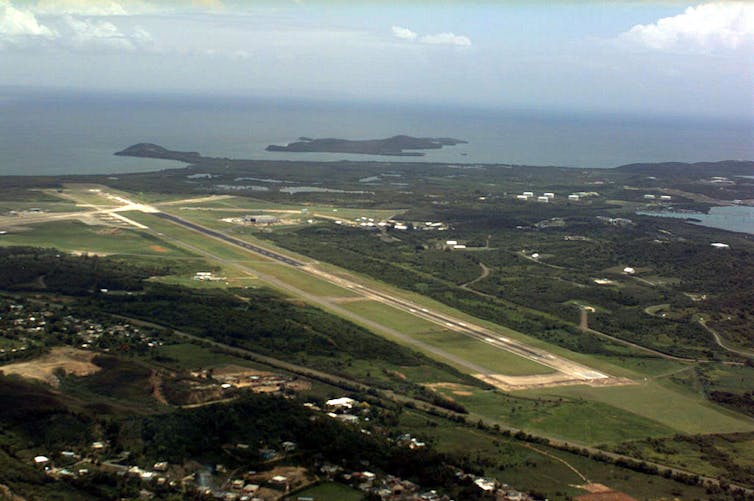
Puerto Rico is the first line of defense in America’s Caribbean ‘third border.’ U.S. Defense Imagery
The Roosevelt Roads Naval Station, which since 1943 has served as the cornerstone of the U.S. Caribbean Defense System, remains operational. Today, the Eastern Maneuver Area, with its five artillery practice fields, hosts critical military training and fleet exercises.
Right now, these military bases – among the few places in Puerto Rico with electricity – are being used for the recovery effort. In a recent visit to the island, military officials supervised the work of the 7,000 troops who’ve been deployed as aid workers and visited the hospital and airport at Roosevelt Roads.
Puerto Rico is also home to parts of the nationwide “Over the Horizon” radar system, which helps the U.S. maintain control over vast aerial and marine areas of the Western Hemisphere. It also aids U.S. efforts to stop incoming drugs trafficked from South America.
As long as Puerto Rico remains in disaster mode, I believe these security functions will be compromised.
Rebuilding time
If humanitarian assistance isn’t sufficiently compelling, then self-interest should compel the federal government to do much more to rebuild Puerto Rico.
Three-and-a-half million people have been unable to receive external help because of the Jones Act, a 1920 law that regulates maritime exchange and circulation in U.S. waters, including in Puerto Rico, Hawaii and the U.S. Virgin Islands.
This legislation, also known as the Merchant Marine Act, was intended to protect American commercial interests. But in Puerto Rico it has proven a legal impediment to getting much-needed aid to the island because fewer ships can take it there.

Despite calls from Sen. John McCain and others to waive the act to speed hurricane relief, the Trump administration recently let an emergency waiver expire.
The government could also replicate some social programming developed after Hurricane Katrina decimated New Orleans in 2005. Back then, the U.S. Department of Labor prioritized workforce development, helping citizens get new jobs. The Small Business Administration also facilitated disaster loans to revitalize New Orleans businesses. Puerto Rican workers could desperately use similar help now.
The Minority Business Development Agency, which provides jobs and access to capital for minorities in the U.S., is also a clear potential player on an island where 90 percent of the population identifies as Hispanic. Assisting minority-run firms applying for disaster relief and loans would help strengthen the whole business sector.
Limited resources
Finally, there’s the matter of Puerto Rico’s financial crisis. Earlier this year, the island declared bankruptcy in the face of an “unpayable” US$123 billion debt.
The resulting cutbacks in public expenditures increased the precariousness of the 50 percent of Puerto Ricans who live in poverty. It also threatens to push up the island’s 12 percent unemployment rate.
Donald Trump is now using Puerto Rico’s debt crisis against it, citing a “total lack of accountability” in Puerto Rico as a reason for withdrawing federal support. That’s a real exaggeration, but if the administration wants to ensure that resource distribution is effective and equitable in a territory with a history of bureaucratic inefficiency and public corruption, there are certainly ways to do so.
Rather than abandon Puerto Rico, the federal government could enable transparent and accountable administration of disaster resources by implementing public audits and participatory budgeting. These tactics have proven effective in several other Latin American countries.
 In the end, simply abdicating responsibility for this ravaged American territory isn’t just wrong, it’s also very risky.
Lilian Bobea, Assistant Professor of Sociology, Bentley University
This article was originally published on The Conversation. Read the original article.


