


from The Conversation
— this post authored by Charles Hankla, Georgia State University
President Donald Trump declared his nearly two-week trip through Asia “tremendously successful,” but economic history should make us more skeptical.

Please share this article – Go to very top of page, right hand side, for social media buttons.
During the trip, the president continued to promote his so-called “America first” trade policy. He is orienting the country distinctly toward protectionism and claiming that unilateralism in trade is good for America.
Here is the problem: President Trump’s approach to trade seems to be based on a false understanding of how the global economy works, one that also plagued American policymakers nearly a century ago. The administration has forgotten an important lesson of the Great Depression, and virtually all economists agree that this could have unfortunate consequences for the U.S. and the world.
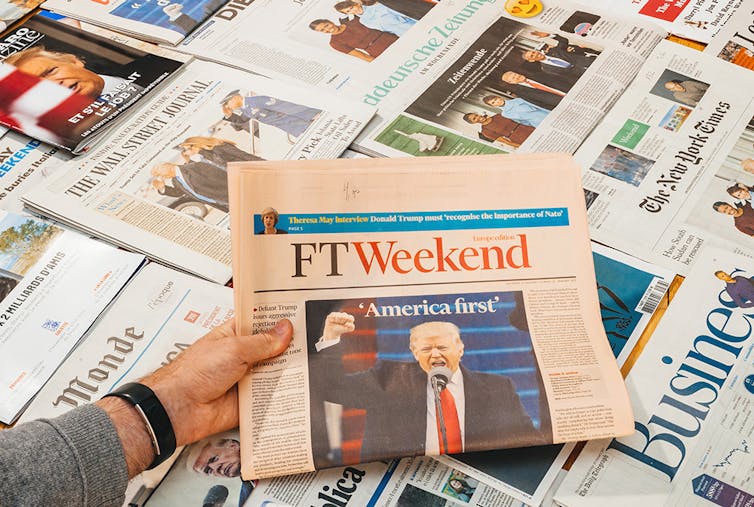
If Trump puts ‘America first’ in trade, other countries will follow. And that’s bad news for everyone. Hadrian/Shutterstock.com
America and the global economy
Trump’s “America first” orientation assumes that the United States, as the world’s dominant actor, can behave freely and independently in trade.
Unfortunately for the administration, America’s top economic position does not shield it from the dire consequences that unilateral trade policy can provoke. The constraints on U.S. action result from the basic nature of the international economy and from America’s declining dominance of the world trade system.
It is a standard principle of economics that all individual actors exist within a system. Any action taken by one actor will likely result in a response from others. This means that wise governments, in considering which policies to adopt, must make difficult calculations about how their actions will interact with those of others.
“America first” fails to make these calculations. It disregards how America’s trading partners will respond to the new U.S. protectionism – which is also what American lawmakers ignored during the Great Depression.
‘Beggar thy neighbor’
Before the 1930s, America’s trade policy was generally set unilaterally by Congress – that is, without the international negotiations used today.
Lawmakers, already in a protectionist mood, responded to the pain of the Great Depression by passing the infamous Smoot-Hawley Tariff Act of 1930, which raised duties on hundreds of imports.
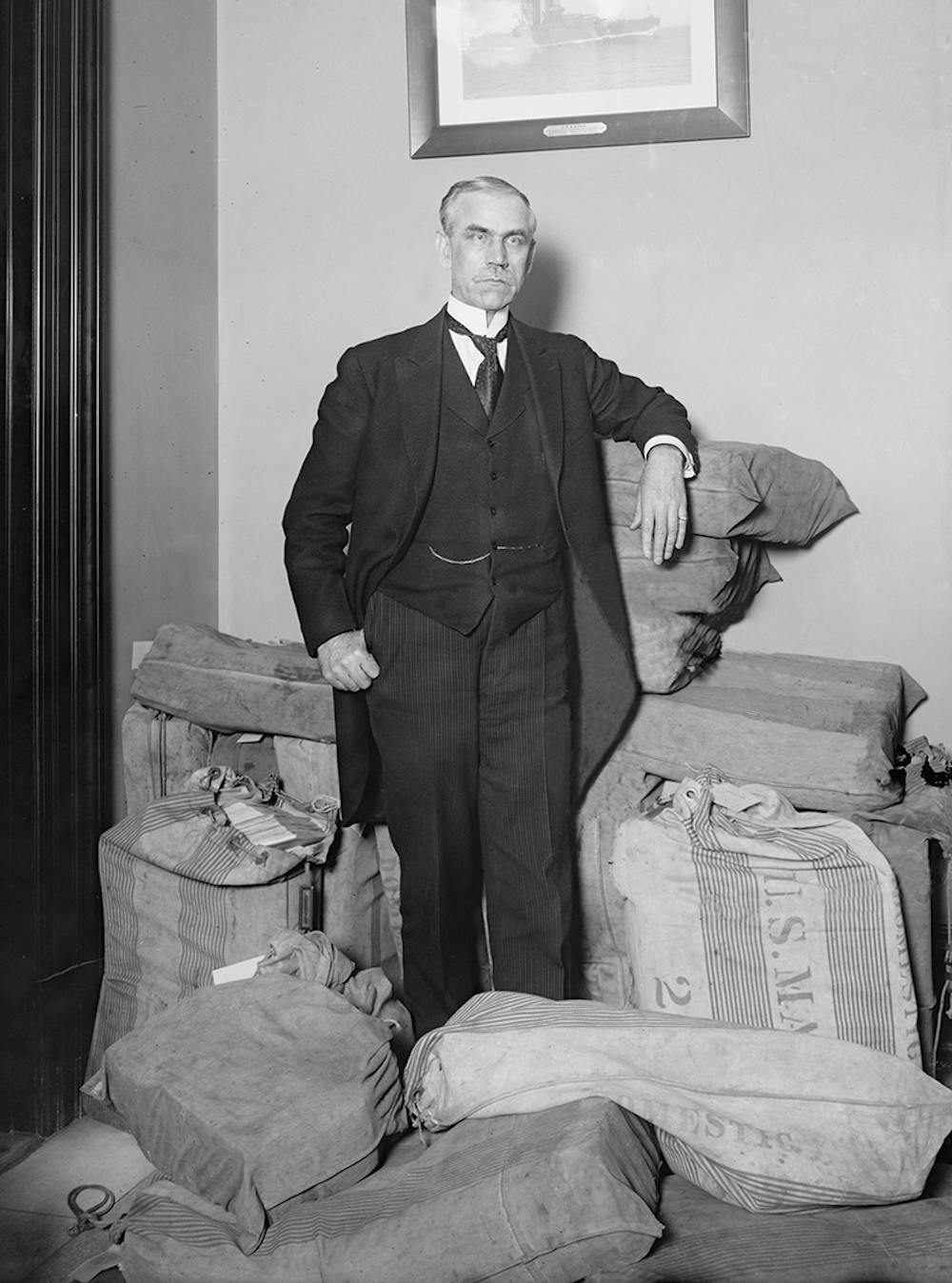
Senator Reed Smoot co-sponsored the famous act that bears his name. Everett Historical/Shutterstock.com
Meant in part to ease the effects of the Depression by protecting American industry and agriculture from foreign competition, the act instead helped prolong the downturn. Many U.S. trading partners reacted by raising their own tariffs, which contributed significantly to shutting down world trade.
Fortunately, America and the world learned a lesson from this experience. With the Reciprocal Trade Agreements Act of 1934 and its successors, which granted the president authority to reach tariff reduction agreements with foreign governments, U.S. trade policy came to be global and strategic. This new approach was institutionalized at the international level with the creation of the General Agreement on Tariffs and Trade in 1948 and its successor, the World Trade Organization, in 1995.
The basic principle of these agreements is reciprocity – that each country will agree to liberalize its trade to the extent that other countries liberalize theirs. The approach uses international negotiations to overcome protectionist political pressures and recognizes that trade is a global phenomenon that generates national interdependence.
Dangers of ignoring history
The dangers of ignoring history are only beginning to manifest themselves, but they can be seen in several recent developments that bode ill for us all.
One of the Trump administration’s first actions was to withdraw the United States from the Trans-Pacific Partnership. This agreement, which was a major initiative of the Obama administration, would have created the largest economic bloc in the world by linking America’s economy with those of 11 other Pacific nations. It would also have created an American-led, liberal bulwark in Asia against any Chinese challenge to the regional economic order.
Withdrawing from the agreement denied American exporters enhanced access to foreign markets and was a gift to Chinese influence in Asia. But we are only now beginning to see the longer-term repercussions of President Trump’s decision.
During Trump’s trip, the other 11 signatories of the original trade deal, including Japan, Australia, Canada and Mexico, agreed to move forward without the U.S. This is a problem for America because it means that these countries will grant preferential market access to one another, making it harder for American companies to compete in their markets.
American companies are already feeling the impact of what happens when they’re left out of a trade deal. A recent New York Times article, for example, highlights the plight of American lobster producers whose prices are being undercut by Canadian producers in the wake of a new Canada-European Union trade agreement.
If the United States is reluctant to participate in multilateral trade agreements, other countries have every incentive to do deals that exclude and even may hurt the U.S.
Trump’s ongoing efforts to renegotiate the North American Free Trade Agreement also pose potential dangers. The administration has a tendency to speak of renegotiation as if it can dictate the terms. But while Canada and Mexico may be more dependent on the U.S. than the U.S. is on them, an implosion of NAFTA would be devastating for many U.S. industries that rely on North American trade. Markets increasingly worry that NAFTA may not survive the negotiations.
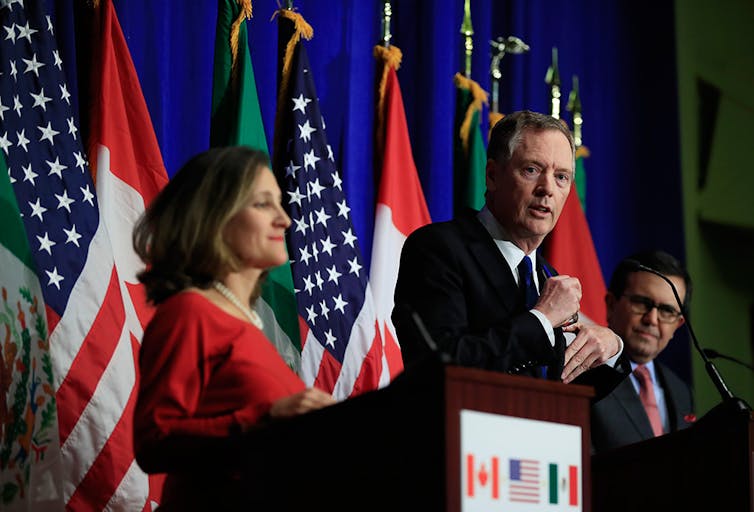
Trade representatives from Canada, the U.S. and Mexico have been meeting to renegotiate NAFTA. AP Photo/Manuel Balce Ceneta
In addition to withdrawing from and renegotiating trade agreements, the administration has ramped up unilateral efforts to sanction U.S. trading partners for receiving subsidies or for dumping their products on the American market.
Decisions to impose trade penalties risk blowback, as when sanctions on Bombardier drove the Canadian plane manufacturer into the arms of Airbus, Boeing’s top foreign rival. The threatened imposition of sanctions on imports of solar panels may have a similar effect, damaging American panel installers and encouraging foreign retaliation.
Trade needs a champion
President Trump assumes the U.S. can act unilaterally without consequences.
Economic history shows this doesn’t work. The world’s economies are far more interdependent than they were during the Great Depression, so the impact of governments all following a “my country first” trade policy – as the president said he expected world leaders to do – could have disastrous consequences.
Today, the international trade system America helped create, one based on open markets and classically liberal principles, is under threat as never before. Yet President Trump’s “America first” approach is a total abdication of the traditional U.S. role as its defender. And in fact, the president is doing his best to undermine that system.
In the final analysis, the Trump administration is reverting to a policy that is dangerous for the U.S. economy and for the international system.
 If the U.S. abdicates, China may be the only country that can take the reins. The question is, what would that mean for the current system of open and free markets?
Charles Hankla, Associate Professor of Political Science, Georgia State University
This article was originally published on The Conversation. Read the original article.


