


by Charles Hugh Smith, Of Two Minds
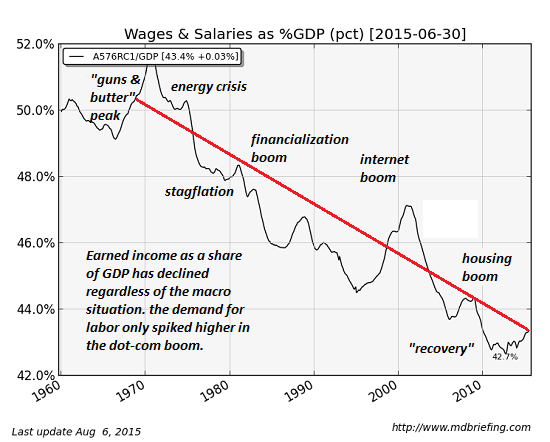
Labor’s share of the national income is in freefall as a direct result of the optimization of financialization.

Please share this article – Go to very top of page, right hand side, for social media buttons.
The Achilles Heel of our socio-economic system is the secular stagnation of earned income, i.e. wages and salaries. Stagnating wages undermine every aspect of our economy: consumption, credit, taxation and perhaps most importantly, the unspoken social contract that the benefits of productivity and increasing wealth will be distributed widely, if not fairly.
This chart shows that labor’s declining share of the national income is not a recent problem, but a 45-year trend: despite occasional counter-trend blips, labor (that is, earnings from labor/ employment) has seen its share of the economy plummet regardless of the political or economic environment.
Given the gravity of the consequences of this trend, mainstream economists have been struggling to explain it, as a means of eventually reversing it. The explanations include automation, globalization/ offshoring, the high cost of housing, a decline of corporate competition (i.e. the dominance of cartels and quasi-monopolies), a failure of our educational complex to keep pace, stagnating gains in productivity, and so on.
Each of these dynamics may well exacerbate the trend, but they all dodge the dominant driver of wage stagnation and rise income-wealth inequality: our economy is optimized for financialization, not labor/earned income.
What does our economy is optimized for financialization mean? It means that capital and profits flow to the scarcities created by asymmetric access to information, leverage and cheap credit–the engines of financialization.
Optimization is a complex overlay of dynamically linked systems: the central bank optimizes the flow of cheap credit to the banking/financial sector, the central state tacitly approves the consolidation of cartels and quasi-monopolies, and gives monstrous tax breaks to corporations even as it jacks up taxes and fees on wage earners and small business.
Financialization funnels the economy’s rewards to those with access to opaque financial processes and information flows, cheap central bank credit and private banking leverage. Together, these enable financiers and corporations to get the borrowed capital needed to acquire and consolidate the productive assets of the economy, and commoditize those productive assets, i.e. turn them into financial instruments that can be bought and sold on the global marketplace.
These commoditized assets include home mortgages, student loans, and specialized labor forces which are “sold” with their employers or arbitraged globally. Once an asset is commoditized, the profits flow to those who process the transactions of packaging and marketing these assets globally.
Take auto loans as an example: the big money isn’t made from collecting the interest on the auto loans; the big money is made by processing and assembling the loans into tranches that can be sold to investors globally.
One way of understanding financialization is to ask: what’s the quickest, easiest way to make $10 million in our economy? Is it building a business based on the labor of employees over a decade or two?
You’re joking, right? The easiest way to make $10 million is to be part of the investment banking team overseeing a $10 billion corporate buyout or merger deal, or investing seed money in a tech company that subsequently goes public.
How about the easiest and quickest way to make $100 million? The answer is the same: working a vein of financial wealth based on commoditized instruments, leverage and credit.
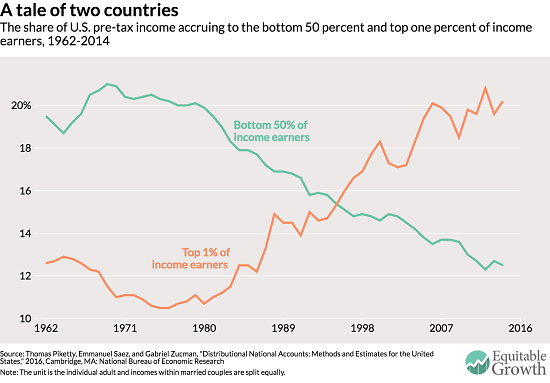
Labor’s share of the national income is in freefall as a direct result of the optimization of financialization. The money flows to those with the capital, credit and expertise to optimize financialized skims. As for selling one’s labor in an economy optimized for capital and the asymmetries of finance–there’s no premium for labor in such an economy, other than technical/managerial skills required by finance to exploit markets.
This is the driver of the rising income-wealth inequality this chart reveals:
This article appeared originally at Of Two Minds 08 September 2017.


