


by Rodger Malcolm Mitchell, www.nofica.com
Why would the middle classes agree to reduce such benefits as unemployment insurance, Social Security, Medicare, Medicaid, food stamps and other aids to the poor?

Many of those benefits aid the middle classes, yet they repeatedly vote to reduce them. They vote against their own interests, doing exactly what the rich want them to do. Why?
The Gap is the difference between the “haves” and the “have-nots,” the difference between the rich and the rest, the difference between the powerful and the powerless.
The income Gap has been growing for the past 45 years, partly because both political parties have convinced the voting public that benefit restriction is necessary:
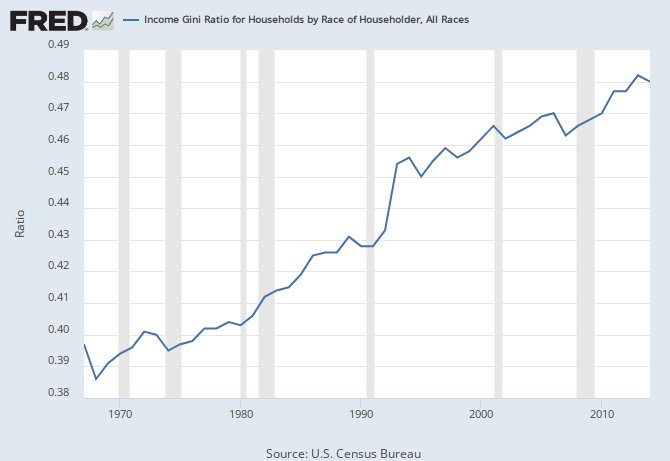
(The Gini ratio shows a Gap difference, with “0.000” meaning everyone has the same income and “1.000” meaning one person has all the income)
Although we speak of “the” Gap, there are, in fact, many Gaps. Not only is there a Wealth Gap, an Income Gap and a Power Gap, but there are Gaps between all levels.
For example, there is an Income Gap between the upper .1% income group and the 1% income group, and Gaps between every income group below.
There are Power Gaps between the President of the U.S. and any individual Congressperson, and the lay people below them.
There are salary Gaps, even among various employees in the same companies.
While every Gap has its own characteristics, a generalization can be made about all Gaps:
The occupants of each level wish to narrow the Gaps above themselves and to widen the Gaps below themselves.
The following article demonstrates this generality at play:
The $70,000 Minimum Wage Experiment Reveals A Dark Truth
Sam Becker, December 25, 2015
Earlier this year, a small Seattle-based payment processing company made headlines when its 31-year-old CEO made a rather jarring change to the company’s pay structure: Gravity Payments would pay all employees, at a bare minimum, $70,000 annually.
It was met with a variety of reactions, ranging from those who said CEO Dan Price was establishing himself as a working-class hero to those who thought he was actively destroying the fabric of society as we know it.
Price had read a study that said the optimal level of happiness can be achieved with an income at around $70,000, and decided that he was in a position to make a difference. So he acted on it – by cutting his own salary by 90%.
Now, with several months having passed, we’re beginning to see the fallout.
The company has lost a handful of clients, but it’s signed on even more – so many more that it’s had to go on a hiring spree.
The other unintended side effect of Price’s minimum wage policy has come from within the company.
According to reports, Gravity Payments lost two of their rock star employees, both who evidently thought it was unfair that other employees were getting big pay bumps, while not necessarily contributing as much to the company’s success.
Essentially, it rubbed them the wrong way that a receptionist was getting a huge raise, while not working harder than they were. They felt that the value of their skills had been diminished.
Said another way, the higher paid employees did not like the fact that the Income Gap between them and those below them had been narrowed. They looked upon the lower levels as being “inferior,” and did not want “inferior” people coming closer, physically, financially or in prestige.
This is comparable to the way the rich feel about the non-rich. “Keep your distance. If you come closer it diminishes our own status.”
We’re seeing similar sentiments pop up all over the country as calls for $15 minimum wages for fast food workers and others start to gain momentum. Basically, people don’t feel like someone who simply cooks fries, serves drinks, or parks cars should be paid that much.
The Gravity Payments employees who quit didn’t see their pay go down, or see a negative externality as a result of their coworkers’ wages going up. Yet, they were unhappy that their coworkers were better off.
It speaks to a certain psychological element that we see in many aspects of society – lots of people are only happy with success when it means that others around them are worse-off. It’s the view that the world is a zero-sum game, and that instead of everyone being better off, we need to have some losers.
The very rich – the .1% – make use of that psychology, by convincing the populace that those below them do not deserve help. Thus, the poor are portrayed by the rich as “lazy undeserving takers,” who if they receive welfare, would simply loll about and refuse to work.
Nevermind that the poor lead comparatively miserable lives, and few if any would prefer receiving welfare than receiving earned salaries. And nevermind that the working poor – the gardeners, car valets, house cleaners, waiters, fast food employees, factory workers, etc. – work harder and receive less for their efforts than do the rich.
The belief is widespread that the wealthy have earned their largess, while the poor have earned their misery. It is a belief disseminated by the rich and the people who have been bribed by the rich: The media, the politicians and the university economists.
Thus brainwashed, each level tends to vote against its own best interests, so long as those below are hurt more.
It also is a strange quirk of human psychology that the “good deed” of giving to charities benefitting those below seems satisfying, while allowing the government to do the same creates resentment.
NOTE to those who object to the government helping the poor and middle classes: Just know you are doing the dirty work of the rich at your own detriment.
That’s just “Gap dumb.”
THE RECESSION CLOCK
Recessions come only after the blue line drops below zero.
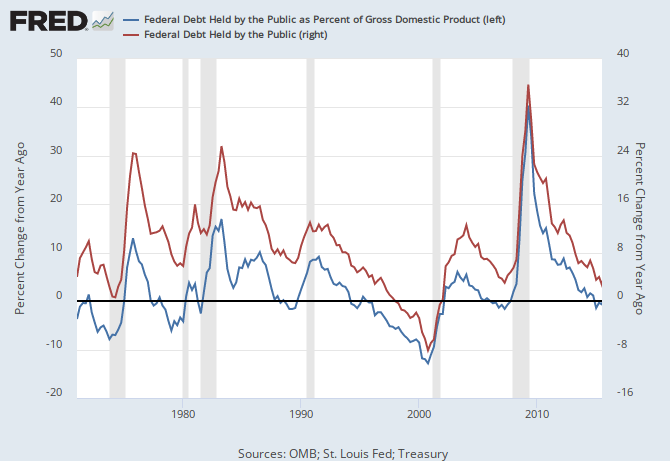
Vertical gray bars mark recessions.
As the federal deficit growth lines drop, we approach recession, which will be cured only when the growth lines rise. Increasing federal deficit growth (aka “stimulus”) is necessary for long-term economic growth.
Mitchell’s laws:
Those, who do not understand the differences between Monetary Sovereignty and monetary non-sovereignty, do not understand economics.
Any monetarily NON-sovereign government – be it city, county, state or nation – that runs an ongoing trade deficit, eventually will run out of money.
The more federal budgets are cut and taxes increased, the weaker an economy becomes..
Liberals think the purpose of government is to protect the poor and powerless from the rich and powerful. Conservatives think the purpose of government is to protect the rich and powerful from the poor and powerless.
The single most important problem in economics is the Gap between rich and the rest..
Austerity is the government’s method for widening the Gap between rich and poor.
Until the 99% understand the need for federal deficits, the upper 1% will rule.
Everything in economics devolves to motive, and the motive is the Gap between the rich and the rest..


