


Written by Gary
US stocks closed modestly higher in volatile late-afternoon trade (SPY +0.2%) as Fed minutes reveal uncertainty about future rate hikes.

The Market in Perspective
| Here are the headlines moving the markets. | |
 | Samsung announces folding phone with 5G at $1,980Samsung Electronics Co Ltd on Wednesday said it will release a folding smartphone in April that works with the next-generation 5G networks and will cost almost $2,000, a move to entice consumers to upgrade their phones. |
| Asia push, Wall Street support lift stocks; oil risesWorld stocks rose on Wednesday, hitting a four-month high on hopes for progress in trade talks between the United States and China, and a supportive backdrop from major central banks also helped push risk assets higher. |
| Microsoft says discovers hacking targeting democratic institutions in EuropeMicrosoft Corp on Wednesday said it had discovered cyber attacks directed at democratic institutions, think tanks and non-profit organizations in Europe and would offer a cyber security service to several countries to close security gaps. |
| Wall St. mostly edges up in volatile trade after Fed minutesU.S. stocks were mostly higher in volatile late-afternoon trade on Wednesday as the release of the Federal Reserve’s minutes from its January meeting showed policymakers thought pausing on U.S. interest rate hikes last month posed little risk. |
| CVS profit miss, rebate questions send shares tumbling 8 percentCVS Health Corp on Wednesday forecast 2019 profit well below Wall Street estimates due to weakness in its pharmacy business that serves long-term care facilities and slower than anticipated growth in drug prices, sending shares down 8 percent. |
| Canada to release federal budget on March 19: finance ministerThe Canadian government will unveil its budget for the 2019/20 fiscal year on March 19, Finance Minister Bill Morneau said on Wednesday. |
| Fed minutes leave questions on balance sheet, patienceFederal Reserve policymakers on Wednesday gave little sense of how long their “patient” stance on U.S. interest rate policy would last, and while promising “before too long” a plan for their $4 trillion balance sheet, left unclear what that plan would entail. |
| January FOMC minutes: Little risk in pauseFederal Reserve policymakers thought pausing on U.S. interest rate hikes last month posed little risk and plenty of benefit, minutes from their Jan. 29-30 meeting showed, giving them time to assess the effects of a global slowdown and the Fed’s rate hikes to date on U.S. economic momentum. |
| Oil settles 1 percent higher on hopes of market rebalance, trade dealCrude prices rose more than 1 percent on Wednesday to their highest level this year on hopes that oil markets will balance later this year, helped by output cuts from top producers as well as U.S. sanctions on OPEC members Iran and Venezuela. |
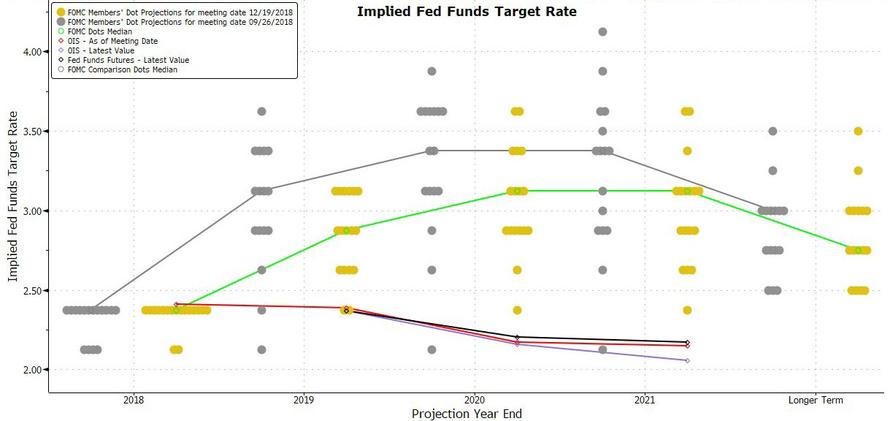
| Sleepy Stocks Drift As Fed Minutes Fail To Ignite Buying BoostThe market’s hopes that today’s snow-delayed Fed minutes would resolve the debate over the fate of the balance sheet unwind, were dashed with the Fed confirming what traders already knew: the Fed would remain patient, data dependent, focused on the fading inflation impulse, and would seek a plan for when the Fed’s balance sheet unwind would end by the end of 2019 suggesting that the QT may continue well into 2020 if not later, dependent on what the Fed concludes is a sufficient amount of required bank reserves. As Bloomberg notes, “small moves in stocks, bonds and FX as the Fed minutes portray a central bank that still sees a decent economy, slow-growing inflation, a tight labor market and an uncertain path for interest rates.” The Minutes punctuated another rather quiet session that saw economically-sensitive stocks such as steel makers, chemical and industrial companies outperform against a flat tape. Following the ambivalent minutes, rate hike expectations were broadly unchanged, with the Fed Funds still pricing in a rate cut in 2020 as the divergence with the Fed’s hawkish dots continues.
As a result, stocks ini … |
| Yesterday’s Perfect Recession Warnings May Be Failing YouSubmitted by Michael Lebowitz of 720 Global Recently, Wall Street and the Financial Media have brought much attention to the flattening and possible inversion of the U.S. Treasury yield curve. Given the fact that an inversion of the 2s/10s Treasury yield curve has predicted every recession over the last forty years, it is no wonder that the topic grows in stature as the difference between the 2-year Treasury yield and the 10-year Treasury yield approaches zero. Unfortunately, much of the discussion on the yield curve seems to over-emphasize whether or not the slope of the curve will invert. Waiting on this arbitrary event may cause investors to miss a very important recession signal. The Incentive to Lend A friend approaches you and asks for a loan. You are presented two options, lend her money for two years at 2% annually or for ten years at the same 2% annual rate. Later that day, another friend approaches you for a loan. This time you have the option of lending money for two years at 2% or for ten years at 6% annually. For the lender/investor in both cases, we will ignore inflation risk and assume the two borrowers are in similar financial circumstances. Given the options, you likely answered that if you were forced to lend in example one, it would be only for two years as lending for ten years produced no additional financial incentive to compensate for the additional eight years of risk. Keep in mind most of us would not lend for two years either due to the low-interest rate. In example two, you may have been incentivized by the higher ten-year interest rate the borrower was willing to pay you. In example one, the “yield curve” is flat at 2%. In example two it is considerably steeper as 10-year “yields” are 4% higher than 2-year yields. As portrayed, when investors are faced with a flat or inverted yield curve, their incentive to lend for longer terms is greatly dim … |
| US Supreme Court Rules To Limit States’ Ability To Seize Property, Impose FinesThe US Supreme Court ruled unanimously on Wednesday that the Excessive Fines Clause in the 8th Amendment applies to state and local governments. Announced in an opinion written by Justice Ruth Bader Ginsburg on her second day back on the bench following a December cancer surgery, the ruling limits states’ abilities to seize property and impose fines deemed excessive on citizens who break the law.
“For good reason, the protection against excessive fines has been a constant shield throughout Anglo-American history: Exorbitant tolls undermine other constitutional liberties,” wrote Ginsburg, as the court sided with Tyson Timbs of Marion Indiana, whose $42,000 Land Rover SUV was seized by the state following a guilty plea for selling $385 worth of heroin to an undercover detective. Following a plea bargain, Timbs was sentenced to a year of home detention followed by five years of probation, as well as $1,200 in fees. “Excessive fines can be used, for example, to retaliate against or chill the speech of … |
| Over At Last? AG Barr To Announce End Of Mueller Probe Next Week: CNNBarely a week after being sworn in as the head of the Justice Department, Attorney General William Barr is reportedly planning to announce as early as next week that Robert Mueller has completed his investigation and that a confidential report on Mueller’s findings will be submitted to Congress in the very near future. According to CNN, the preparations – which are in line with an NBC report from late last year that the Mueller report would be completed by the end of February – “are the clearest indication yet that Mueller is nearly done with his almost two-year investigation.” Barr has said that he wants to be as “transparent” as possible while being “consistent with the rules and the law.”
According to the law, Mueller must submit a “confidential” report to the AG after the investigation ends. But the rules don’t require it to be shared with Congress or the public (tho … |
| 30 January 2019 FOMC Meeting Minutes: Federal Funds Rate Future Increases Not Clear
The 30 January 2019 meeting statement presented the actions taken. This post covers the economic discussion during this FOMC meeting between the members (minutes were released today). An interesting quote:
|
| Outside the Box: Target-date funds are more expensive and less effective than this simple investment planSave yourself some money and headaches. |
| The Tell: This stock-market gauge just hit an all-time high — and that’s bad news for bearsOne widely used signal of the health of the stock market has hit an all-time high, setting the stage for a potentially further rally in U.S. equity benchmarks, say technical analyst. |
| In One Chart: Chances of a U.K. election in 2019 are on the rise as Brexit defections weaken May’s grip on powerChances of a U.K. election this year are on the rise, according to betting markets, after three lawmakers quit British Prime Minister Theresa May’s Conservative Party due to disagreements over Brexit. |

 — this post authored by Steven Hansen
Summary of Economic Releases this Week
Earnings Summary for Today
leading Stock Positions
Current Commodity Prices
Commodities are powered by Investing.com
Current Currency Crosses
The Forex Quotes are powered by Investing.com.
To contact me with questions, comments or constructive criticism is always encouraged and appreciated:


