


Written by Lance Roberts, Clarity Financial
While you may feel strongly about one party or the other when it comes to politics, it doesn’t matter much when it comes to your money.

Please share this article – Go to very top of page, right hand side, for social media buttons.
Such is particularly the case today.
“For the second election in a row, voters will cast ballots for the candidate they dislike less, not whose policies they like more.” – Lance Roberts, Real Investment Show
What the market already understands is with the parties more deeply divided than at any other single point in history; the likelihood of any policies getting passed is slim. (2017 was the latest data from a 2019 report. That gap is even larger currently as Social Media fuels the divide.)
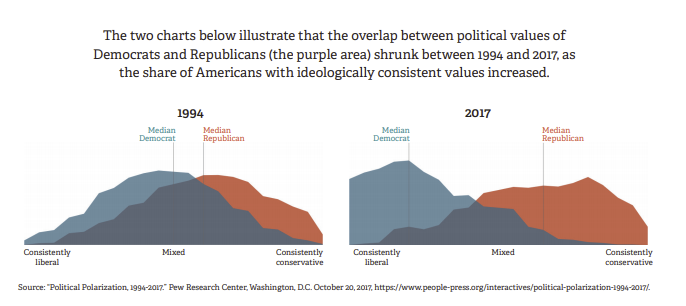
The one thing markets do seem to prefer – “political gridlock.”
“A split Congress historically has been better for stocks, which tend to like that one party doesn’t have too much sway. Stocks gained close to 30% in 1985, 2013 and 2019, all under a split Congress, according to LPL Financial. The average S&P 500 gain with a divided Congress was 17.2% while GDP growth averaged 2.8%.” – USA Today

It’s Not A Risk-Free Outcome
What we can derive from the data is the odds suggest the market will end this year on a positive note. However, such says little about next year. If you go back to our data table above, the 1st year of a new Presidential cycle is roughly a 50/50 outcome. It is also the lowest average return year going back to 1833.
Furthermore, from the election and 2021, outcomes are overly dependent on many things continuing to go “right.”
- Avoidance of a “double-dip” recession. (Without more Fiscal stimulus, this is a plausible risk.)
- The Fed continues expanding monetary policy. (There is currently no indication of this.)
- The consumer will need to expand their current debt-driven consumption. (This is a risk without more fiscal stimulus or sustainable economic growth.)
- There is a marked improvement in both corporate earnings and profitability. (This will likely be the case as mass layoffs will benefit bottom-line profitability. However, top-line sales remain at risk due to items #1 and #3.)
- A sharp improvement in employment, rising wages, and falling jobless claims will signal a sustainable economic recovery. (There is currently little indication this is the case outside the bounce from the March shutdown.)
These risks are all undoubtedly possible.
However, when combined with the longest-running bull market in history, high-valuations, and excessive speculation, the risks of something going wrong indeed have risen.
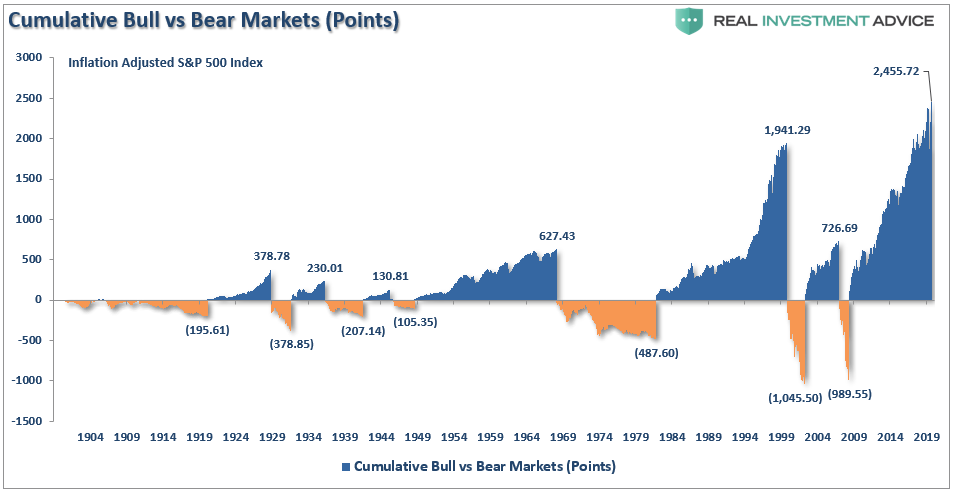
(While most financial media types present bull and bear markets in percentages, which is deceiving because a 100% gain and a 50% loss are the same thing, it worth noting what happens to investors by viewing cumulative point gains and losses. In every case, the majority of the previous point gain is lost during the full-market cycle.)
So, how do you position your portfolio into the election?
Portfolio Positioning For An Unknown Election Outcome
Over the last few weeks, we have repeatedly discussed the idea of reducing risk, hedging, and rebalancing portfolios. Part of this was undoubtedly due to the overly exuberant rise from the March lows and the potential for an unexpected election outcome. As we noted in “Tending The Garden“:
“Taking these actions has TWO specific benefits depending on what happens in the market next.
- If the market corrects, these actions clear out the ‘weeds’ and allow for protection of capital against a subsequent decline.
- If the market continues to rally, then the portfolio has been cleaned up and new positions can be added to participate in the next leg of the advance.
No one knows for sure where markets are headed in the next week, much less the next month, quarter, year, or five years. What we do know is not managing ‘risk’ to hedge against a decline is more detrimental to the achievement of long-term investment goals.”
That advice continues to play well in setting up your portfolio for the election. As we have laid out, the historical odds suggest that markets will rise regardless of the electoral outcome. However, those are averages. In 2000 and 2008, investors didn’t get the “average.”
Such is why it is always important to prepare for the unexpected. While you certainly wouldn’t speed down a freeway “blindfolded,” it makes little sense not to be prepared for an unexpected outcome.
Holding a little extra cash, increasing positioning in Treasury bonds, and adding some “value” to your portfolio will help reduce the risk of a sharp decline in the months ahead. Once the market signals an “all clear,” you can take “your foot off the brake,” and speed to your destination.
Of course, it never hurts to always “wear your seatbelt.”


