


Written by Lance Roberts, Clarity Financial
Such was a point I discussed with our RIAPRO Subscribers (30-day Risk-Free Trial) last week.

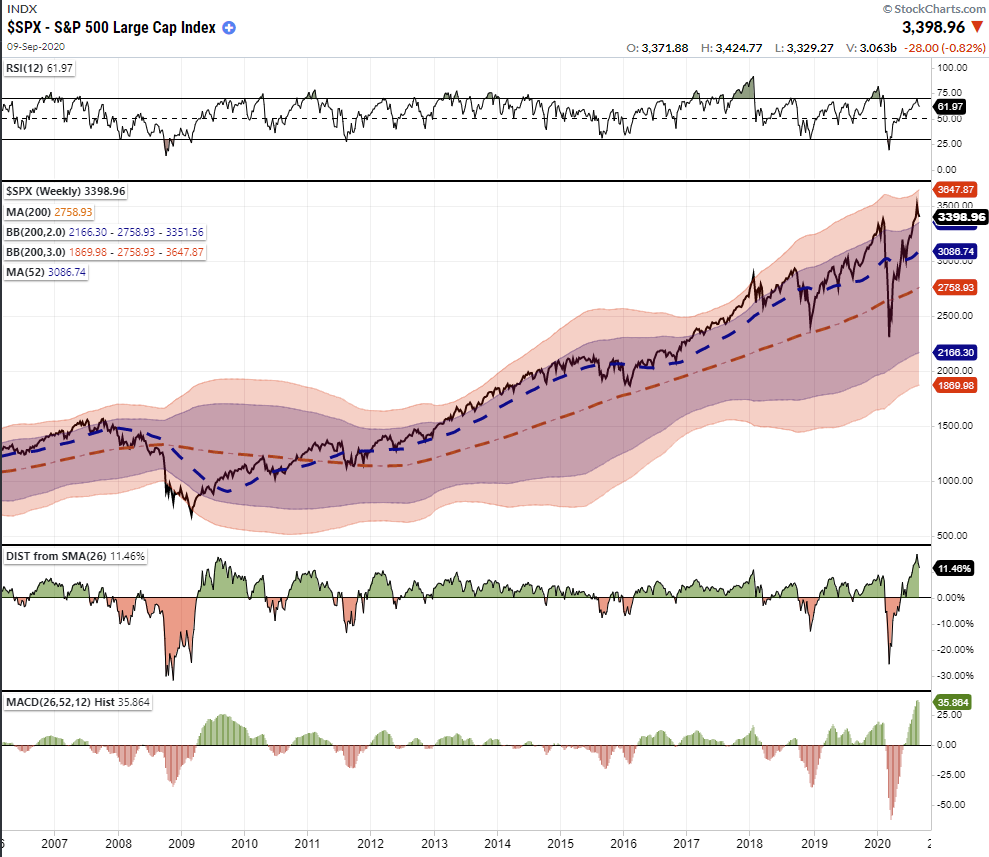
- On a weekly basis, the market backdrop remains much more bearish.
- The market is very extended, overbought, and deviated on an intermediate-term basis.
- The correction barely moved the needle of a market trading 3-standard deviations above the long-term moving average.
- Read “A Tale Of Two Bull Markets“ for more explanation and detail on this and other relevant charts.
- Remain patient. The odds are high that more downside risk remains if the economy begins to show signs of weakening again.
With the potential for a disruptive political election, weakening economic data, and a failure to garner more stimulus for households, the risks to earnings and growth have increased.
On a longer-term basis, the technical backdrop is also problematic.
Monthly
- First, from an investment standpoint, look at the last two bull market advances compared to the current Central Bank fueled surge. The present extension failed at the top of the rising upper-trend line forming a “megaphone” pattern.
- This pattern is more indicative of a market topping process, rather than a continuation pattern.
- Secondly, the market is trading MORE THAN 2-standard deviations above the long-term mean, which was ideal for a more considerable corrective decline.
- The good news, however, is that a monthly BUY signal did get triggered with the liquidity fueled advance. Usually, these signals are slow to turn. However, in recent years these signals are becoming more frequent due to the increased volatility.
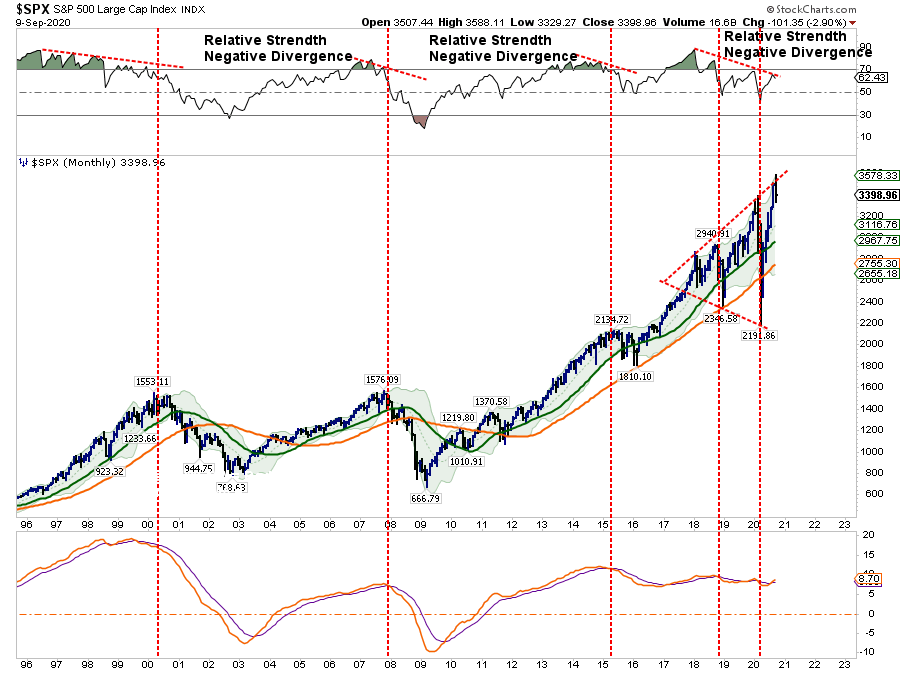
Importantly, MONTHLY data is ONLY valid at the end of the month. Therefore, these indicators are VERY SLOW to turn but do provide relevant analysis on price trends. However, this is why we use both Daily and Weekly charts to manage portfolio risk.
Portfolio Positioning
Over the last few week’s we have repeatedly discussed reducing risk, hedging, and rebalancing portfolios as we suspected this decline was a real possibility. As noted in “Tending The Garden“:
“Taking these actions has TWO specific benefits depending on what happens in the market next.
- If the market corrects, these actions clear out the “weeds” and allow for protection of capital against a subsequent decline.
- If the market continues to rally, then the portfolio has been cleaned up and new positions can be added to participate in the next leg of the advance.
No one knows for sure where markets are headed in the next week, much less the next month, quarter, year, or five years. What we do know is not managing ‘risk’ to hedge against a decline is more detrimental to the achievement of long-term investment goals.”
With the actions we have taken over the last few weeks, we now have some cash to deploy into assets that provide us our next opportunity.
Getting Back To Even
Such is the primary problem with “buy and hold” investing.
Riding markets up and down is okay to a point, but eventually, the market will decline and provide a real opportunity to buy assets at discounted prices. Unfortunately, since a “buy and hold” strategy never raised any cash, there is nothing to buy discounted assets with. Yes, eventually, the market will recover its losses, and portfolios will return to even. However, you can never recover the time lost. (You also don’t have 100+ years to invest.)
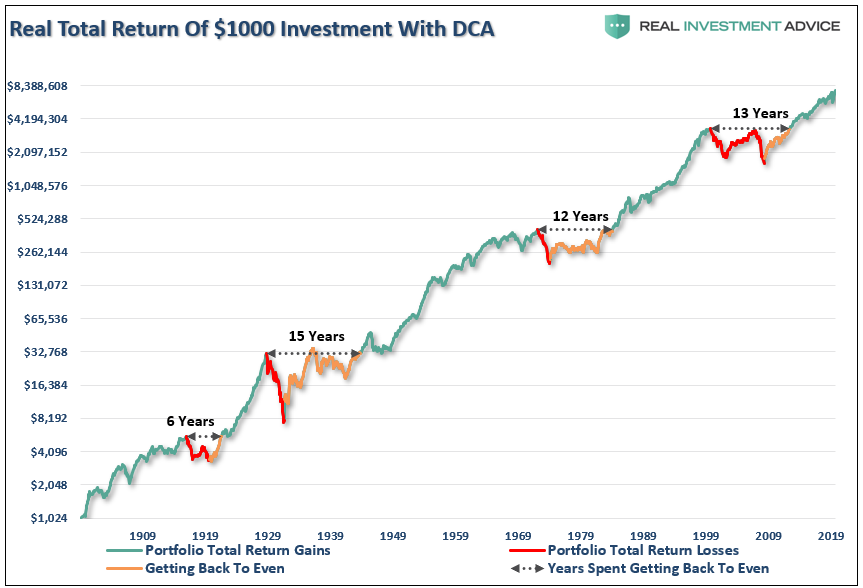
Such is why the primary rule of every great investor throughout history is to “buy low and sell high.” While it seems simple, it is incredibly hard to do, particularly when emotions overtake logic.
Currently, the “speculative frenzy” has engulfed the markets and the media. Such can last a lot longer than most expect, but it will eventually end.
Sometimes, the best investment strategy is knowing when to stop. Remember, no rule states you can’t play again tomorrow after a hot meal and a good night’s sleep.
.


