


Written by Lance Roberts, Clarity Financial
The bulls accomplished their task this week of pushing the S&P 500 index back to “all-time” highs.

“The S&P 500 set a new record high this week for the first time since Feb. 19, surging an eye-popping 51% from its March 23 closing low of 2,237 to a closing high of 3,389 on Tuesday. This represents the shortest bear market and third fastest bear-market recovery ever.” – Yahoo
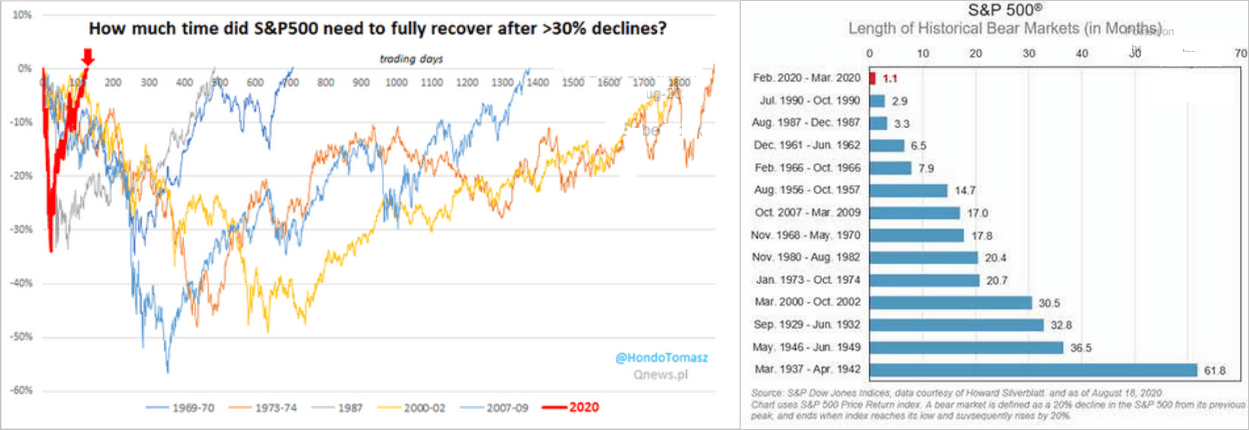
As we discuss in more detail in this week’s #MacroView (to be posted here tomorrow night), the claim is a bit faulty as March was not a bear market, but only a correction in the ongoing bull trend.
Nonetheless, in “Close, But No Cigar,” we suspected “new highs” were likely:
“With options expiring next week, the bulls are going to attempt to push markets up. A breakout to all-time highs is entirely possible. However, the question is whether they will be able to maintain it?”
The question of maintaining record highs is going to be the challenge over the next few weeks. Historically, the months prior to an election tend to be volatile, but with the market very overbought there is a risk of a normal correction.
“With the markets overbought on several measures, there is a downside risk heading into the end of the month. These risks come from several fronts we will discuss momentarily. However, from a technical perspective, the downside risk is about 5.6% to the 50-dma and 9.4% to the 200-dma.
Importantly, earnings season is now behind us and economic data is showing signs of deterioration along with the internals of the market. As we will discuss momentarily, after having been long-biased over the last couple of months, it is now likely time to “tend to the garden”
But first, let’s review some of the factors suggesting the “season may be changing.”
The Market Has “Bad Breadth”
One of our primary concerns relating to the current elevation in the market has been extremely narrow participation. As Bob Farrell once quipped:
“Markets are strongest when broad, and weakest when narrow.”
There is little doubt that markets reek of “bad breadth.” As shown below, the market has achieved new highs with only a small percentage of the S&P 500 index participating.
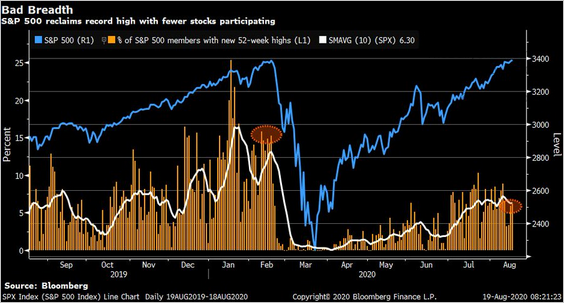
This “narrowness” is a result of the “passive indexing” effect on the markets which I explained in “Bulls Charge To All-Time Highs“:
“Currently, the top-5 S&P stocks by market capitalization (AAPL, AMZN, GOOG, FB, and MSFT) make up the same amount of the S&P 500 as the bottom 394 stocks. Those same five also comprise 26% of the index alone.”
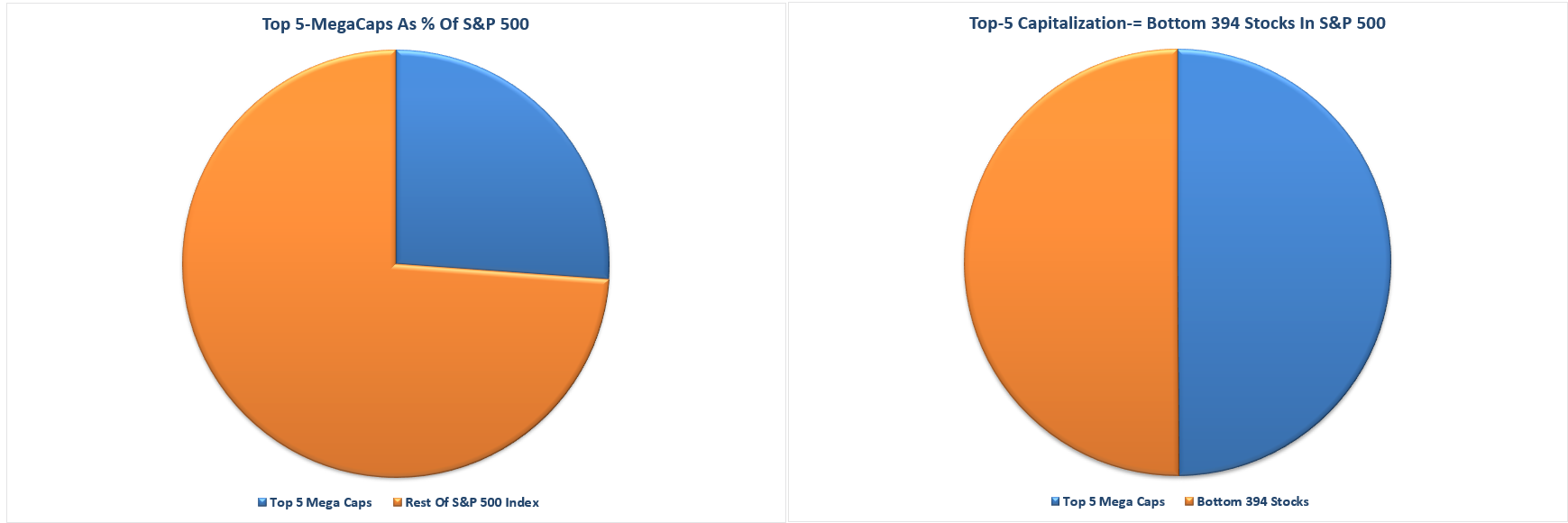
“What investors are missing is that the top-5 stocks are distorting the movements in the overall index.
For each $1 put into each of those top-5 stocks, the impact on the index is the same as putting $1 into each of the bottom 394 stocks. Such is clearly not a true representation of either the market or the economy.”
The two charts below show the problem a bit more clearly. Currently, the “Top-5″ and “Top-10″ stocks by market capitalization, are now near the largest percentage share since 1980. This far eclipses the “Dot.com” era.
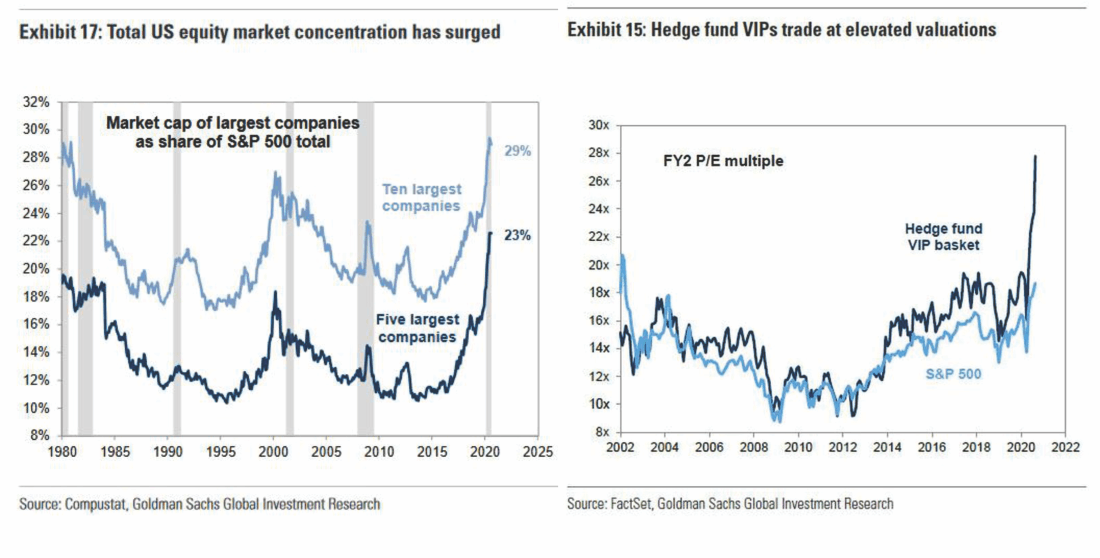
Furthermore, the “Top-50″ stocks owned by hedge funds (which include all of the Top-10 largest), are trading at astronomical values based on 2-YEAR forward estimates. This is occurring at a time where the advance-decline breadth on the Nasdaq stock market is deteriorating sharply.
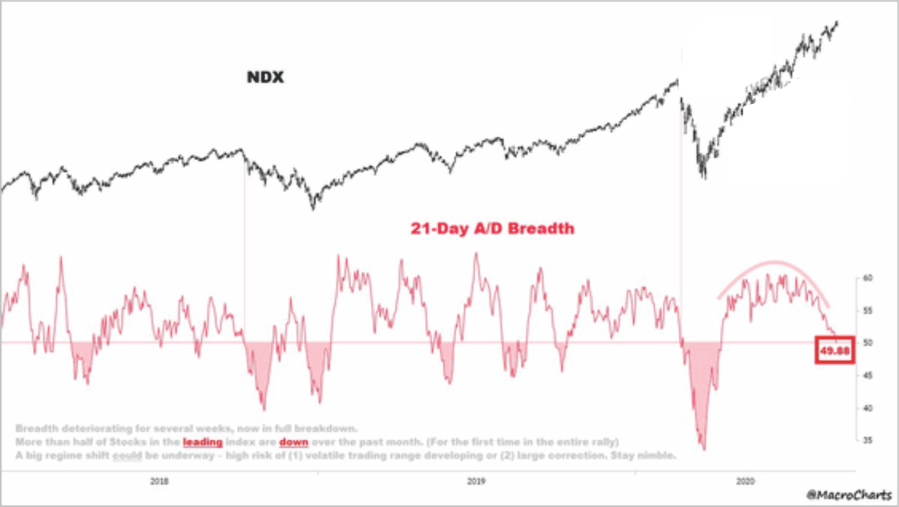
These are just some of the participation concerns. Investor exuberance has also reached extremes.
Signs Of Excessive Exuberance
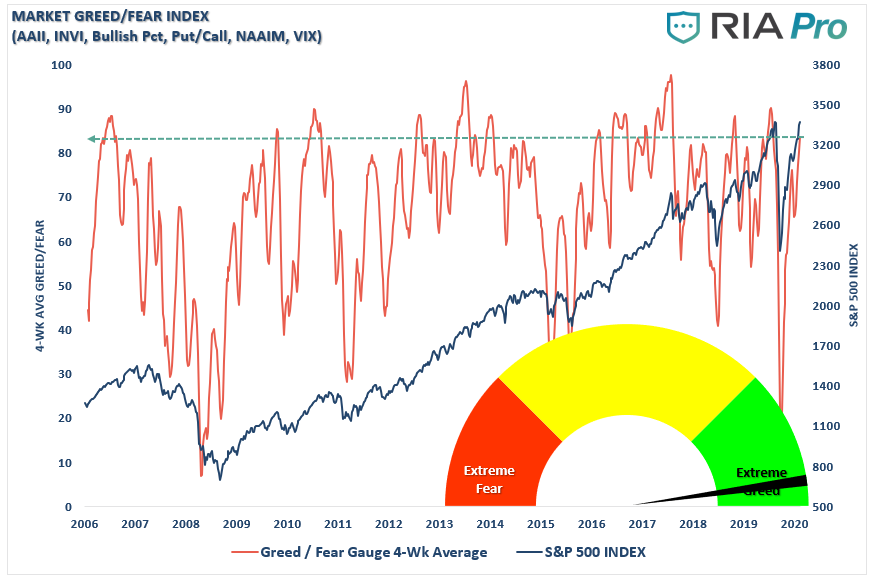
The RIAPro sentiment gauge, which is based on actual investor positioning, is back to more extreme levels. This gauge is different from the CNN gauge. The RIAPro gauge is based on how investors are “positioning” themselves in the market. In other words, rather than it being based on how investors “feel,” it is what they are “doing” in the market.
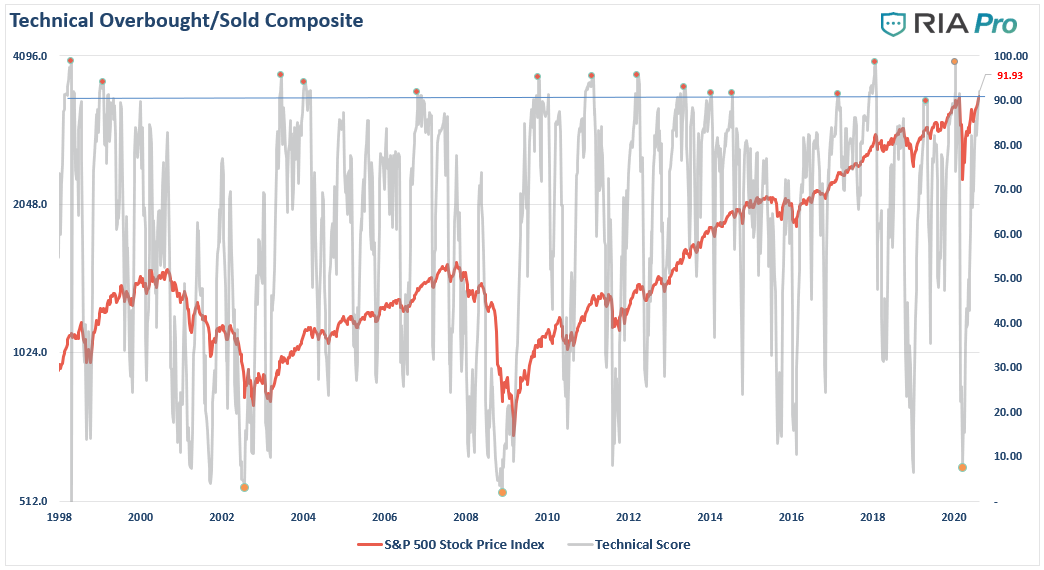
However, it isn’t just positioning that is at extremes. The RIAPro Technical Gauge (a weekly composite of technical measures) is also back to extreme levels. Such levels are historically coincident with short-term market corrections.
I also pulled a few charts from Sentiment Trader which are showing more extreme levels of optimism.
(Click to enlarge. Clockwise from top left: 1) Medium-term risk indicators, 2) Dumb money confidence, 3) Large call-option buyers, and 4) Small call-option buyers.
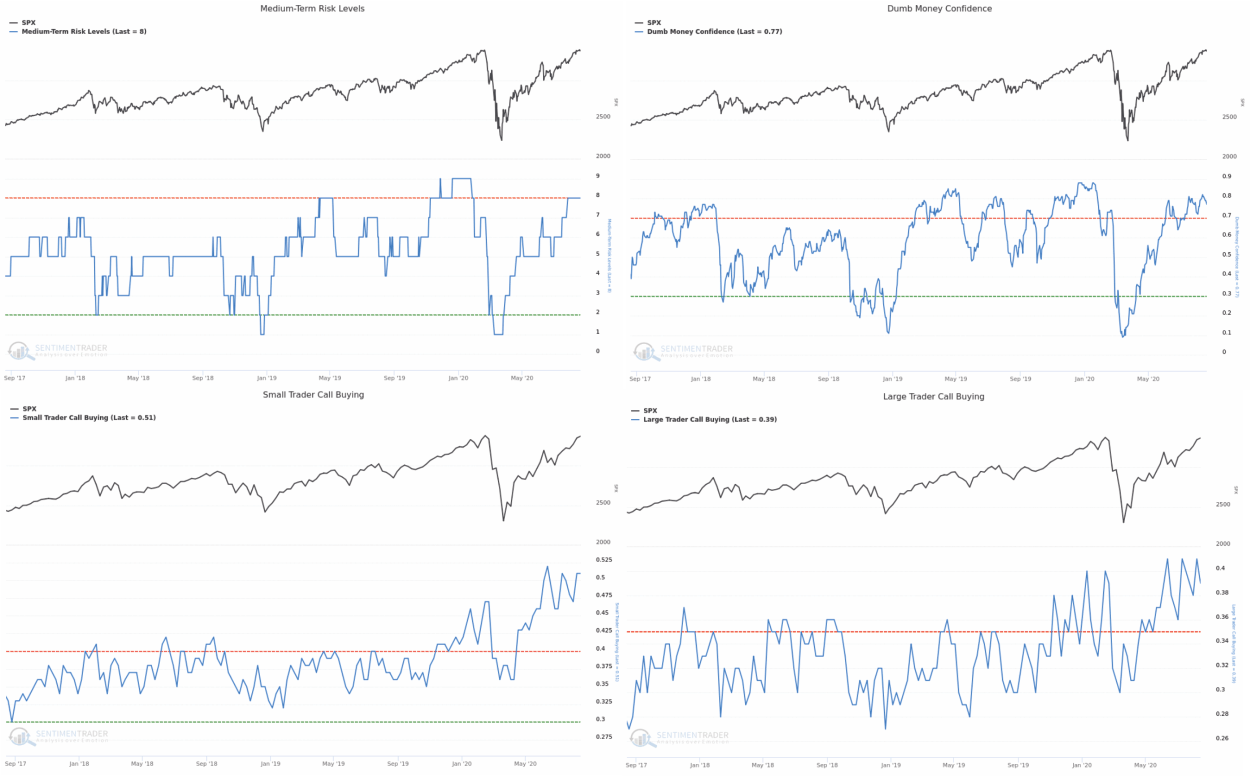
Historically, each of these indicators tends to align with short-term market corrections, or worse.
Given a large number of confirming indicators, this is why we have decided its time to “harvest” before “winter” approaches.
Why Investing Is Like Gardening
The biggest mistake that investors make over time is failing to manage investment risk. I have found over the years, the concept of “gardening” tends to resonate with individuals when it comes to portfolios management.
Investing has a lot of similarities to gardening. In the “Spring,” it is time to till the soil and plant your seeds for your summer crops. Of course, the ground must be watered and fertilized, and weeds pulled, otherwise the garden won’t grow. As the “Spring turns into Summer” it’s time to harvest the bounty the garden has produced and begin to rotate crops for the “Fall” cycle. Eventually, even those crops need to be harvested before the “Winter” snows set in.
Therefore, in order to have a successful and bountiful garden we must:
- Prepare the soil (accumulate enough cash to build a properly diversified allocation)
- Plant according to the season (build the allocation based on cycles)
- Water and fertilize (add cash regularly to the portfolio for buying opportunities)
- Weed (sell loser and laggards, weeds will eventually “choke” off the other plants)
- Harvest (take profits regularly otherwise “the bounty rots on the vine”)
- Plant again according to the season (add new investments at the right time)
Just like all things in life, everything has a “season” and a “cycle.” When it comes to the markets, the seasons are dictated by the “technical constructs” and the “cycles” are dictated by “valuations.“
Currently, as noted above, the “technical constructs” are warning us we are late into the “Fall” and “Winter” is approaching. This is why we are taking actions to “tend to our garden” now so that we will be prepared for the first “cold snap” of winter.
Tending The Portfolio Garden
Step 1) Clean Up Your Portfolio
- Tighten up stop-loss levels to current support levels for each position.
- Hedge portfolios against major market declines.
- Take profits in positions that have been big winners
- Sell laggards and losers
- Raise cash and rebalance portfolios to target weightings.
Step 2) Compare Your Portfolio Allocation To The Model Allocation.
- Determine areas requiring new or increased exposure.
- Calculate how many shares need to be purchased to fill allocation requirements.
- Determine cash requirements to make purchases.
- Re-examine portfolio to rebalance and raise sufficient cash for requirements.
- Determine entry price levels for each new position.
- Evaluate “stop-loss” levels for each position.
- Establish “sell/profit taking” levels for each position.
(Note: the primary rule of investing that should NEVER be broken is: “Never invest money without knowing where you are going to sell if you are wrong, and if you are right.”)
Step 3) Have positions ready to execute accordingly given the proper market set up. In this case, we are looking for positions that have either a “value” tilt or have pulled back to support and provide a lower-risk entry opportunity.
The Benefits Of A Healthy Garden
Taking these actions has TWO specific benefits depending on what happens in the market next.
- If the market corrects, these actions clear out the “weeds” and allow for protection of capital against a subsequent decline.
- If the market continues to rally, then the portfolio has been cleaned up and new positions can be added to participate in the next leg of the advance.
No one knows for sure where markets are headed in the next week, much less the next month, quarter, year, or five years. What we do know is not managing “risk” to hedge against a decline is more detrimental to the achievement of long-term investment goals.
Portfolio Positioning
With the analogy of gardening in mind, we have started to “tend to our garden” by harvesting some of the crops. The primary reason was the triggering of our “money flow” sell signal combined with longer-term overbought conditions. I discuss the concept in the video below.
(We publish “3-Minutes” Monday-Thursday. Click here to subscribe to our YouTube channel for email notification of all of our video postings and live-streams.)
In addition, a report we produce each week for our RIAPro Subscribers is a ” Risk Range” report which shows which sectors and markets are trading outside of their normal ranges, and are extremely deviated from short and long-term moving averages.
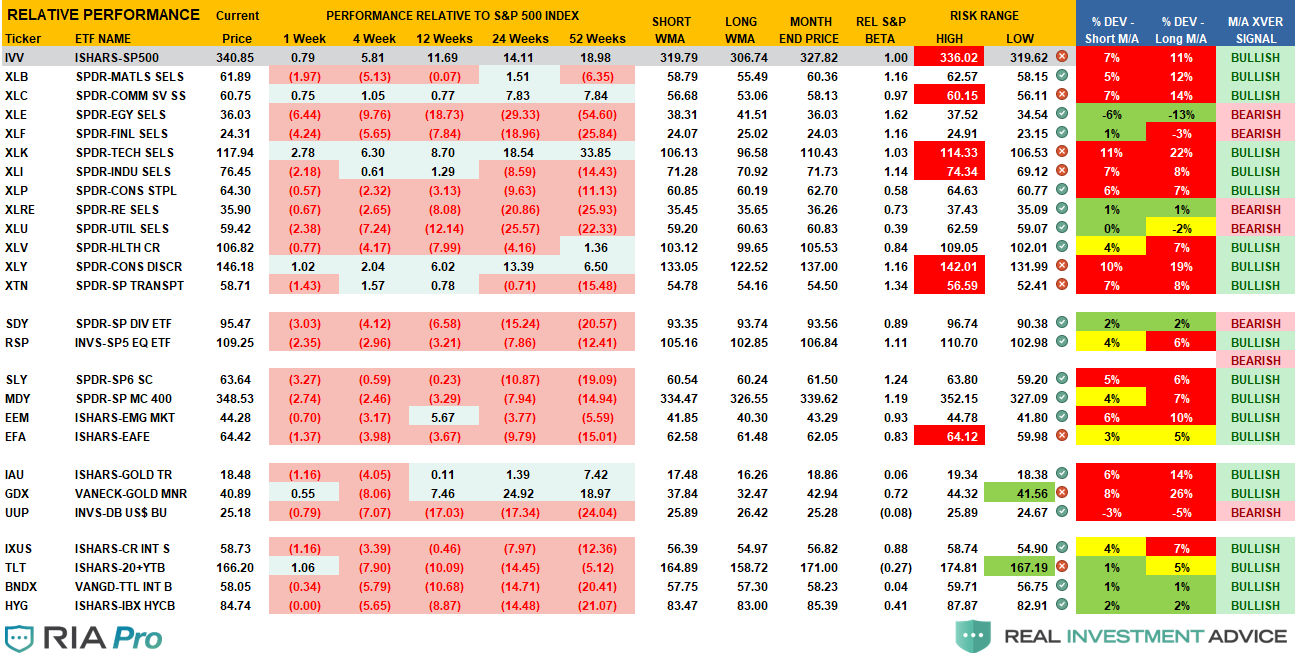
Consequently, given the more extreme short-term overbought conditions and deviations, the risk of a short-term reversion has risen. Therefore, we spent this past week harvesting some of our gains and planting a few seeds for our “Fall” garden.
Importantly, this does not mean we sold everything and went to cash. We continue to maintain our equity exposure to the markets. We are just reducing risk by “hedging around the edges,” adjusting our bond duration, and adding more “defensive” names to our equity allocation. Our analyst Nick Lane recently evaluated one of the recent positions we are slowly building exposure to.
(This is unlocked content reserved for RIAPro Subscribers. Try RISK-FREE for 30-days.)
Once the first “cold snap” washes across the markets, we will likely get more defensive and increase cash positions further.
In the short-term we certainly remain “bullish” on the markets as momentum is still in play. However, just as any farmer is keenly aware of the signs “Winter” is approaching, we are just taking some precautionary actions. If you wait for the “blizzard” to hit, it will be too late to make much difference.
.


