


Written by Lance Roberts, Clarity Financial
With the Fed once again engaged in QE, each “dip is bought” as “FOMO” continues to prevail. As the markets push higher, investors now believe the risk of recession is now gone.

Please share this article – Go to very top of page, right hand side, for social media buttons.
However, as I have noted previously, there is a vast difference between today and 2009 when the Fed first launched QE-1 namely trailing valuations were 13x versus 30x currently. Also, pretty much every other metric is reversed as well.
As I wrote in “QE – Then, Now, & Why It May Not Work:
If the market fell into a recession tomorrow, the Fed would be starting with roughly a $4 Trillion balance sheet with interest rates 2% lower than they were in 2009. In other words, the ability of the Fed to ‘bailout’ the markets today, is much more limited than it was in 2008.
However, there is more to the story than just the Fed’s balance sheet and funds rate. The entire backdrop is completely reversed. The table below compares a variety of financial and economic factors from 2009 to the present.”
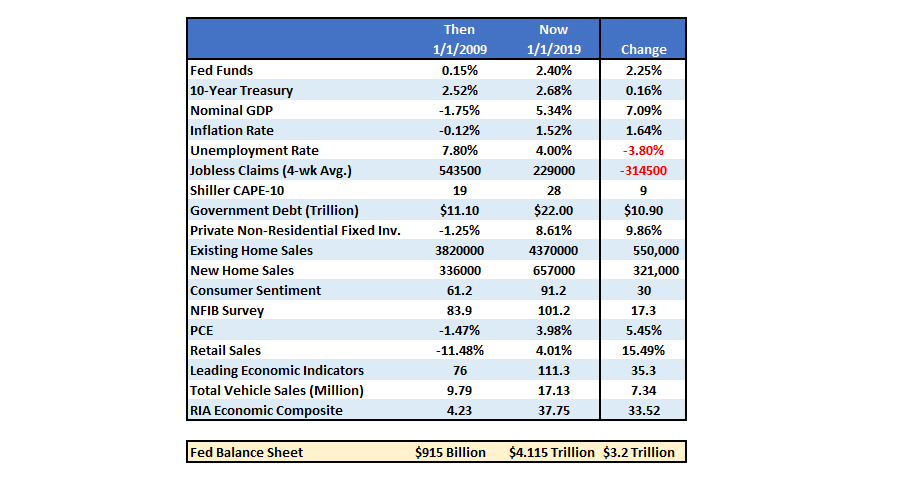
“The critical point here is that QE and rate reductions have the MOST effect when the economy, markets, and investors have been ‘blown out,’ deviations from the ‘norm’ are extended, and confidence is exceedingly negative.
In other words, there is nowhere to go but up.”
While such does not mean the market will crash tomorrow, next quarter, or next year, it does suggest that forward returns are likely going to become much harder to come by.
This is a point being dismissed by investors in the rush to chase markets higher. As we showed last week, investor sentiment swung from very “bearish” to “exceedingly bullish” in just a few short weeks.
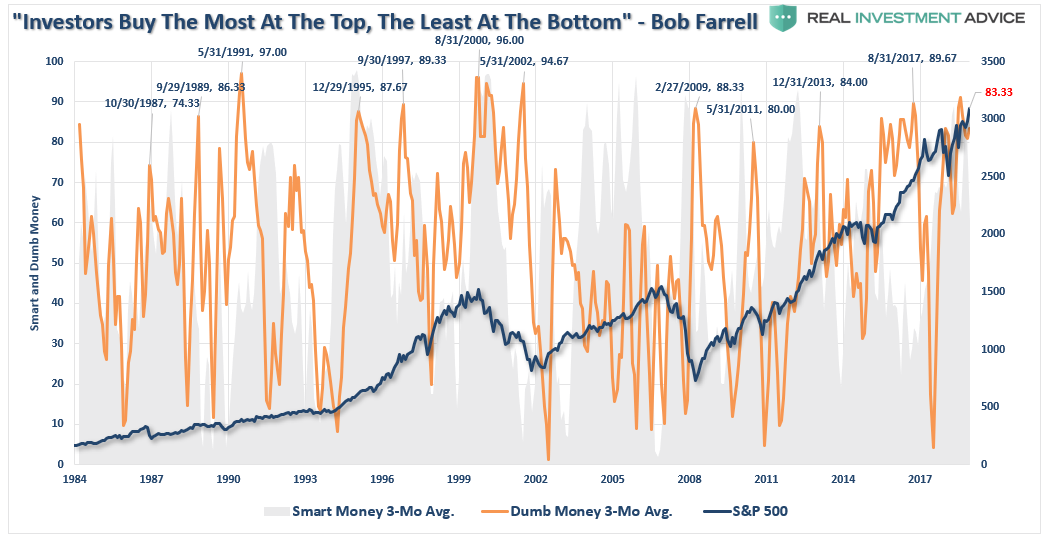
This surge should not be dismissed, as David Rosenberg noted this past week:
“Enjoy it while it lasts, but think of how artificial it all really is and how to prepare yourself, at these lofty price levels, for the reversal that is as inevitable as night following day and vice versa. The stock market surely remains on wheels and is being driven by concentrated gains in certain large-cap names and a major shift in economic sentiment, with views that a ‘phase one’ trade agreement is coming our way soon.”
The problem is that there is not a “major shift” coming for the economy, at least not yet, as shown by the readings from our Economic Output Composite Index (EOCI).
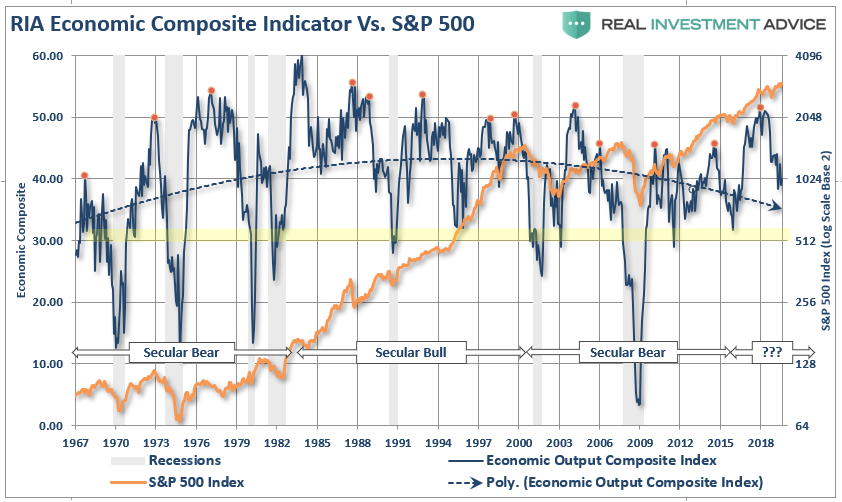
There are a couple of important points to note in this very long-term chart.
- Economic contractions tend to reverse fairly frequently from high peaks and those contractions tend to revert towards the 30-reading on the chart. Recessions are always present with sustained readings below the 30-level.
- The financial markets generally correct in price as weaker economic data weighs on market outlooks.
Currently, the EOCI index suggests there is more contraction to come in the coming months, which will likely weigh on asset prices as earnings estimates and outlooks are ratcheted down heading into 2020.
Again, this is a long-term indicator, but currently, the deviation between stock prices and economic growth is somewhat concerning. Throughout history, stock prices always, without exception, have “caught down” to the economic data and not vice-versa.
Furthermore, as we noted for our RIAPro Subscribers on Friday in our daily market commentary:
“The chart below shows that the year over year change in continued claims (new and old claims), turned positive for the first time in this economic expansion. Positive readings have preceded all prior recessions since at least 1970, but it’s not a full-proof indicator as there have been a number of false signals.”
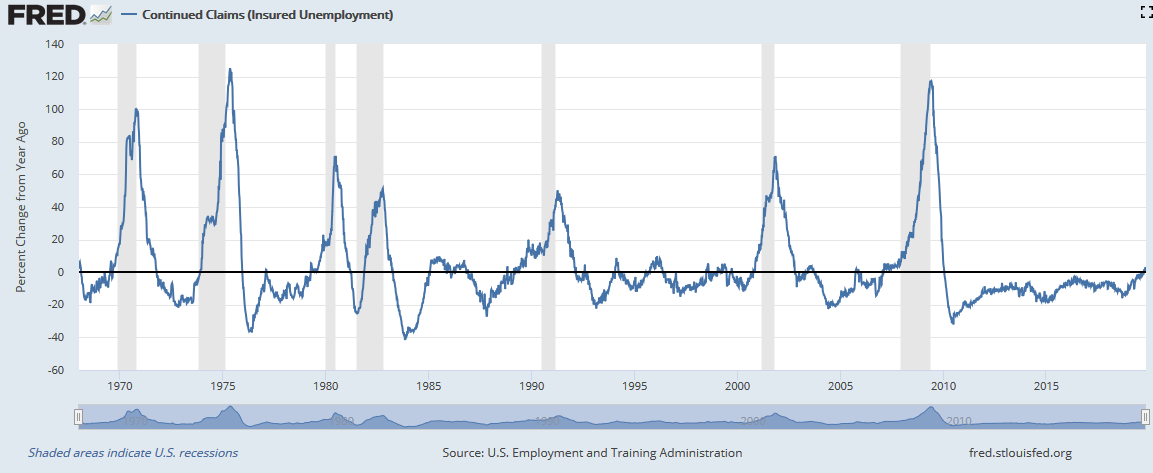
Furthermore:
“Leading Economic Indicators rose 0.3% year over year, which is the slowest rate of growth in a decade. The last 5 times the index went from positive to negative growth on a year over year basis resulted in four recessions (2008, 2001, 1990, and 1981) and one false signal (1996). On a monthly the basis the indicator was negative for the third month in a row. Since the data was first calculated in 1959, three consecutive monthly declines occurred 11 times and 7 of those 11, were followed by a recession within 6 months. Needless to say, this indicator is flashing a warning sign.”
If we overlay the 6-month average of the Leading Economic Index with our EOCI index we see clear warnings of potential recession risks heading into 2020.

The point here is that “risk” remains elevated, and when that “risk” is combined with investor “exuberance,” poor outcomes tend to occur. By the way, it’s not just individuals who are overly exuberant, but professionals as well. As David concluded:
“In barely more than a month, we have seen portfolio managers move from their highest cash levels and recession concerns in a decade to downright exuberance. The just-released [Bank of America Merrill Lynch] survey of institutional investors showed the biggest improvement in economic growth expectations in the year ahead since the poll began in 1994.”
This is purely “FOMO,” in action.
Where Does This Leave Our Hedges?
As noted last week, we hedged our long-equity positions with a short-market hedge. This was done in anticipation of a short-term correction due solely to the more extreme overbought technical conditions.
The correction this past week is likely not yet complete. Our short-term trading indicators are NOT oversold, but it is worth noting they are not as overbought as they were. This suggests the market could certainly muster a post-Thanksgiving rally.
Looking ahead, a subsequent pre-Christmas correction remains likely, particularly as the market drifts between one “trade deal” tweet, to the next.
For now, we continue to maintain our hedges as all of our indicators are still suggestive of a short-term reversal.
Longer-term, a deeper correction remains likely, particularly as we head into 2020. If economic and earnings data don’t begin to improve markedly, as currently expected by Wall Street, the current overvaluation of asset prices is going to become more problematic to justify.
If you need help or have questions, we are always glad to help. Just email me.
See you next week.
“NEW” – Financial Planning Corner
by Danny Ratliff, CFP
T-minus 14 days – it’s currently Medicare open enrollment time!
October 15th through December 7th is the time of year that current Medicare recipients can change their current Medicare Advantage plans, Part D (Prescription Plans) or switch between Original Medicare and Medicare Advantage (Part C) for the following year. Very similar to benefits period for those of you covered under an employer benefits plan, but with more options and potentially more consequential pitfalls.
Holistic financial planning and wealth management isn’t strictly about managing risk assets, but also helping you make good decisions that keep more money in your pocket.
According to Medicare Matters the average Medicare Part D recipient pays $300 more than someone who shops. Savings is only one reason to shop your Part D. Many Part D plans change annually and might not cover a prescription drug from one year to the next making your out of pocket costs go up exponentially.
It’s also a good idea to shop your Medicare Advantage or Medigap supplemental policy to ensure no major changes have occurred for the following year such as network changes for your primary care physician, premiums or other out of pocket costs.
Just like each season or holiday has a time so does the opportunity to switch to a better plan. Do yourself a favor and shop your plans. If you’re not on Medicare yet use this piece as a conversation starter at the dining room table on Thanksgiving. You never know who you might help. If you’re having trouble contact your advisor or use one of the helpful resources below. Good luck shopping your plans and we hope you have a Happy Thanksgiving with family and friends!
Here are a few trusted resources:
- The official US government website for Medicare.Visit Medicare.gov
- Find and compare Medicare Advantage and Prescription Drug plans. Visit Plan Finder
- Learn about the Affordable Care Act and find the insurance options available to you.
- The Medicare Rights Center and Medicare Matters National Council On Aging
- The Kaiser Family Foundation’s provides complete access to the Foundation’s reports, surveys, issue briefs, charts, slides and fact sheets containing in-depth analysis and the public’s views on timely and critical issues such as the growing number of uninsured, Medicare, Medicaid, rising health care costs and health reform.
Don’t hesitate to send me an email if you have any questions or if you, or someone you know, needs help. We encourage your feedback and look forward to hearing from you.
.


