


Written by Lance Roberts, Clarity Financial
Currently, our portfolios are long-biased meaning we have more equity-risk in our allocation than fixed income and cash.

Please share this article – Go to very top of page, right hand side, for social media buttons.
Given the market’s advance, and the data points set out above, and last week, we have three choices in how we manage our client portfolios at this juncture:
- Do Nothing – if the markets correct, we lose some of our gains and just have to wait for the portfolio to recover.
- Take Profits – as we have done with extremely overvalued assets in the past, we can take profits, raise cash, and reduce our equity exposure in advance of a correction. Such actions mitigate the damage of the decline, but positions have to be repurchased, or new ones added, to resize the portfolio in the future.
- Hedge – adding a position to the portfolio that is the “inverse” of the market. (the position goes up in value as the market declines.) This action allows us to keep our existing positions intact, and by “shorting against the portfolio” allows us to effectively reduce our equity risk (and related capital destruction) during a market correction.
Why did we choose “Option 3″ at this juncture?
Option 1 – is never really a good option. Riding the market up and down, and spending time “getting back to even,” doesn’t make a whole lot of sense.
Option 2 – is something that we took advantage of twice this year already. We took profits at the peak of the market in May and July before both of the subsequent swoons. We also added new exposures in early October. So, taking profits again in some positions would lead to a gross underweight in certain areas of the portfolio allocation.
This makes Option 3 the most optimal at this stage of the rally.
With the Fed engaged in pumping liquidity into the markets, and any day may also include a random market manipulation from a “Trump tweet,” the most opportunistic method to hedge risk is to add a “short S&P 500″ index position to the portfolio. The chart below shows the range of options which we expect could occur.
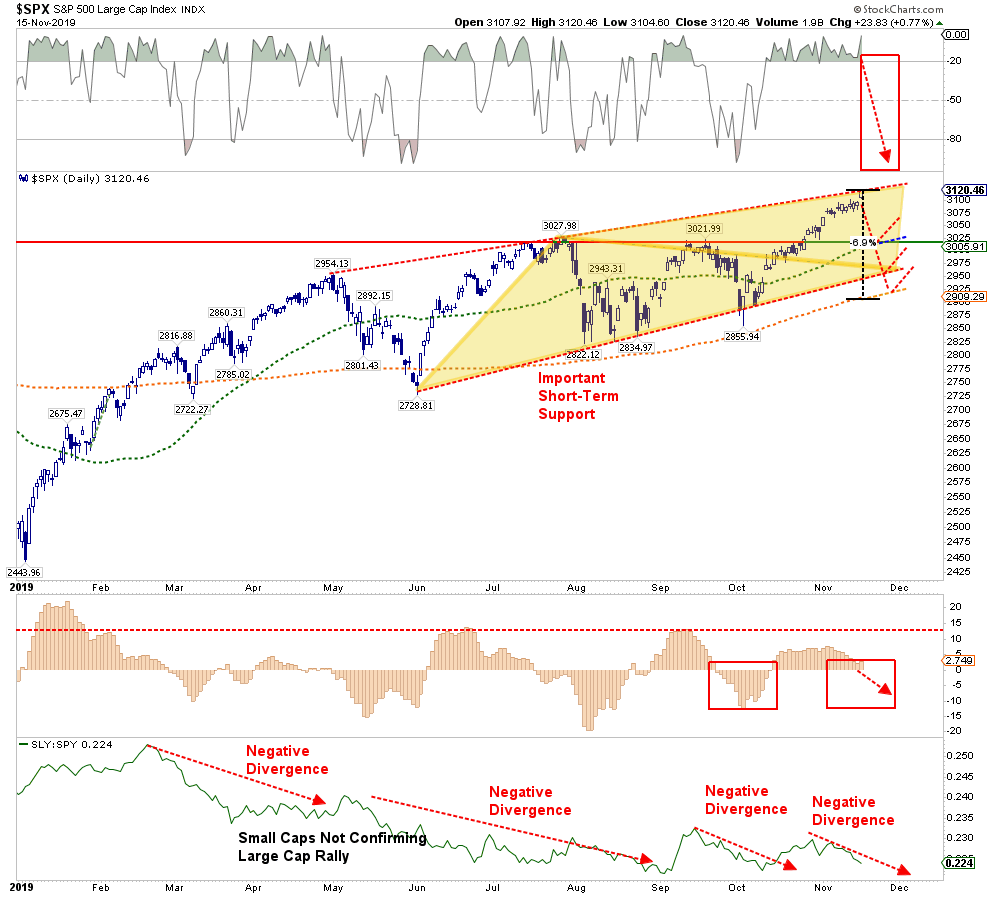
- Market breaks ABOVE the current upward trending range. We are currently carrying a stop at 3150 for our short position, where we will close it out. Yes, we will have a minimal loss in the position but the rest of our equity holdings will advance more than making up for the differential. (Example: On Friday, the S&P 500 increased .77%, our 60/40 Equity Portfolio with the Short Position rose by .46%)
- Market corrects to the currently rising 50-dma and in that process reverses the current overbought condition of the market (top panel, red box) back to oversold. Note: the 50-dma also currently coincides with the previous resistance of this year’s market highs. A retest of this level that holds, and removes the overbought condition as noted, would be very bullish. We will close out the hedge and increase our long-exposure.
- If the market breaks below the 50-dma, and is NOT oversold, the next level of support is the lower rising trendline. This is also important support, and a successful test that reverses the overbought condition would require a removal of hedges.
- The last support is the rising 200-dma. If the market test and holds the 200-dma, is oversold, and sentiment has returned to a more bearish position, we will close out our hedges.
- IF the market breaks below the 200-dma, we will likely be discussing the process of reducing long positions and increasing short-hedges.
Importantly, the range of corrections discussed only runs 3-6%, which is well within the normal confines of a bullish correction.
When we discuss hedging against risk, it is invariably taken that we have sold everything and are now betting on a market “crash.”
Such is hardly the case. We are simply taking prudent actions in the portfolio management process to reduce capital risk, and potentially add some incremental “alpha” to portfolios if a correction occurs.
This is just how we manage risk.
You have a choice to either manage risk, or ignore it.
The only problem is that ignoring risk has a long history of not working out very well.
If you need help or have questions, we are always glad to help. Just email me.
See you next week.
.


