


Written by Lance Roberts, Clarity Financial
Data Analysis Of The Market and Sectors For Traders

Please share this article – Go to very top of page, right hand side, for social media buttons.
S&P 500 Tear Sheet
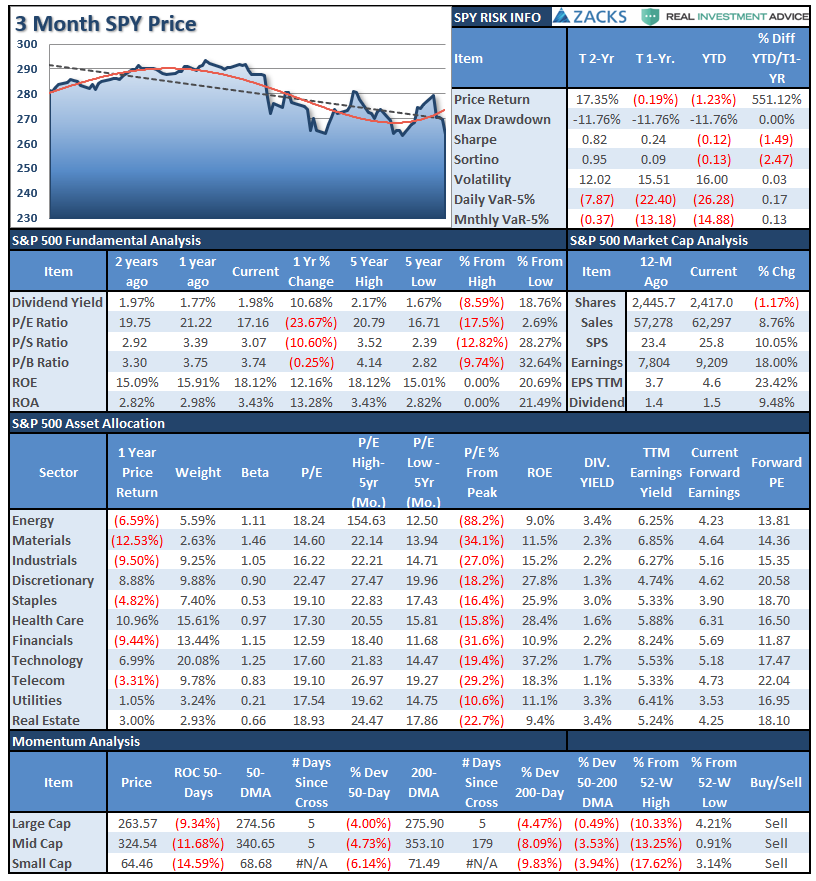
Performance Analysis

ETF Model Relative Performance Analysis

Sector & Market Analysis:
Sector-by-Sector

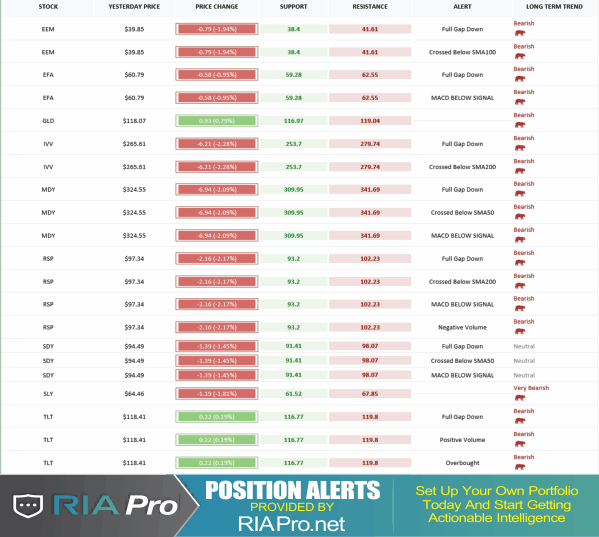
Discretionary and Technology The brief rally back above declining 50- and 200-dma averages failed last week confirming the continuing downtrend in these two sectors in particular. After having sold our positions previously, we will continue to sit on our hands until the current correction is complete. While not grossly oversold yet, I would suspect we could see a sellable short-term bounce next week.
Industrials, Materials, Energy, Financials, Communications – we are currently out of all of these sectors as the technical backdrop is much more bearish. With all of these sectors below their respective 50- and 200-dma’s, the downside pressure remains on for these sectors for now. The ongoing “trade war” and flattening yield curve is weighing on the outlook for these sectors. If you choose to be long these sectors it is advisable to reduce weightings markedly on rallies. As I have stated repeatedly over the last several months:
“Industrials, Materials, and Energy are representative of the broader economic activity in the U.S. and currently suggests we are seeing weakness on the horizon.”
Real Estate, Staples, Healthcare, and Utilities continue to be bright spots as “defensive” sectors. A warning, these are NOT safe sectors, they are defensive plays in a bull market. In a bear market, they will decline with the rest of the market, maybe just not as much. However, the dividend chase over the last several years has pushed valuations to extremes. We continue to remain long staples and healthcare specifically but the sell-off last week pushed both below their 50-dma. .Trends are still positive which may provide an opportunity to add to these sectors so we will re-evaluate again next week.

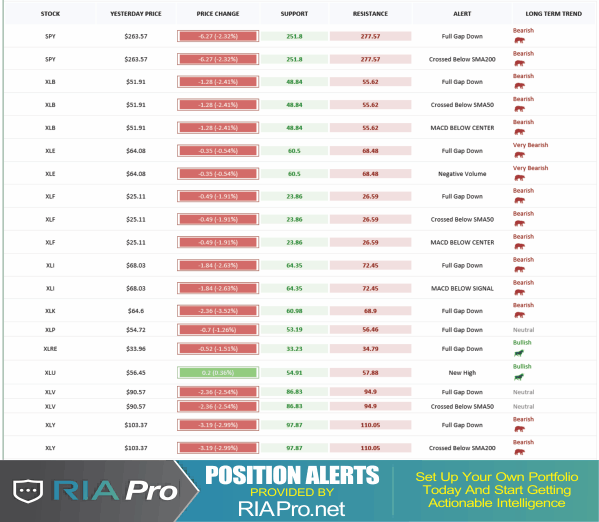
Small-Cap and Mid Cap – both of these markets are currently on macro-sell signals and the recent rally in both markets failed to get above technical resistance. As I noted last week:
“More importantly, the previous oversold condition is now gone and suggests lower prices are coming. Like Industrials and Materials above, Small and Mid-cap stocks are very economically sensitive and suggests a much weaker backdrop going into 2019. We remain out of these markets for now.”
Both of these markets are once again oversold. Small-caps broke their recent lows last week and Mid-caps are not far behind. As noted, we are out of these markets currently.
Emerging and International Markets – As noted last week:
“Emerging markets broke above its downward trending 50-dma last week and showed some signs of life. We have seen this before which ultimately led to lower lows.”
As suspected, emerging markets failed to hold above the 50-dma last week and is threatening to break the recent series of higher bottoms. A move lower next week is possible.
International markets still look terrible and no improvement is being made there just yet. With major sell signals in place currently, there is still no compelling reason to add either of these markets to portfolios at this time.
Dividends, Market, and Equal Weight – Not surprisingly, given the rotation to “defensive” positioning in the market, dividend-based S&P Index is outperforming other weighting structures. All three sold off last week as downward pressure was broad-based across all sectors. The overall market dynamic remains negative for now and important supports are being tested.
Gold – As we noted last week, while Gold remains in a downtrend, the good news is the price continues to hug along the 50-dma which has turned up. This market volatility this past week, gave gold the boost it needs to make a run for the declining 200-dma. With Gold very overbought short-term look for a pullback next week to the $115-116 area to add trading positions to portfolios with a tight stop at $112.
Bonds – continued to perform better last week and after a successful retest of the 50-dma have turned higher and broke above the 200-dma. Currently, bonds are very overbought which likely suggests a pullback is coming which would coincide with a rally in the stock market. However, such a pullback will likely provide a good buying opportunity as evidence of broader economic weakness continues to mount. We remain long our core bond holdings for capital preservation purposes and will look for a trading opportunity which does not violate the 200-dma.
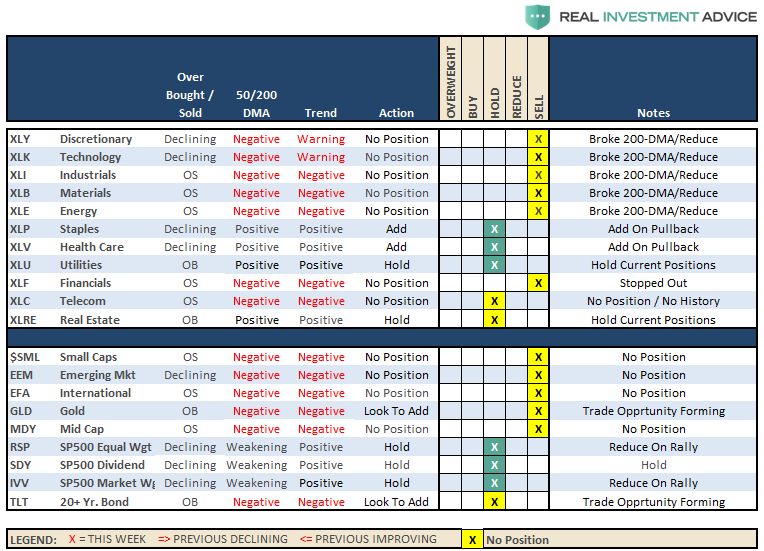
The table below shows thoughts on specific actions related to the current market environment.
(These are not recommendations or solicitations to take any action. This is for informational purposes only related to market extremes and contrarian positioning within portfolios. Use at your own risk and peril.)
Portfolio/Client Update:
As noted last week, the market action remains troubling, to say the least. The bullish trend longer-term remains intact, but more bearish dynamics continue to mount. We continue to sit on our hands with current positions and overweights in both cash and fixed income.
With the longer-term bullish trend intact, and multiple supports at current levels, it is not yet viable to short the broader market. That time will come, but shorting has capital risk just like being long. Given the recent uncertainty of the market, the best “hedge” remains cash for now.
While we expect a rally next week from short-term oversold conditions, we will remain on hold with any actions.
- New clients: We will continue to hold existing positions and sell “out of model” holdings on rallies.
- Equity Model: We will continue to hold current positions which are mostly 1/2 weights. Stops have been dramatically tightened up.
- Equity/ETF blended – Same as with the equity model.
- ETF Model: We will hold current holdings for now.
Again, we are moving cautiously. There is mounting evidence of short to intermediate-term risk of which we are very aware. However, with the market moving into the seasonally strong period of the year, we realize that short-term performance is just as important as the long-term. It is always a challenge to marry both.
It is important to understand that when we add to our equity allocations, ALL purchases are initially “trades” that can, and will, be closed out quickly if they fail to work as anticipated. This is why we “step” into positions initially. Once a “trade” begins to work as anticipated, it is then brought to the appropriate portfolio weight and becomes a long-term investment. We will unwind these actions either by reducing, selling, or hedging, if the market environment changes for the worse.
.


