


Written by Lance Roberts, Clarity Financial
Over the last couple of weeks, as interest rates surged above 3%, we explored the question of whether something had “just broken” in the market.

Please share this article – Go to very top of page, right hand side, for social media buttons.
- Did Something Just Break? (10/09/18)
- Something Did Break (10/15/18)
This is an important question given the current stance by the Fed appears to be considerably hawkish as noted by the recent minutes:
A Number of Officials Saw Need to Hike Above Long-Run Level
“A few participants expected that policy would need to become modestly restrictive for a time and a number judged that it would be necessary to temporarily raise the federal funds rate above their assessments of its longer-run level.”
The Fed is worried about asset bubbles…
“Some participants commented about the continued growth in leveraged loans, the loosening of terms and standards on these loans, or the growth of this activity in the nonbank sector as reasons to remain mindful of vulnerabilities and possible risks to financial stability.”
In other words, the Fed is “gonna hike until something breaks” and it will likely break in a credit related area like junk bonds, covenant-light, and leveraged loans.
Important note: It won’t be one, or another, but all of them at once when “something breaks.”
As noted by Bloomberg:
“The total of outstanding U.S. dollar leveraged loans has hit $1.27 trillion, according to data compiled by Bloomberg, overtaking high-yield bonds in the past week to cement their status as the go-to financing source for speculative-grade companies. October is on course for the highest issuance since June, while junk bond sales are the slowest since 2009.”
“For regulators at the BIS – sometimes called the central bank for central banks – a boom in leveraged loans often presages a bust in the wider economy. The market is ‘particularly procyclical,’ according to the report, and it rose faster than high-yield bonds in the run-up to the global financial crisis.”
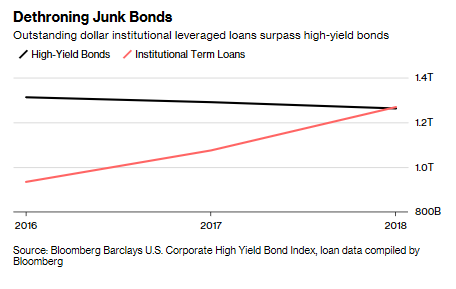
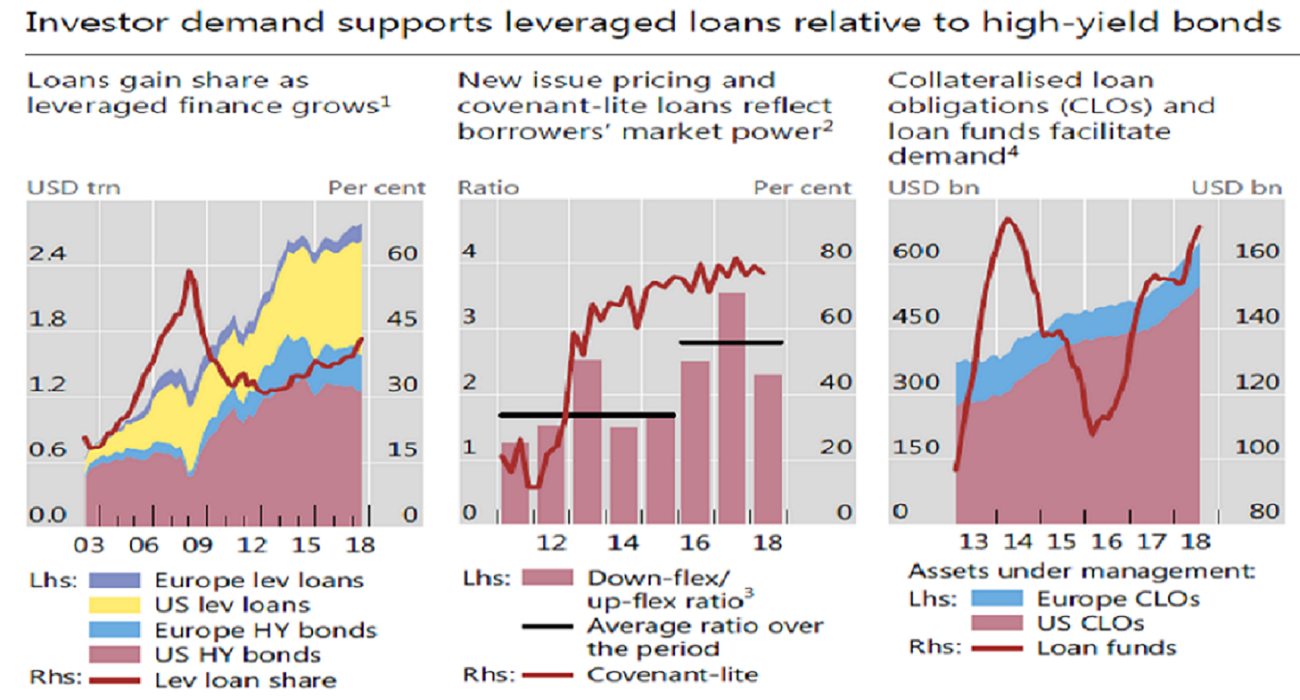
With substantially weaker loan documentation, accelerating demand for CLO’s (collateralized loan obligations), and a proliferation of covenant-lite loans, the risk to the next “financial crisis” has risen markedly given the massive surge in debt due to an extended period of ultra-low interest rates.
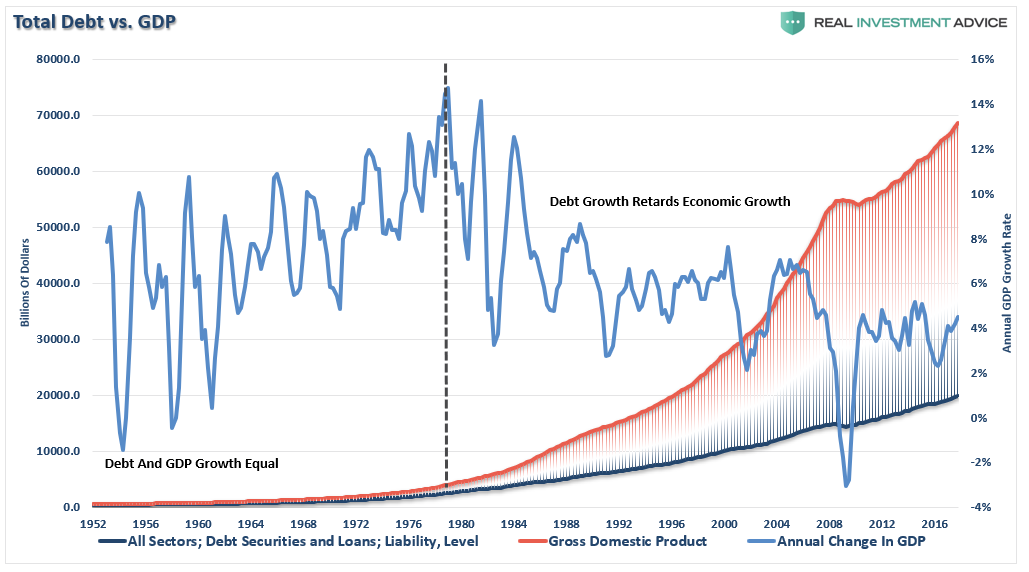
Of course, with the Fed hiking interest rates, which is pushing debt servicing costs higher, it is only a function of time until the rate of change in interest rates causes a financial decoupling in heavily levered companies with marginal balance sheets and debt servicing capacity.

Pay attention to the warnings the credit market is sending.
Clinging To Support
The market may already be sniffing out an impending problem. I noted last week that if interest “rates remain above 3%, stocks are going to continue to struggle.”
This past week has been a decidedly tough struggle for stocks to pick themselves up after last week’s drubbing. While we saw a sharp reflexive bounce earlier this week, that bounce quickly faded as stocks returned to retest support at critically important levels.
The chart below is the updated “pathway” chart from last week. I have only updated the price on the chart again this week but did NOT change any of the previously detailed paths set out last week.
Chart updated through Friday – pathways remain unchanged
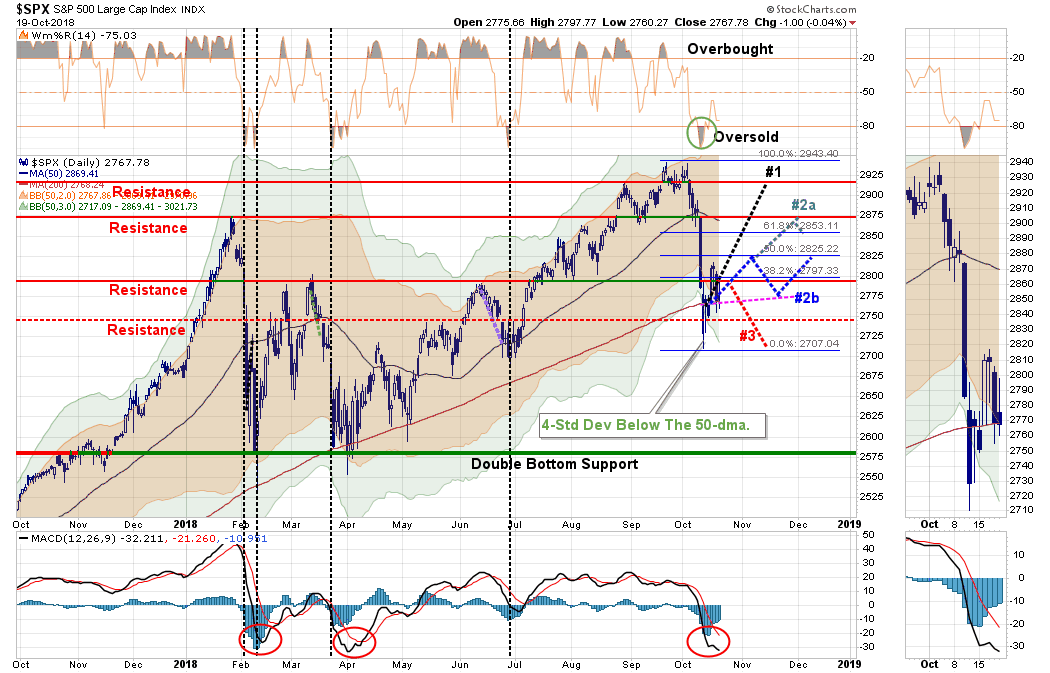
As I wrote, no matter how many different paths I trace out, the possibilities of the market rallying back to new all-time highs this year have been greatly reduced. Therefore, all four possibilities continue to suggest a broader topping pattern in place through the end of this year.
The good news, if you want to call it that, is the market DID hold the 200-dma for the week. With the market deeply oversold currently, we still expect a bounce going into next week. This bounce could well be supported by the end of the “blackout” period for companies to buy back their own shares.
Also, note that back in early February we saw a similar short-term bottoming process where the initial bounce failed then bounced in mid-March before failing again to retest the February lows.
My suspicion is that we will likely see much of the same action over the next month or so. Currently, pathway #2a and #2b are still the most likely outcomes currently and should be used to “sell into” to raise capital, deploy portfolio hedges, raise stop levels, and reduce risk.
Pathway #2a: The market rallies from current levels to the January high. Again, this would likely be fueled by a stronger than expected earnings season and a pickup in economic activity. However, the run to the January highs is capped by that resistance but the market finds support at the 62% Fibonacci retracement level just below. (30%)
Pathway #2b: The most feasible rally from current oversold levels is back to the 50% Fibonacci retracement of the recent decline. The market gets back to very overbought conditions and the market begins to trade between the 200-dma and/or the 32% Fibonacci retracement level. (30%)
However, the risk of Pathway #3 becoming a reality has also risen markedly during this past week. But given the deep short-term oversold condition, we are due for a fairly strong bounce first.
With the understanding the economic and fundamental background may not be supportive for higher asset prices heading into 2019, it is important to note the market is sending a very different technical signal this time. As discussed last week, this is the FIRST time the market has broken the bullish trend line that began in 2016.
Importantly, the market surge last week tested, and failed, at the previous rising bullish trend line. While the market is still holding important support this past week, the deterioration in momentum is warning of a potentially larger correction process in the making.
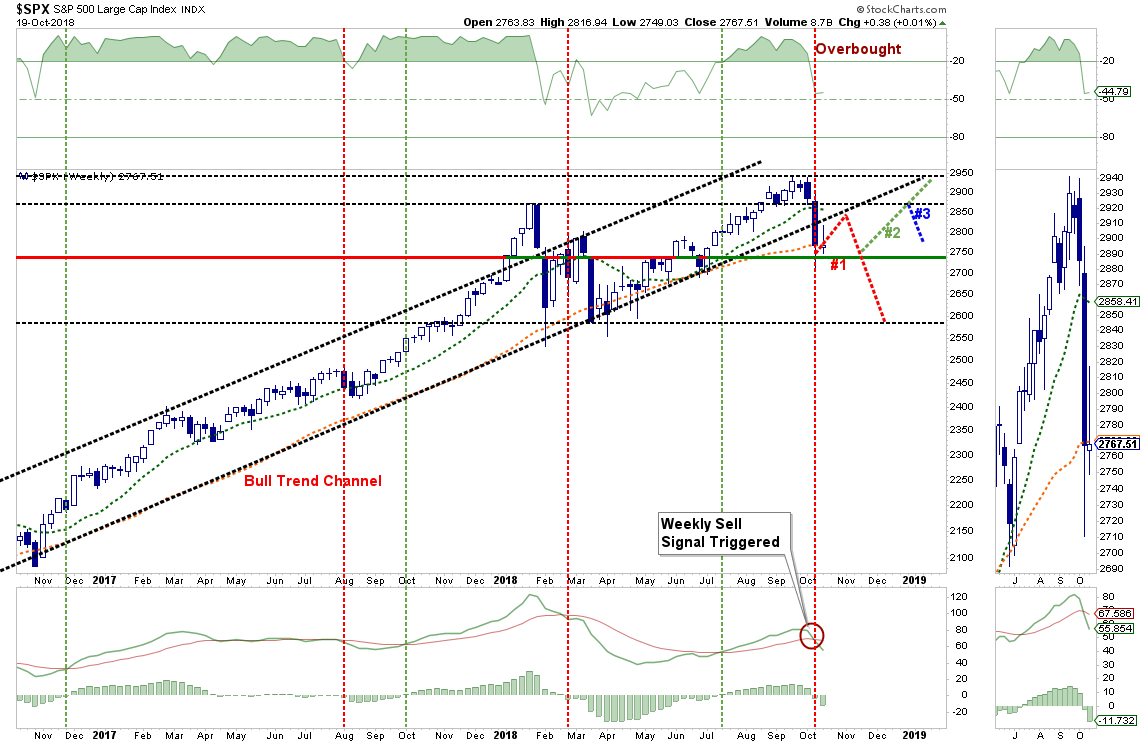
With an early “sell signal” intact, the warnings to reduce portfolio risk could not be more prevalent.
Importantly, we should not react emotionally to these issues but be opportunistic about making changes. With the “blackout” period ending, earnings season in full swing, and a deeply oversold market – the likelihood of a substantial rally is a very real possibility. However, just because the market rallies, does NOT mean the problems are solved and the “bull market” is back in full swing. Only new “all time” highs would signal the return of the “bull market” and given the current technical, fundamental, and economic backdrop such is only a faint possibility.
Actions To Take Next Week
With the market still 3-standard deviations below the 50-dma and very oversold technically, we still suspect a fairly strong bounce to sell into next week. Portfolio management processes should be switched from “buying dips” to “selling rallies” until the technical backdrop changes.
The actions remain the same as this past week and the actions we will specifically be taking on a rally.
- Re-evaluating overall portfolio exposures. It is highly likely that equity allocations have gotten out of tolerance from the original allocation models. We will also look to reduce overall allocation models from 60/40 to 50/50 or less.
- Look to add bond exposure to mitigate volatility risk. (Read: The Upcoming Bond Bull Market)
- Use rallies to raise cash as needed. (Cash is a risk-free portfolio hedge)
- Review all positions (Sell losers/trim winners)
- Look for opportunities in other markets (Gold may finally shine)
- Add hedges to portfolios (If the market begins to show a negative trend we will add short positions)
- Trade opportunistically (There are always rotations that can be taken advantage of)
- Drastically tighten up stop losses. (We had previously given stop losses a bit of leeway as long as the bull market trend was intact. Such is no longer the case.)
If I am right, the conservative stance and hedges in portfolios will protect capital in the short-term. The reduced volatility allows for a logical approach to further adjustments as the correction becomes more apparent. (The goal is not to be forced into a “panic selling” situation.)
If I am wrong, and the bull market resumes, we simply remove hedges, and reallocate equity exposure.
As investors, we have to prepare for the storm BEFORE it hits, and there are definitely storm clouds on the horizon. This was a point J.C. Parets noted last week:
“In my opinion, we are in a stock market environment where a crash is entirely possible. Now, just because it is possible doesn’t mean it will come. I think of it like the city of Miami, where I grew up, during hurricane season. Just because it’s the season doesn’t guarantee that a storm will come, but it is absolutely the time to be aware that one can show up and destroy your home or even kill you if you’re not prepared.
Hurricanes don’t hit Miami in February and stock market crashes aren’t sparked from all-time highs. It’s more of a process. The thing is, the ingredients for a market crash are absolutely starting to appear”
.


