


Written by Lance Roberts, Clarity Financial
Data Analysis Of The Market and Sectors For Traders

Please share this article – Go to very top of page, right hand side, for social media buttons.
S&P 500 Tear Sheet
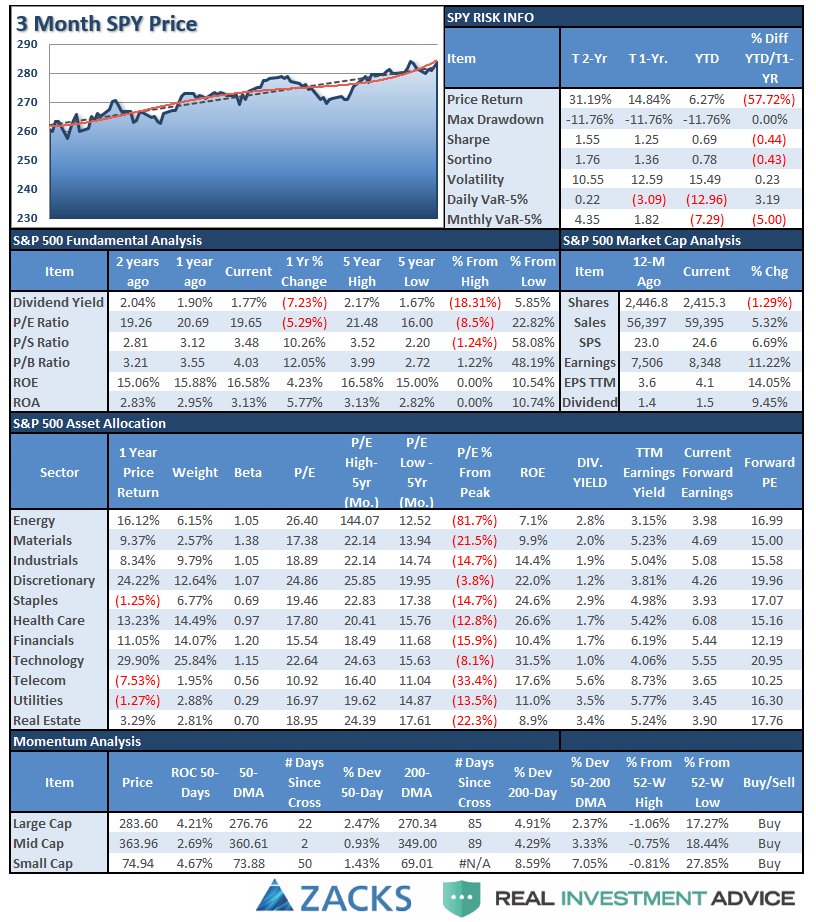
Performance Analysis
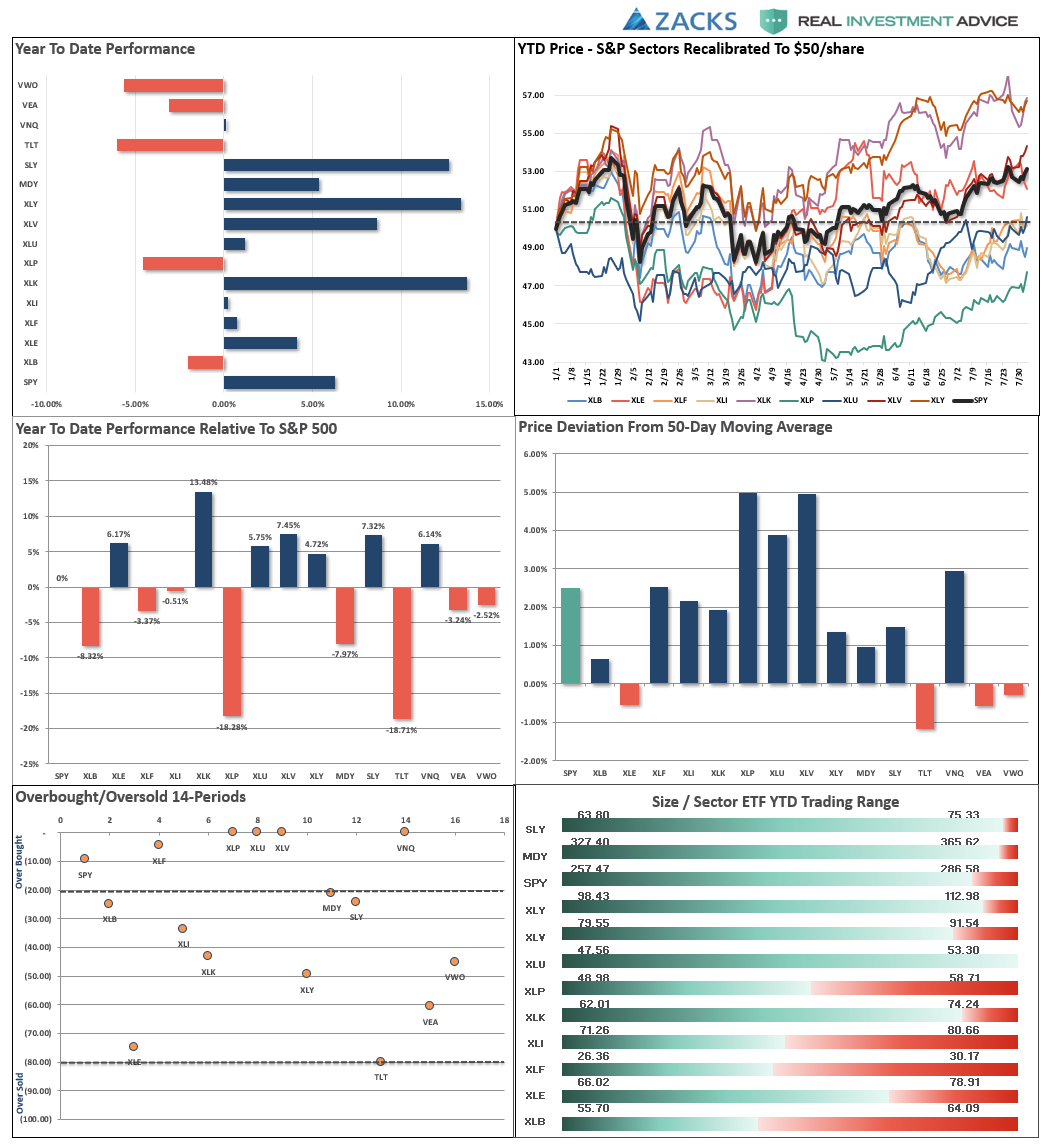
ETF Model Relative Performance Analysis

Sector & Market Analysis:
Last week, this section wasn’t available due to my travels. Therefore, changes in this week’s commentary is based on two week’s of data.
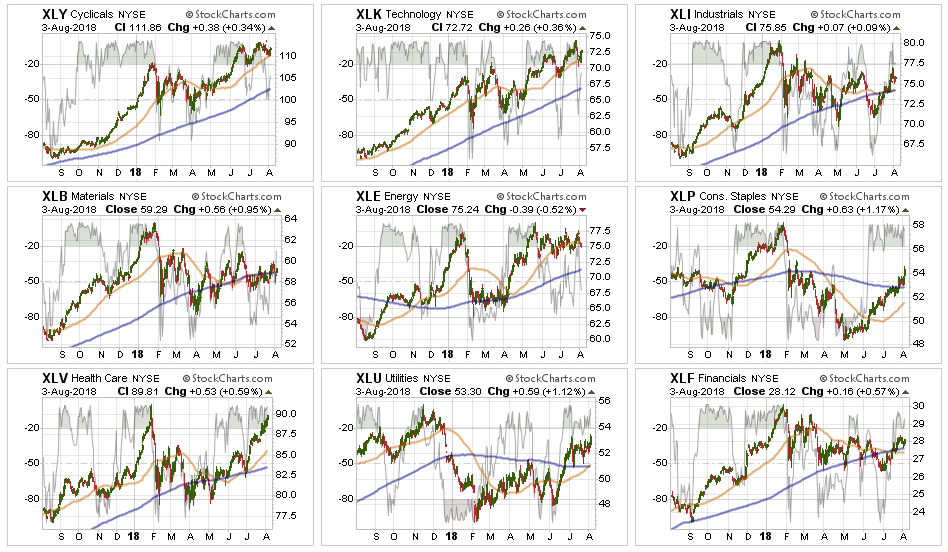
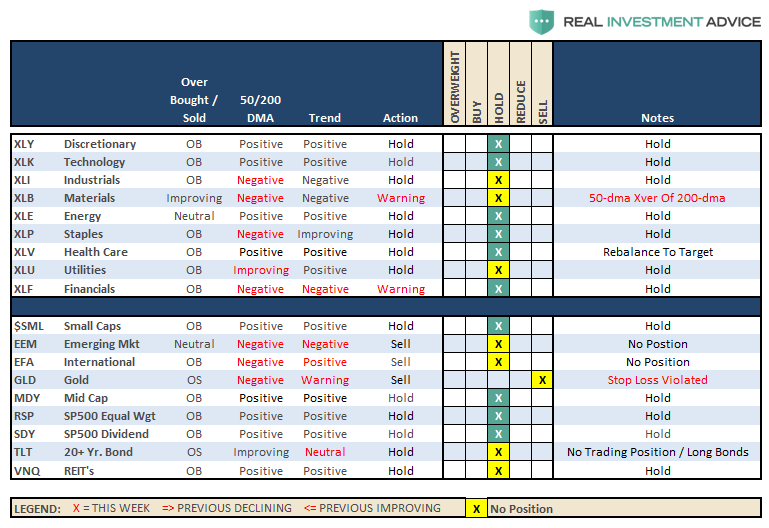
Discretionary and Technology – After recommending to take some profits out of the Technology sector, the $FB episode led to sell-off back to the 50-dma support. The same occurred with the discretionary sector as well. The trends for both remain very bullish right now, and the pullback provides an opportunity to rebalance sector holdings back to target weights.
Healthcare, Staples, and Utilities – after cooling briefly, money has once again flowed strongly into the sector. Healthcare, in particular, has gotten very extended and taking some profits and rebalancing back to portfolio weight makes sense. Despite the recent uptick in rates, Utilities have also continued to perform nicely after a long basing period earlier this year. Staples also continue to improve.
Financial, Energy, Industrial, and Material stocks showed a bit of improvement this past week. Industrials were the only sector in the group to climb back above its 50-dma but remains below several previous tops. While the trend for Energy remains in place, for now, we remain underweight holdings due to lack of relative performance. We currently have no weighting in Industrial or Materials as the “trade war” continues to negatively impact the companies in the sectors. The decline of the “yield curve” continues to weigh on major banks.
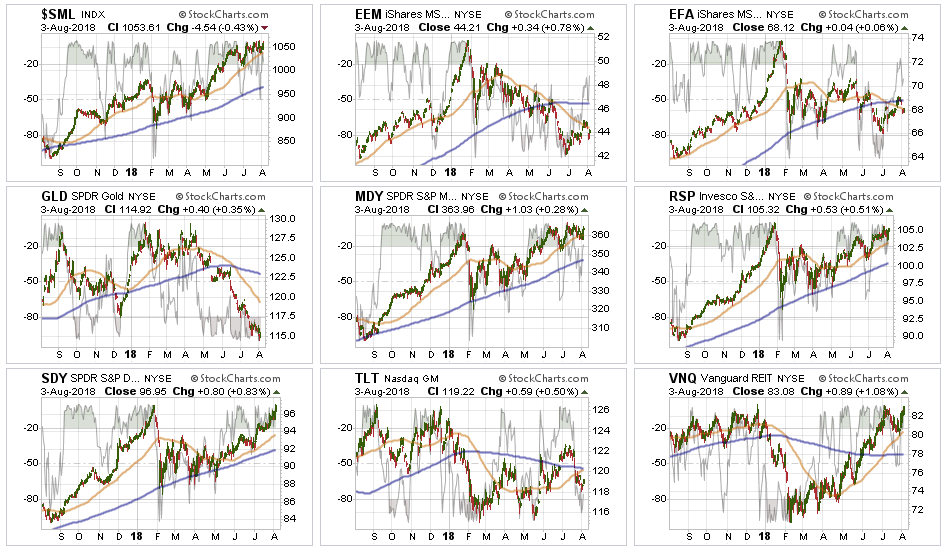
Small-Cap and Mid Cap continue to perform well as of late. We noted two weeks ago, that after small and mid-caps broke out of a multi-top trading range, we needed a pull-back to add further exposure. That pullback to the 50-dma happened and we added exposure to portfolios with stops at the 50-dma. On any further weakness in the markets that hold supports and we increase exposure further to get us to full target weights in our models.
Emerging and International Markets were removed in January from portfolios on the basis that “trade wars” and “rising rates” were not good for these groups. Furthermore, we noted that global economic growth was slowing which provided substantial risk. That recommendation to focus on domestic holdings in allocations has paid off well in recent months. With emerging markets and international markets continuing to languish, there is no reason to ad exposure at this time. Remain domestically focused to reduce the drag on overall portfolio performance.
Dividends and Equal weight continue to hold their own and we continue to hold our allocations to these “core holdings.”
Gold – we haven’t owned Gold since early 2013. However, we suggested three months ago to close out existing positions due to a violation of critical stop levels. We then recommended that again given the cross of the 50-dma back below the 200-dma.
That bounce came and went and gold broke to new lows. With gold very oversold on a short-term basis, if you are still long the metal, your stop has been lowered from $117 two weeks ago, to $114 this week. A rally sale point has also declined from the previous level of $121 to $117.50.
Bonds – This past week, bonds sold off on concerns of a major issuance of new bonds by the Treasury to fill the Government’s funding gap. With the 50-dma about to cross back above the 200-dma, the technical backdrop continues to build for adding bonds to portfolios. However, be patient and let’s see what happens next week. As noted previously, we remain out of trading positions currently but remain long “core” bond holdings mostly in floating rate and shorter duration exposure.
REIT’s keep bouncing off the 50-dma like clockwork. Despite rising rates, the sector has continued to catch a share of money flows and the entire backdrop is bullish for REIT’s. However, with the sector very overbought, take profits and rebalance back to weight and look for pullbacks to support to add exposure.
The table below shows thoughts on specific actions related to the current market environment.
(These are not recommendations or solicitations to take any action. This is for informational purposes only related to market extremes and contrarian positioning within portfolios. Use at your own risk and peril.)
Portfolio/Client Update:
As I noted last week, the market’s improvement allowed us the ability to further increase equity exposure in portfolios in anticipation of registering a confirmed buy signal. With the retest of the “Maginot Line” this past week, we will look to further increase equity exposure on opportunity. However, given the August and September are historically weak months for the market, we will remain a bit more cautious on the how and when we increase holdings in our models.
The cluster of support at the 50- and 100-dma remains in place which limits much of the downside risk currently. However, we are quite aware of the risk stemming from “tariff talk” and further tightening of Fed policy. As we noted several weeks ago:
“While we are not raging long-term bulls, we do think that with earnings season in process the bias will be to the upside. There is a high probability of a substantive rally over the next couple of weeks.”
While that has indeed been the case, we continue to follow our “process” internally with an inherent focus on the risk to client capital.
- New clients: We added 50% of target equity allocations for new clients. We will look to add further exposure opportunistically.
- Equity Model: We previously added 50% of target allocations. We “dollar cost averaged” into those holdings opportunistically. We recently added new positions to the model and will continue to look for opportunity accordingly.
- Equity/ETF blended models were brought closer to target allocations as we added to “core holdings.”
- Option-Wrapped Equity Model were brought closer to target allocations and collars will be implemented.
Again, we are moving cautiously, and opportunistically, as we continue to work toward minimizing risk as much as possible. While market action has improved on a short-term basis, we remain very aware of the long-term risks associated with rising rates, excessive valuations and extended cycles.
It is important to understand that when we add to our equity allocations, ALL purchases are initially “trades” that can, and will, be closed out quickly if they fail to work as anticipated. This is why we “step” into positions initially. Once a “trade” begins to work as anticipated, it is then brought to the appropriate portfolio weight and becomes a long-term investment. We will unwind these action either by reducing, selling, or hedging, if the market environment changes for the worse.


