


Written by Rick Ackerman, Rick’s Picks
Movie-Theater Deflation
Desperate to drum up business, America’s largest theater chain has made a last-ditch offer to moviegoers: Pay a monthly fee of just $19.95 to see up to three movies per week. This is a variation on MoviePass, which at one point offered four movies a month for under $10 at participating theaters.

That may sound unbeatable, but it didn’t stop AMC from trying. Their pass has fewer restrictions and better perks: discounts on food, no online booking fees, advance reservations for up to three movies without having to visit the theater, et cetera.
Either offer is a no-brainer for customers, especially fans of the Marvel comic-book heroes who dominate movie fare these days. Teens and millennials who see each new Marvel film many times will save the most, albeit with dead zones between films that could last for months. (Marvel is hard at work solving this problem, by the way, producing more and more movies based on minor Marvel characters, sometimes even characters who have never appeared in a comic book.) Meanwhile, movie choices outside of the action-hero genre are likely to remain meager, since none of the other big studios will dare any longer to release a franchise film (i.e., Star Wars or Deadpool) in the U.S. or abroad within two weeks of the release of a competing Marvel picture.
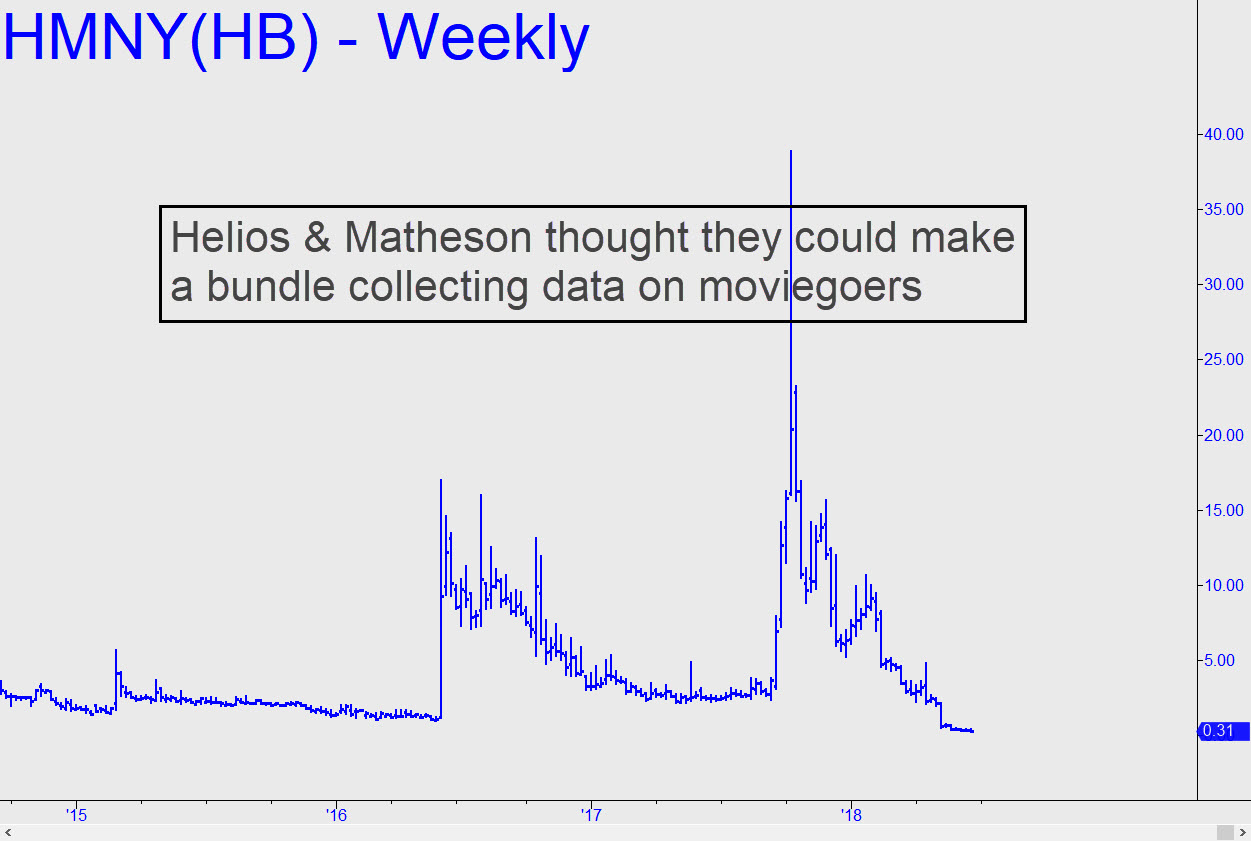
It is predictable that neither MoviePass nor AMC’s new-and-improved version of it will succeed. The AMC chain, with more than 8000 screens and not nearly enough ‘product” to fill them, may be able to reduce operating losses and slow its rapid death spiral by selling more popcorn and beverages. But the current owners of MoviePass, Helios & Matheson Analytics [Nasdaq: HMNY], will bathe in red ink until the company goes bankrupt.
Their business model was so badly conceived to begin with that investors in the company might have done better drilling for oil in suburban bowling alleys. H&M evidently thought they could make money by mining data on pass-holders. But really, how much is it worth to know that 90% of them like Avenger movies – the only game in town for exhibitors these days – or that their beverage loyalties are evenly divided between Coke and Pepsi? HMNY’s chart (below) provides a sobering answer to that question. For firms other than Facebook, Amazon, Google and a few others that have mastered the science of web-based marketing, the value of consumer ‘data’ is diminishing with each passing day. We’ve all been data-mined to death by now, and the backlash is starting to take the form of privacy-law revisions that will make it increasingly difficult for marketing firms to intrude on our space in order to ‘monetize’ our eyeballs.
Customer Loyalty Delusions
Enter the customer loyalty program, an alternative tactic that is hugely in vogue at the moment. It is used by purveyors mostly of services, but sometimes of goods, to hold onto customers by giving them incentives to stick with the provider exclusively for a certain period of time. As practiced online by big-time vendors, however, the tactic seems destined to fail. That’s because, when customers choose between two companies that offer more or less the same item or service, they choose mainly on the basis of price.
Lyft is the latest to jump on the marketing freight train, with a monthly pass that yields a variety of discounts and clever incentives. The idea is to make customers commit to Lyft rather than to Uber their next ride just because Uber at a given moment is offering a better price. But loyalty programs are already so ubiquitous that they wind up competing on value, which to most users will come down to…price.
The inevitable result is that Uber and Lyft will continue to beat each other’s brains in by lowering the cost of a ride, whether through loyalty incentives or adjustments in everyday fares. Price wars initially will be of little concern to investors, since they tend to giddily ignore the bottom line of any publicly traded company that excels at ‘economic disruption’.
The impact unfortunately will fall mainly on Uber and Lyft drivers, who will be caught in disruption’s deflationary vise, unable to make more than a few bucks an hour after costs. Bottom line: If a good or service can be offered online, it is a given that its price will be subject to this downforce; moreover, that the price pressure will persist until only the lowest-cost provider is left standing.
If you don’t currently subscribe to Rick’s Picks, just click here for a free two-week trial. It will give you instant access not only to the chat room, but to Rick’s actionable touts, intraday alerts, ‘jackpot’ bets using super-leveraged options and impromptu ‘requests’ sessions online.


