


Written by Lance Roberts, Clarity Financial
— this post authored by Michael Liebowitz
The explosive rise of Bitcoin (BTC) has taken the investing world by storm, and for good reason. Over the past six months alone BTC has quadrupled in value. Since 2012, it has risen over 200,000%. To put that into context, had one invested 10k in 2012 they would be worth over $20 million today. The graph below shows the meteoric rise.

Please share this article – Go to very top of page, right hand side, for social media buttons.

There are predominantly two camps with strong opinions on what the future holds for BTC. One generally believes it to be the currency of the future while the second camp thinks BTC is another financial bubble. Given BTC’s increasing popularity we thought it would be helpful to present these two competing perspectives and then offer our own assessment.
Believers
Believers in BTC claim it is quickly becoming a widely accepted global currency. To better understand their view let’s see how BTC meets the definition of a currency, both as a means of transacting (money) as well as a store of value.
Money: money is anything that two parties can agree is acceptable in exchange for goods and services. For example, if I pay you a case of beer to mow my lawn, the beer, in this instance, is money. However, for “money” to be widely accepted, the masses must ascribe similar value to it. While there is an increasing number of vendors accepting BTC, it is nearly impossible to use BTC to meet your everyday needs. Further, the value, or price of money, needs to be relatively stable to be effective. If a dollar bill bought you a case of beer today, but only a single bottle tomorrow and a keg the following week, few consumer or vendors would trust the dollar’s value. BTC’s value can fluctuate 5-10% on an hourly basis
Store of value: a store of value is something that allows one to save money and retain its value. When we save money we want comfort in knowing the money we earned can buy us the same amount of goods and services tomorrow that it can buy today. Again, the extreme volatility of the price of BTC makes it difficult to project how much purchasing power a BTC will buy you in the future. All currencies fluctuate but typically nowhere near the degree we are witnessing in BTC.
If the extreme price movements of BTC subside it is possible that BTC can serve as a widely accepted currency and the believers could be correct.
Deniers
A second camp believes BTC is a financial bubble. The chart below compares BTC to other recent investment fads.
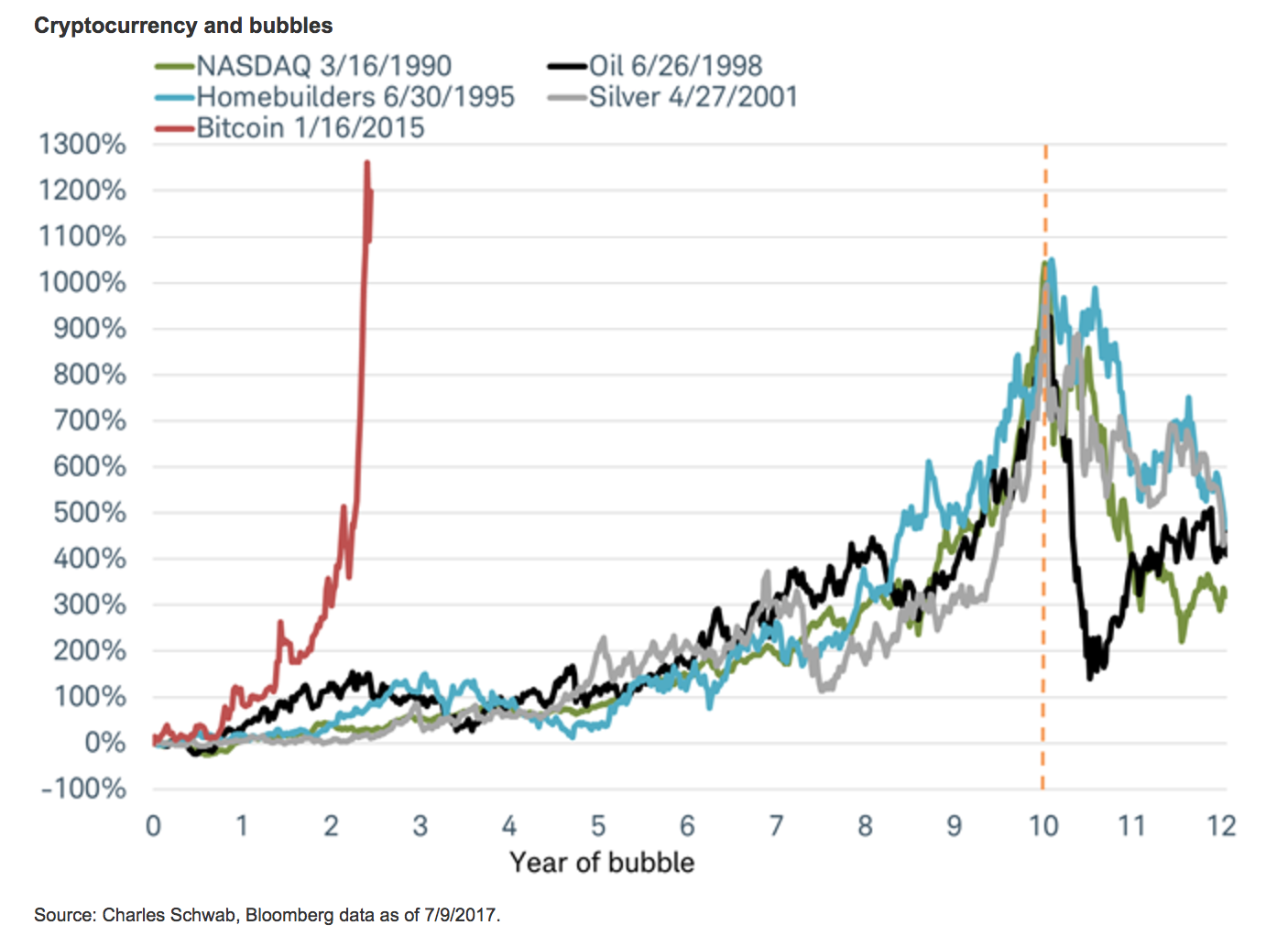
You will notice in all instances above the bubbles rise steadily in price before transitioning to an exponential increase prior to collapse. Often, in the so-called euphoric phase, prices go well beyond the point most investors think is reasonable. In this respect, BTC is following the path of prior bubbles.
Bubbles are not solely defined by price movements, but more importantly by a lack of supporting fundamental value. If you subscribe to the value of BTC as does the first camp, the rapid increase in price may well be justified. If you believe there is no value, BTC is showing the classic pattern of most bubbles.
Our Take
We believe BTC can rise even further from current levels. That said, we question whether it has any meaningful fundamental value. In the textbook on sound investing, Security Analysis, Benjamin Graham and David Dodd define investing as follows:
“An investment operation is one which, upon thorough analysis promises safety of principal and an adequate return. Operations not meeting these requirements are speculative.”
Based on this very clear definition of terms, there is no way to classify BTC as anything other than speculation. Furthermore, while we agree with those in camp one that BTC might one day be universally accepted as money and a reliable store of value, we have one major problem with which to contend.
To help you grasp our issue, consider that an investor who bought Bitcoin a few years ago and sold it today would have accumulated a remarkable gain. Even better, unlike a capital gain on stocks, bonds, real estate and all other financial assets, that profit is tax-free.
Now ask yourself, how long will the government allow investors to avoid paying taxes on gains in BTC? Further, will the U.S. government, or any other government, cede control of its currency and ultimately the economy? We expand on this concept below from a primer we wrote on cryptocurrencies- Salt, Wampum, Benjamins – Is Bitcoin next?
The preamble to the U.S. Constitution states the purpose of the Federal government is to:
“…form a more perfect union, establish justice, insure domestic tranquility, provide for the common defense, promote the general welfare, and secure the blessings of liberty to ourselves and our posterity.”
In other words, the government’s role is to protect the freedoms and liberties of its citizens. If the government has no ability to fund itself and is unable to provide defense and law enforcement it cannot uphold the Constitution. More precisely – the sovereignty of any nation, regardless of its form of government, rests upon the strength and integrity of its currency.
Summary
There may still be gains ahead for BTC, but the volatility of its price and still low adoption as a means of transacting pose obvious problems. The bigger risk, however, is given government incentives to impose taxes on the public and manage economic activity, the speculative value currently being ascribed to BTC does not seem durable and is therefore unlikely to survive.


