Written by Lance Roberts, Clarity Financial
The Real 401k Plan Manager – A Conservative Strategy For Long-Term Investors

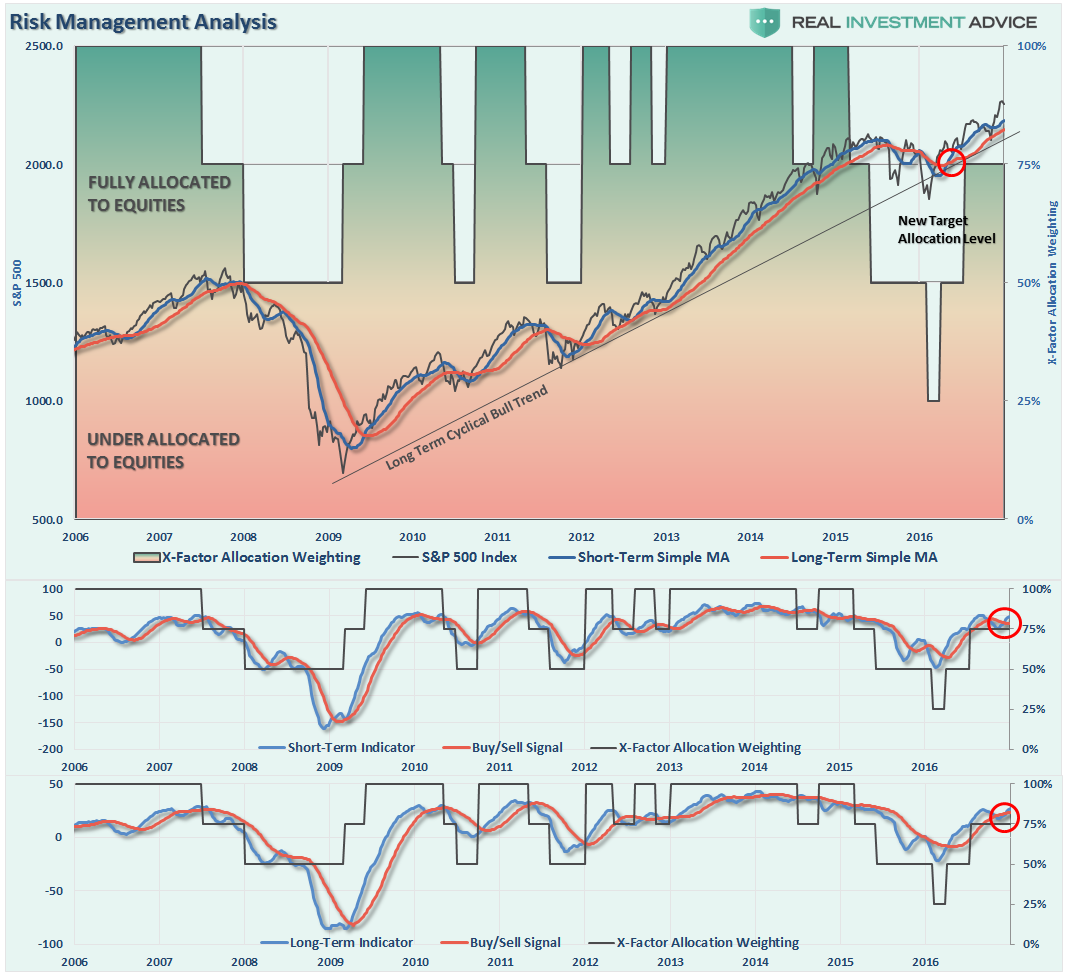
There are 4-steps to allocation changes based on 25% reduction increments. As noted in the chart above a 100% allocation level is equal to 60% stocks. I never advocate being 100% out of the market as it is far too difficult to reverse course when the market changes from a negative to a positive trend. Emotions keep us from taking the correct action.

Happy New Year
With the last holiday-shortened trading week ahead for a while, look for some selling to continue into the New Year as positions are rebalanced. (Managers can take in gains and not pay taxes until 2018)
The last three years have seen some pretty decent corrective actions in January. However, when you have three years in a row of anything, the odds rise this year could be different.
With buy signals on all three indicators registered currently, any corrections are likely to be somewhat limited back to the rising short to intermediate-term moving average. This would suggest a correction back to 2200 would likely be a “buyable” trading level.
However, it should not be forgotten that we are long into a cyclical bull market. Therefore, “tradeable” rallies should be treated as short-term opportunities as long as extreme overbought, overbullish and overvalued conditions exist as they do now.
I continue to suggest using current levels to clean up portfolios as detailed in previously.
Step 1) Clean Up Your Portfolio
Tighten up stop-loss levels to current support levels for each position.
Hedge portfolios against major market declines.
Take profits in positions that have been big winners
Sell laggards and losers
Raise cash and rebalance portfolios to target weightings.
Step 2) Compare Your Portfolio Allocation To The Model Allocation.
Determine areas requiring new or increased exposure.
Determine how many shares need to be purchased to fill allocation requirements.
Determine cash requirements to make purchases.
Re-examine portfolio to rebalance and raise sufficient cash for requirements.
Determine entry price levels for each new position.
Determine “stop loss” levels for each position.
Determine “sell/profit taking” levels for each position.
(Note: the primary rule of investing that should NEVER be broken is: “Never invest money without knowing where you are going to sell if you are wrong, and if you are right.”)
Step 3) Have positions ready to execute accordingly given the proper market set up. In this case, we are looking for a correction to reduce the overbought condition of the market to allow for a better opportunity to rebalance equity risk.
The big risk remains when the markets eventually come to grips with the rise in rates, simultaneously with a stronger dollar, which will quickly erode earnings in an already over-valued market. Pay attention.
If you need help after reading the alert; don’t hesitate to contact me.
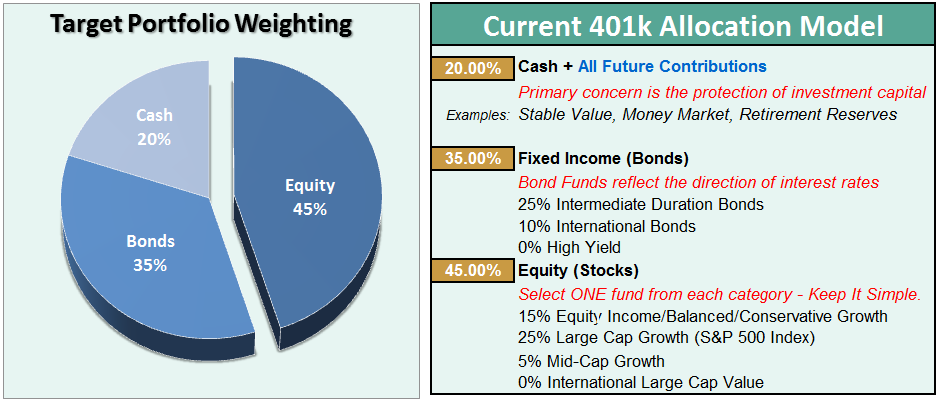
Current 401-k Allocation Model
The 401k plan allocation plan below follows the K.I.S.S. principal. By keeping the allocation extremely simplified it allows for better control of the allocation and a closer tracking to the benchmark objective over time. (If you want to make it more complicated you can, however, statistics show that simply adding more funds does not increase performance to any great degree.)
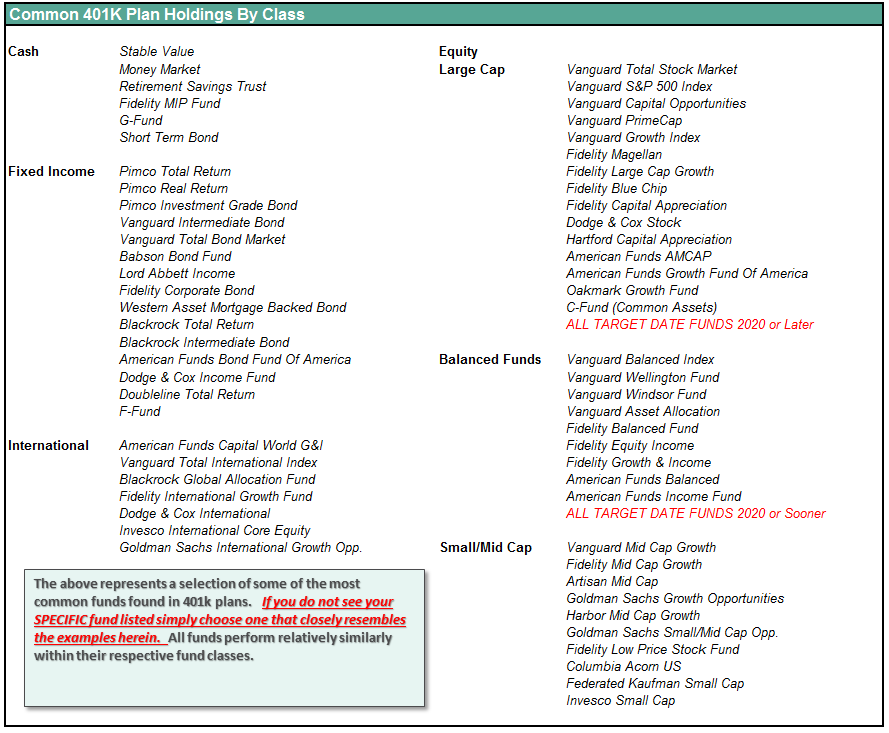
401k Choice Matching List
The list below shows sample 401k plan funds for each major category. In reality, the majority of funds all track their indices fairly closely. Therefore, if you don’t see your exact fund listed, look for a fund that is similar in nature.