


Written by Lance Roberts, Clarity Financial
Short Market Note & Review
We wrapped up 2016 with a fairly dismal trading week last Friday as the S&P had its biggest plunge since the election diving 24.95 points or 1.10%. This has left the bulls pondering if they will ever be able to recover from such a catastrophe. (Dripping with sarcasm)

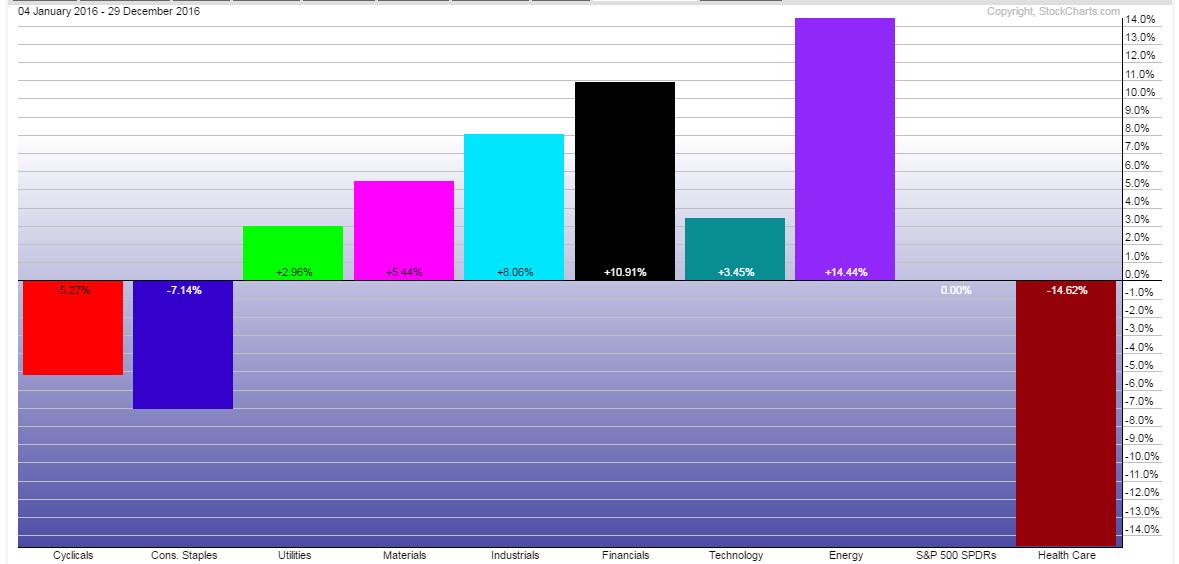
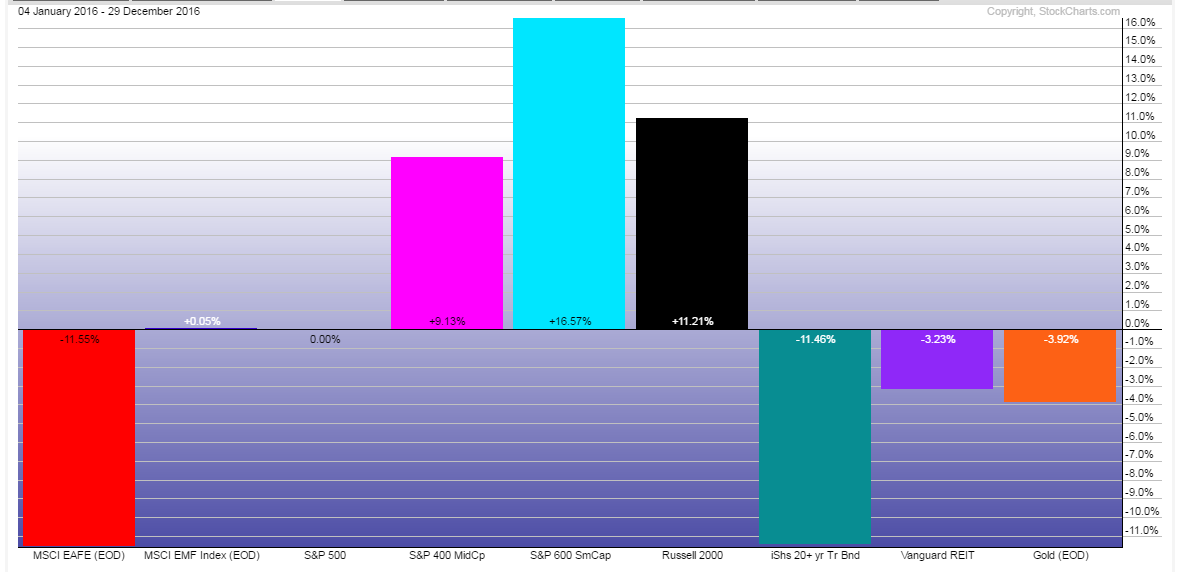
However, for the year, all of the gains of the S&P 500 came in just the last two months of the year and those gains were somewhat relegated to only a few areas of the market. The two charts below show returns by sector, and by major market, as compared to the S&P 500 for the year.
S&P 500 Sector Returns Vs. S&P 500
Major Index Returns Vs. S&P 500
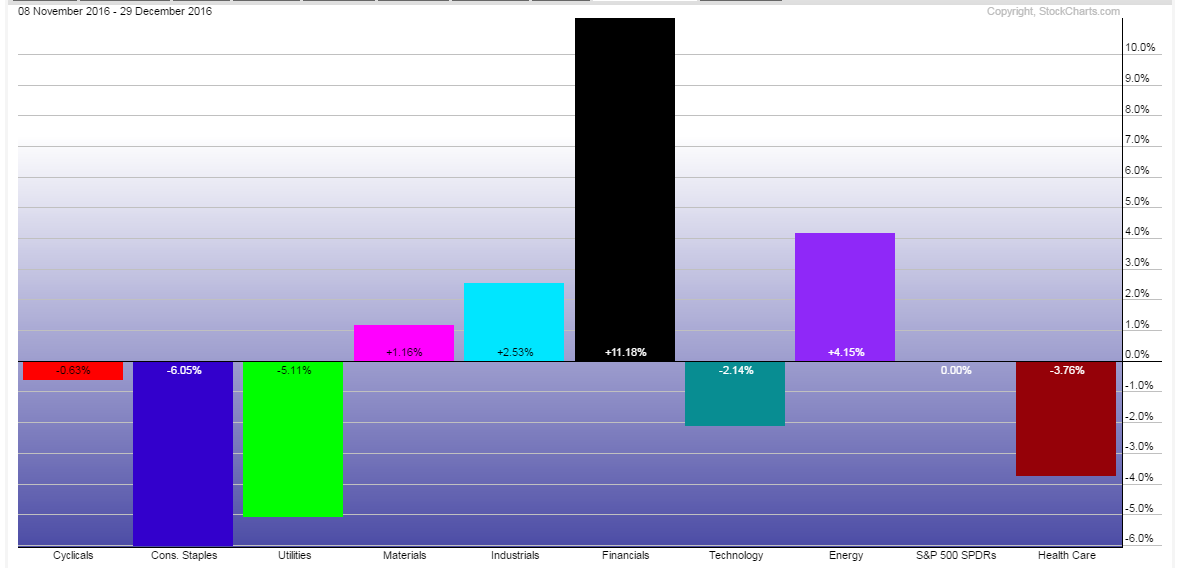
Now, take a look at the gains above for the entire year as compared to the charts below which show comparative returns since the November 8th election.
S&P 500 Sector Returns Vs. S&P 500 since November 8th
Major Index Returns Vs. S&P 500 since November 8th
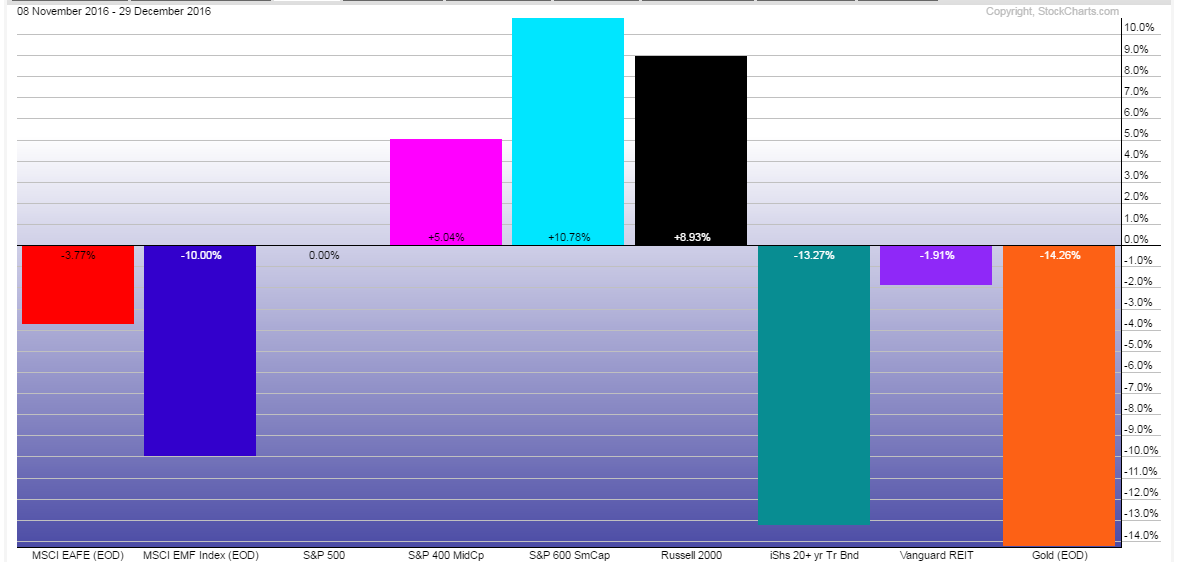
As you can see, the bulk of the returns for the S&P 500 came from the massive explosion of the heavily weighted sector of financial related companies since the election. Furthermore, if you were invested anywhere other than domestically (large, mid and small capitalization stocks) you underperformed the S&P 500 this year.
You will hear a lot heading into the New Year about fund managers once again underperforming the S&P 500 index and why you should just buy an index and go home.
Unfortunately, the majority of those individuals touting such nonsense don’t, and never have in many instances, actually managed money for individuals or institutions. The reason you know this to be the case is they are they same ones touting the benefits of “diversification.”
If you were diversified this year, you underperformed. Period.
However, as I have written extensively about in past articles (see here, here and here), beating some random benchmark index is the worst thing you can do long-term for your money. As I noted:
“But it gets worse. Often times, these comparisons are made without even considering the right way to quantify ‘risk’. That is, we don’t even see measurements of risk-adjusted returns in these ‘performance’ reviews. Of course, that misses the whole point of implementing a strategy that is different than a long-only index.
It’s fine to compare things to a benchmark. In fact, it’s helpful in a lot of cases. But we need to careful about how we go about doing it.”
It is highly unlikely that you will ever “beat the market” over the long-term anyway.
“While Wall Street wants you to compare your portfolio to the “index” so that you will continue to keep money in motion, which creates fees for Wall Street, the reality is that you can NEVER beat a “benchmark index” over a long period. This is due to the following reasons:
1) The index contains no cash
2) It has no life expectancy requirements – but you do.
3) It does not have to compensate for distributions to meet living requirements – but you do.
4) It requires you to take on excess risk (potential for loss) in order to obtain equivalent performance – this is fine on the way up, but not on the way down.
5) It has no taxes, costs or other expenses associated with it – but you do.
6) It has the ability to substitute at no penalty – but you don’t.
7) It benefits from share buybacks – but you don’t.”
For all of these reasons, and more, the act of comparing your portfolio to that of a “benchmark index” will ultimately lead you to taking on too much risk and into making emotionally based investment decisions. The index is a mythical creature, like the Unicorn, and chasing it takes your focus off of what is most important – your money and your specific goals.
Investing is not a competition and, as history shows, there are horrid consequences for treating it as such. So, do yourself a favor and forget about what the benchmark index does from one day to the next. Focus instead on matching your portfolio to your own personal goals, objectives, and time frames.
In the long run, you may not beat the index, but you are likely to achieve your own personal investment goals which is why you invested in the first place.
The Only Chart That Matters Heading Into 2017
As we head into 2017 we enter into the year with:
Markets pushing historic levels of extreme overbought conditions,
2nd highest levels of valuation on record,
Extreme deviations from long-term growth trend lines,
Investor sentiment and confidence pushing extreme bullishness,
Investors fully committed to the market with low levels of cash, and;
High levels of leverage in terms of margin debt and corporate debt.
In other words, after 8 straight years of a bull market advance, what is the risk you are taking to garner additional returns?

With markets pushing overbought, overvalued, and bullish extremes the future outcomes have not been terrific.
Just something to think about.
Investor Resolutions For 2017
Here are my annual resolutions for the coming year to be a better investor/portfolio manager:
I will do more of what is working and less of what isn’t.
I will remember that the “Trend Is My Friend.”
I will be either bullish or bearish, but not “piggish.” (Pigs get slaughtered)
I will remember it is “Okay” to pay taxes.
I will maximize profits by staging my buys, working my orders and getting the best price.
I will look to buy damaged opportunities, not damaged investments.
I will diversify to control my risk.
I will control my risk by always having pre-determined sell levels and stop-losses.
I will do my homework. I will do my homework. I will do my homework.
I will not allow panic to influence my buy/sell decisions.
I will remember that “cash” is for winners.
I will expect, but not fear, corrections.
I will expect to be wrong and I will correct errors quickly.
I will check “hope” at the door.
I will be flexible.
I will have the patience to allow my discipline and strategy to work.
I will turn off the television, put down the newspaper, and focus on my own analysis.
These are the same resolutions I attempt to follow every year. There is no shortcut to being a successful investor. There are only the basic rules, discipline and focus that is required to succeed long-term.
The biggest problem for investors is the bull market itself.
When the “bull is running” we believe we are smarter and better than we actually are. We take on substantially more risk than we realize as we continue to chase market returns and allow “greed” to displace our rational logic. Just as with gambling, success breeds overconfidence as the rising tide disguises our investment mistakes.
Unfortunately, it is during the subsequent completion of the full-market cycle that our errors are revealed. Always too painfully and tragically as the loss of capital exceeds our capability to “hold on for the long-term.”
Remembering these basic rules from Bob Farrell will help you survive, and win, the long-term investment game.
Markets always revert to the mean.
Excesses in one direction always lead to excesses in the other.
There are no new eras and excesses are never permanent.
Exponentially rising/falling markets go further than logic would expect.
Markets do not correct excesses by going sideways.
The public buys the most at the top and least at the bottoms.
Fear and greed are stronger than long-term resolve.
Markets are strongest when they are broad and weakest when they are narrow.
Bull and bear markets have three stages. Both end with capitulation.
When all experts agree, something else will happen.
Bull markets are more fun their bear markets.
Happy New Year


