


Written by Lance Roberts, Clarity Financial
This past week, Janet Yellen and the Federal Reserve finally did something they have been promising to do for an entire year – raise interest rates.

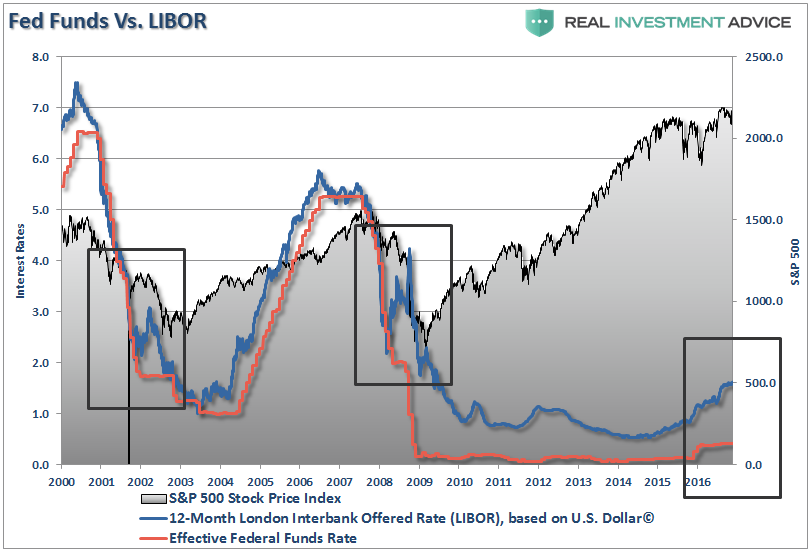
Mind you, the lift in interest rates from 0.50% to 0.75% has hardly moved the Effective Federal Funds Rate BUT the London Interbank Offered Rate (LIBOR), which is what affects a variety of actual interest payments, has already risen sharply in recent months. In other words, the Fed is already well behind the actual market in terms of tightening monetary policy.
Here is Janet’s statement on the rate hike:
“The committee currently expects that, with gradual adjustments in the stance of monetary policy, economic activity will continue to expand at a moderate pace and labor market indicators will continue to strengthen.“
And with that, the Fed’s “Dot Plot” shows the Fed plans to hike rates 3-times during the next year moving the Fed Funds Rate to 1.5%.
Oh, wait a second, that was what she said in 2015.
Here is what she said this past week:
“Our decision to raise rates should certainly be understood as a reflection of the confidence we have in the progress the economy has made and our judgment that will continue.”
And once again, the Fed’s “Dot Plot” suggests the Fed hopes to hike rates 3-times within the next year.
The problem, and as I will dissect in a bit more detail, is the expanse betweens the Fed’s “fantasy” and economic realities. This is shown in the table below which documents the median of the Fed’s economic projections versus reality. In every single year, they have been wrong.

Yet, besides being the world’s worst economic forecasters, the market still believes statement she makes. Let’s analyze her comments and compare them to reality for a moment.
Employment
“Job gains, averaged nearly 180,000 per month over the past three months, maintaining the solid pace that we have seen since the beginning of the year. Over the past 7 years, since the depths of the great recession, more than 15 million jobs have been added to the U.S. economy. The unemployment rate fell to 4.6 percent in November, the lowest level since 2007, prior to the recession.”
Depending on where you start counting, 15-million jobs may have been added to the U.S. economy. However, there is an important distinction to be made. As shown below, the actual number of jobs created is 4.77 million fewer than the increase in the working-age population. (June 2009 to Present).

This explains why, outside of mandated minimum wage and Supervisory employee salary increases, wages and economic growth have remained exceptionally weak.
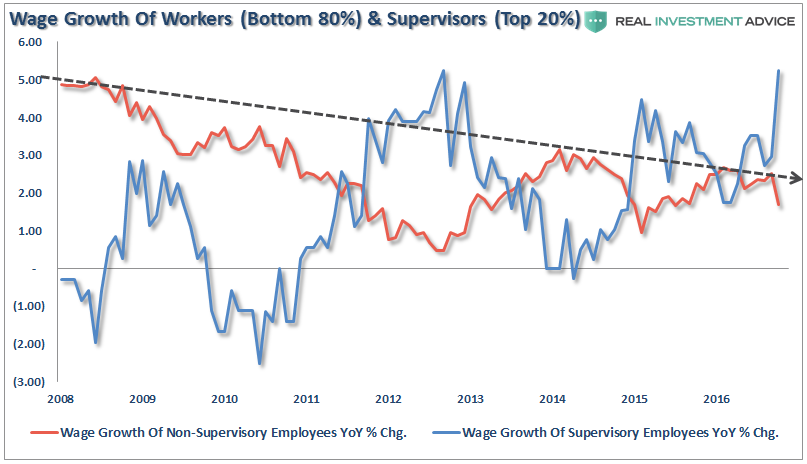
And inflation-adjusted hourly wages are also headed back to zero growth which hardly suggests economic acceleration.

Even the Fed’s own Labor Market Conditions Index (LMCI) suggests that something isn’t quite right in the economy as its 12-month moving average has now dipped below zero for an entire quarter. As I noted last Thursday, she is right about one thing:
YELLEN: LABOR MKT LOOKS LIKE IT DID BEFORE RECESSION
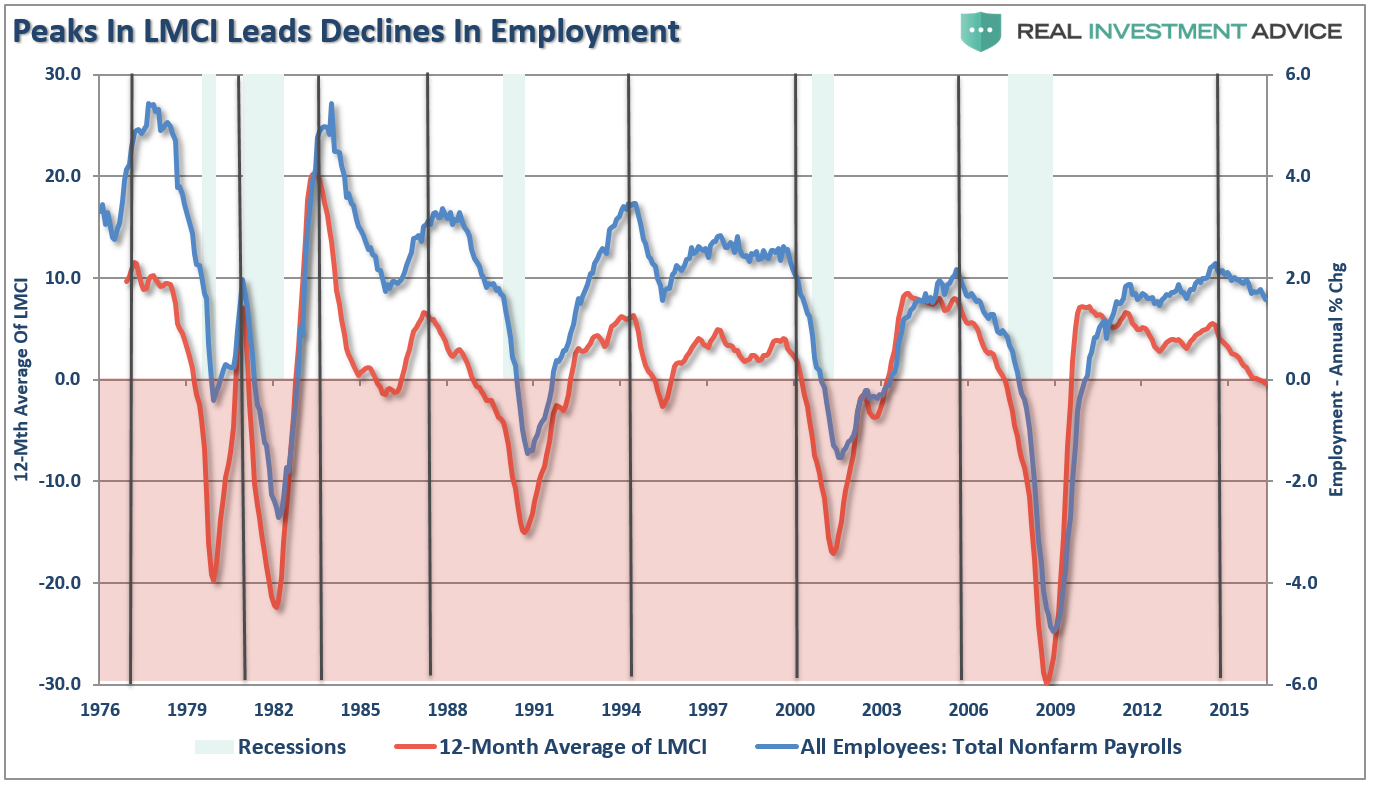
“Historically speaking, peaks in the 12-month average of the LMCI index have been coincident with declines in employment and the onset of weaker economic growth.
While the Fed raised it’s longer term interest rate forecast, and projected three more hikes to the Fed Funds Rate in 2017, there is a strong probability this is the same wishful thinking they have had over the last two years.
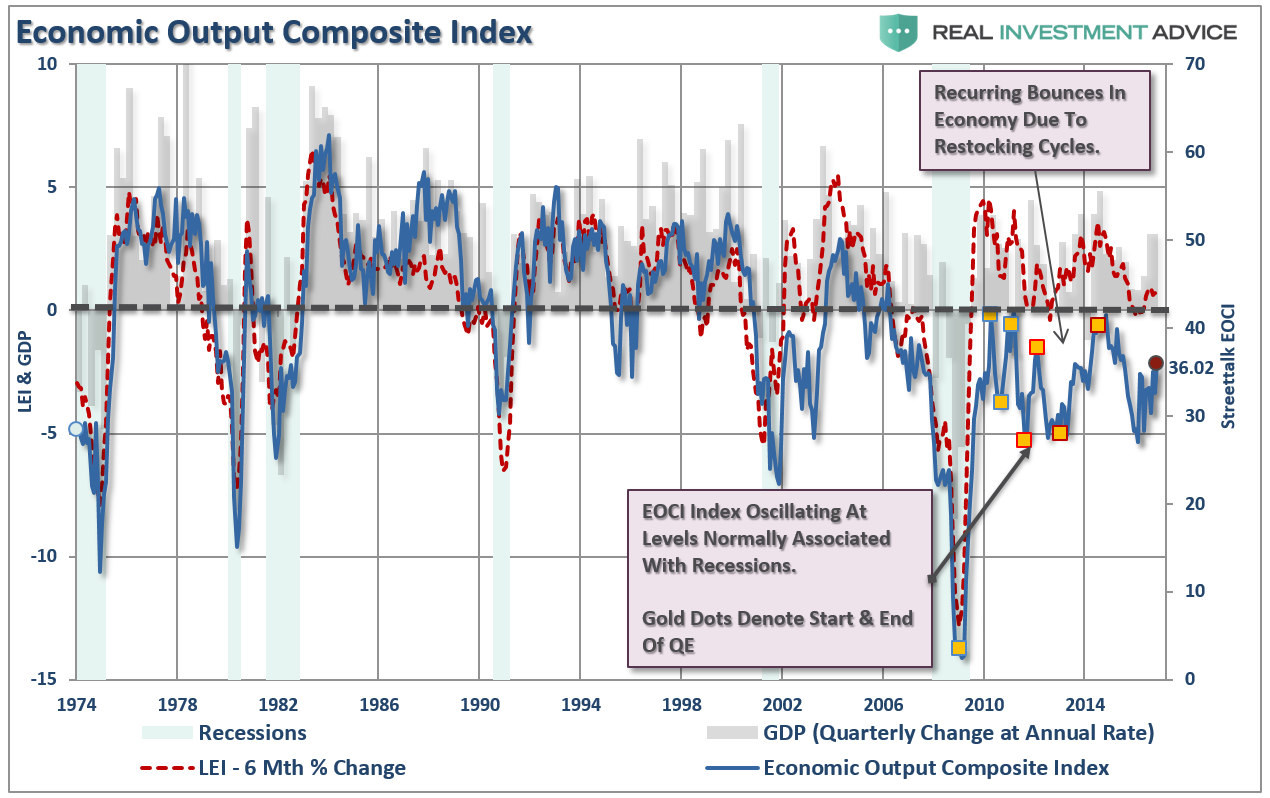
As shown in all the data above and the EOCI index below (a broad composite of manufacturing, service and leading indicators), the current economic bounce is likely another in a series of temporary restocking cycles. These cycles have been repeatedly witnessed after cyclical slowdowns in economic growth. Furthermore, as shown below, with the broader economy operating at levels more normally associated with recessions than expansions, there is little suggesting an ability to support substantially higher rates or generate inflationary pressures above 2%.”
Inflation
“Core inflation which excludes energy and food prices that tend to be more volatile than other prices, has risen to one and three-quarters percent. As the transitory influences of earlier declines in energy prices and prices of imports continue to fade, and as the job market strengthens further we expect overall inflation to rise to 2 percent over the next couple of years.”
Here is the problem.
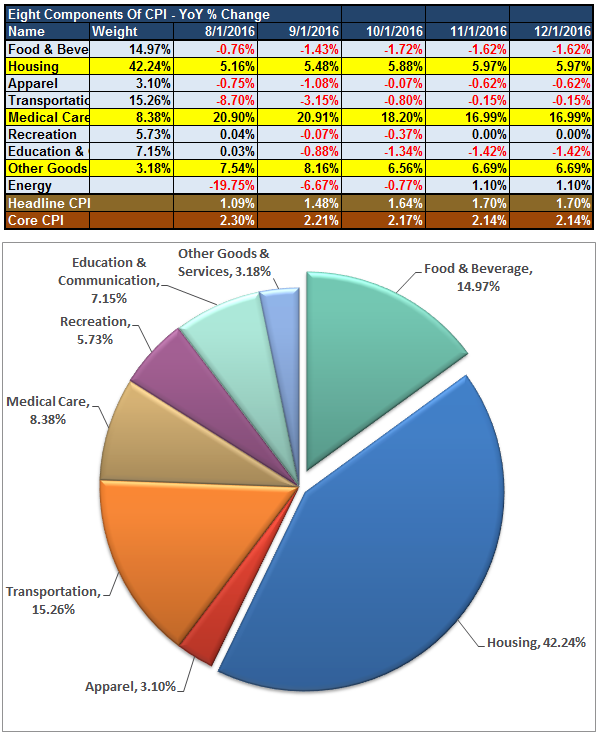
The only inflation in the market currently is coming from spiking health care costs and rental rates as shown in the breakdown of the Consumer Price Index. It is clear where inflationary pressures have come from over the last 5-months.
Inflation can be both good and bad. Inflationary pressures can be representative of expanding economic strength if it is reflected in stronger pricing of both imports and exports. Such increases in prices would suggest stronger consumptive demand, which is 2/3rds of economic growth, and increases in wages allowing for absorption of higher prices. That would be the good.
The bad would be inflationary pressures in areas which are direct expenses to the household. Such increases curtail consumptive demand, which negatively impacts pricing pressure, by diverting consumer cash flows into non-productive goods or services.
If we take a look at import and export prices there is little indication that inflationary pressures are present.
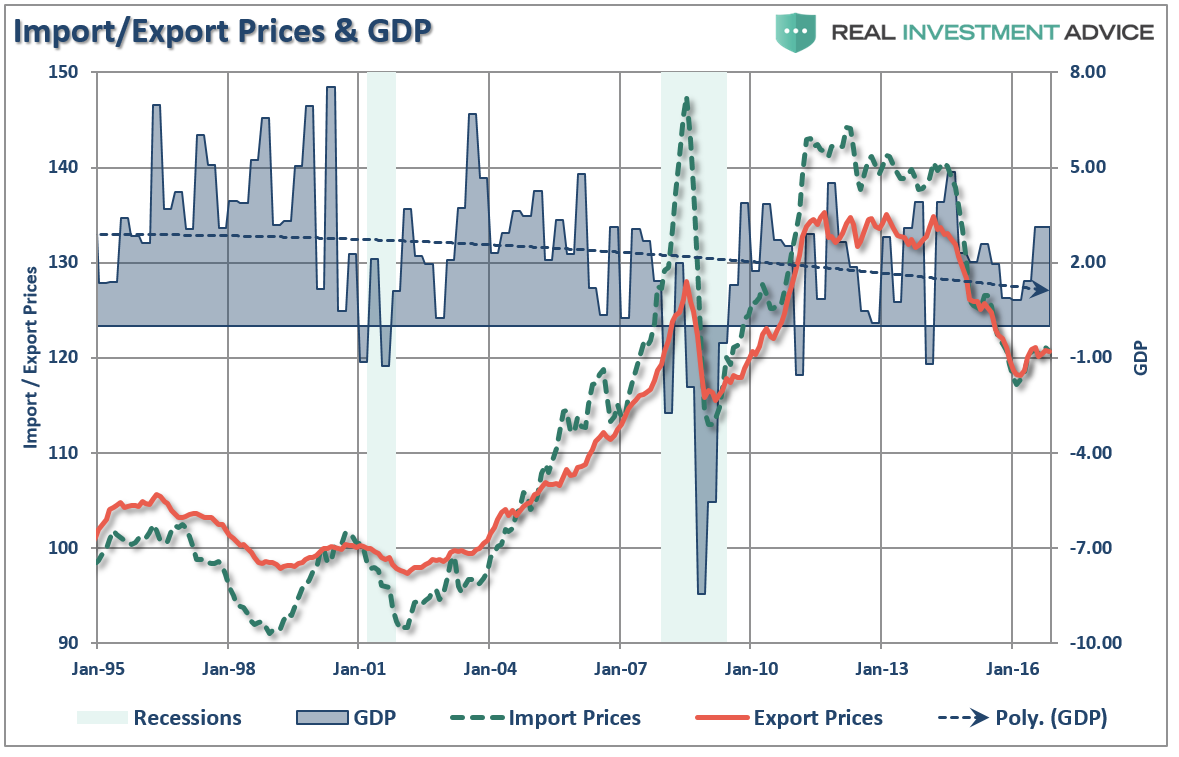
In fact, there are more deflationary forces in the economy currently than inflationary. Furthermore, with Housing and Medical Care extracting dollars from consumers into areas that do not boost economic growth, expectations of higher “good inflation” that leads to stronger employment, wage and economic growth are likely misplaced.
Economic Growth
“The median projection for growth of inflation-adjusted gross domestic product rises from 1.9 percent this year to 2.1 percent in 2017, and stays close to 2 percent in 2018 and 2019, slightly above its estimated longer run rate.”
Unfortunately, she will likely be proved wrong once again as she has been in every year since 2011 as “hope” is eventually faced with economic realities.
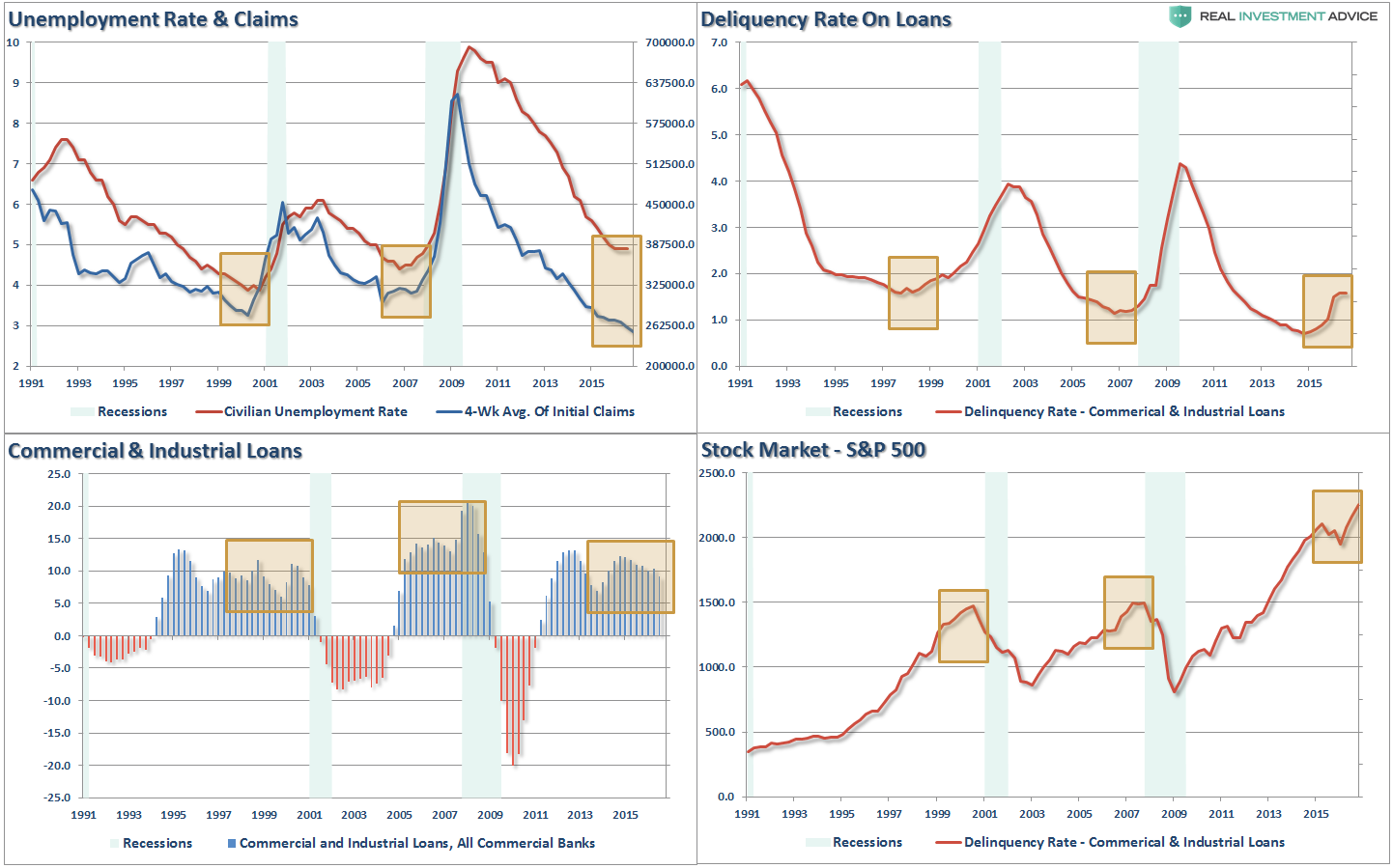
First, “record levels” of anything are records for a reason. It is where the point where previous limits were reached. Therefore, when a “record level” is reached it is NOT THE BEGINNING, but rather an indication of the MATURITY of a cycle. While the media has focused on employment, record stock market levels, etc. as a sign of an ongoing economic recovery, history suggests caution. The 4-panel chart below suggests that current levels should be a sign of caution rather than exuberance.
Paul Kasriel summed the problem up as well:
“Notice the green line in Chart 1. It represents the year-over-year percent change in quarterly-average observations of the sum of commercial bank credit (loans and securities on the books of commercial banks) and the monetary base (reserves held at the Fed by depository institutions and currency in circulation). As regular readers (are there still two of you?) of this commentary remember, this sum is what I refer to as thin-air credit because it is credit that is created by the commercial banking system and the Fed figuratively out of thin air. The unique characteristic of thin-air credit is that no one else need cut back on his/her current spending as the recipient of this credit increases his/her current spending. Notice that growth in this measure of thin-air credit, as represented by the green line in Chart 1, has been trending lower since hitting a post-recession peak in the fourth quarter of 2014.”
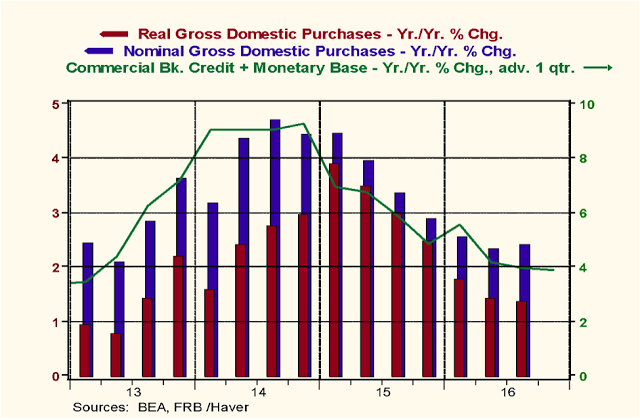
“Based on published data so far for Q4:2016, the Atlanta Fed is forecasting real GDP annualized growth in this current quarter of 2.4%, down from the previous quarter’s 3.2% annualized growth. With current growth in thin-air credit already very weak and likely to get even weaker after the Fed contracts the monetary base more in order to push the federal funds rate 25 basis points higher, real and nominal U.S. economic growth is likely to slow further in the first half of 2017.”
So, if you are betting on a strong economic recovery to support excessive valuations and extremely stretched markets, you could be setting yourself up for disappointment.
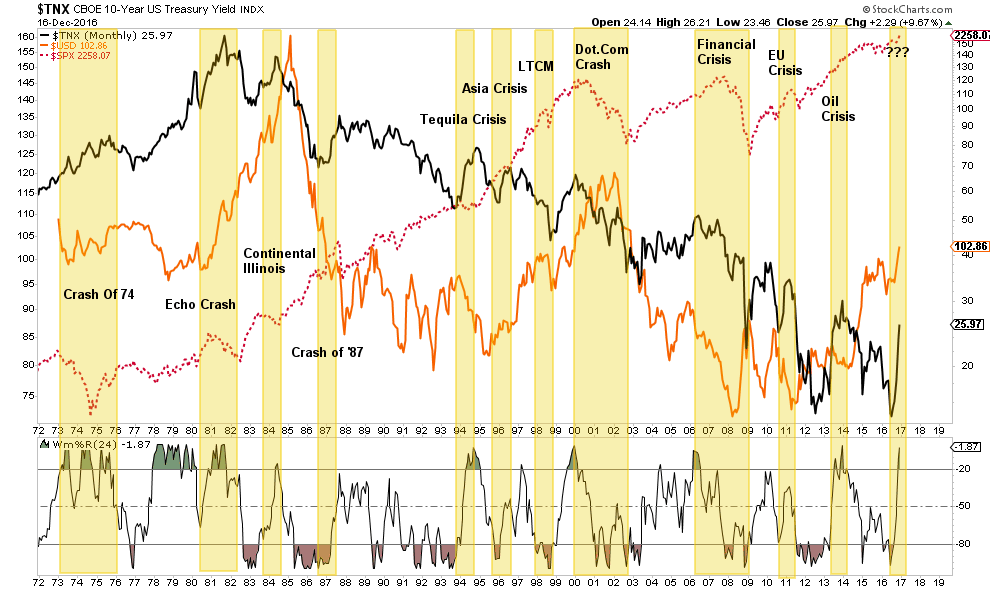
Oh, and don’t think for a moment that rising interest rates, combined with a strongly rising dollar, is somehow “good for stocks.”
It isn’t.
It has never been.
Hedging portfolio risk remains prudent.
#PortfolioHedgesMatter


