

econintersect.com
  • 토토사이트
    • 카지노사이트
    • 도박사이트
    • 룰렛 사이트
    • 라이브카지노
    • 바카라사이트
    • 안전카지노
  • 경제
  • 파이낸스
  • 정치
  • 투자
No Result
View All Result
  • 토토사이트
    • 카지노사이트
    • 도박사이트
    • 룰렛 사이트
    • 라이브카지노
    • 바카라사이트
    • 안전카지노
  • 경제
  • 파이낸스
  • 정치
  • 투자
No Result
View All Result
econintersect.com
No Result
View All Result
Home Uncategorized

Infographic Of The Day: Remembering What Happened To The Space Shuttle Challenger

admin by admin
9월 6, 2021
in Uncategorized
0
0
SHARES
0
VIEWS

NASA’s space shuttle Challenger accident was a devastating tragedy that killed seven astronauts and shocked the world on Jan. 28, 1986.

Killed in the accident were Challenger commander Dick Scobee, pilot Michael Smith, mission specialists Judy Resnik, Ronald McNair and Ellison Onizuka, payload specialist Gregory Jarvis and Christa McAuliffe, who was set to become the first teacher in space.

Here’s a look at how the Challenger accident occurred:

An inspection of the launch pad revealed large quantities of ice collecting due to unusually cold overnight Florida temperatures. NASA had no experience launching the shuttle in temperatures as cold as on the morning of Jan. 28, 1986. The coldest temperature of a previous launch was 20 degrees warmer.

Morton Thiokol, the builder of the solid-rocket boosters, advised NASA that they believed the O-ring seals in the solid-rocket boosters would perform adequately in the cold.

To make each solid-rocket booster, the Morton Thiokol factory built four hull segments filled with powdered aluminum (fuel) and ammonium perchlorate (oxidizer).

At the launch site, the fuel segments were assembled vertically. Field joints containing rubber O-ring seals were installed between each fuel segment.

The O-rings were never tested in extreme cold. On the morning of the launch, the cold rubber became stiff, failing to fully seal the joint.

As the shuttle ascended, one of the seals on a booster rocket opened enough to allow a plume of exhaust to leak out. Hot gases bathed the hull of the cold external tank full of liquid oxygen and hydrogen until the tank ruptured.

At 73 seconds after liftoff, at an altitude of 9 miles (14.5 kilo- meters), the shuttle was torn apart by aerodynamic forces.

 The two solid-rocket boosters continued flying until the NASA range safety officer destroyed them by remote control.

The crew compartment ascended to an altitude of 12.3 miles (19.8 km) before free-falling into the Atlantic Ocean.
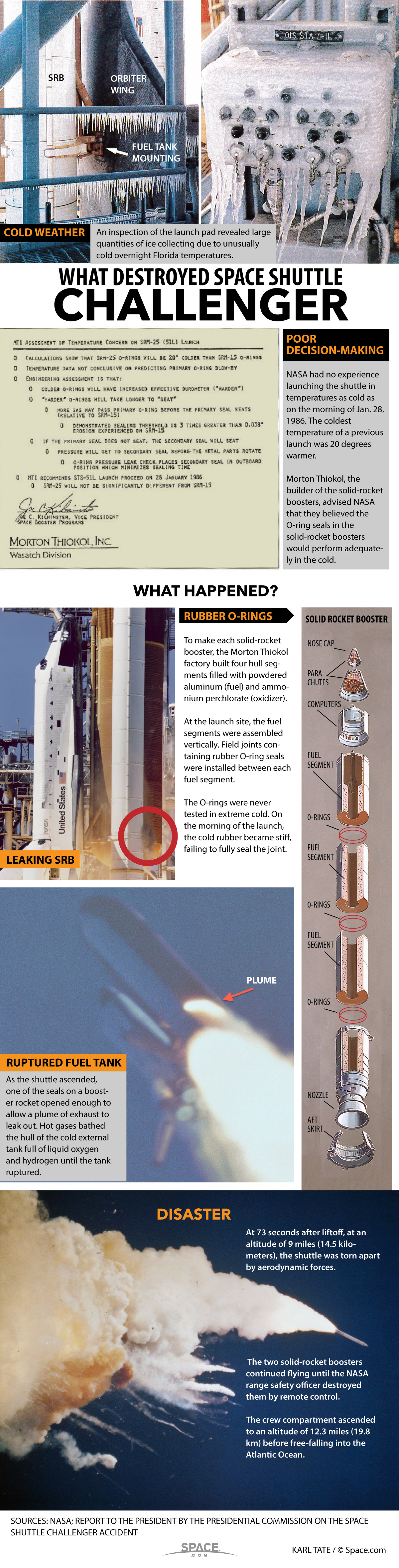
[click here to enlarge infographic]

Chart details the causes of the destruction of Challenger on Jan. 28, 1986.
Source SPACE.com: All about our solar system, outer space and exploration.

Source: http://www.space.com/31732-space-shuttle-challenger-disaster-explained-infographic.html

Previous Post

Early Headlines: Antonin Scalia Dies, GOP Debate Brawl, Turkey Shells Kurds In Syria, Militants Down Libya Jet, Mosul Dam Threatens Half Million Iraqis And More

Next Post

Rising Productivity, Declining Population Impact Russia’s Economy

Related Posts

Scammers Steal $300K Using Fake Blur Airdrop Websites
Uncategorized

FBI Warns Investors Of Crypto-Stealing Play-to-Earn Games

by admin
Maersk Almost Completing Russia Exit After The Sale Of Logistics Sites
Uncategorized

Maersk Almost Completing Russia Exit After The Sale Of Logistics Sites

by admin
Why Is ‘Staking’ At The Center Of Crypto’s Latest Regulation Scuffle
Uncategorized

Why Is ‘Staking’ At The Center Of Crypto’s Latest Regulation Scuffle

by admin
Mexico's Pemex Dismantled Resources Worth $342M From Two Top Fields
Uncategorized

Mexico’s Pemex Dismantled Resources Worth $342M From Two Top Fields

by admin
Oil Giant Schlumberger Rebrands Itself As SLB For Low-Carbon Future
Uncategorized

Oil Giant Schlumberger Rebrands Itself As SLB For Low-Carbon Future

by admin
Next Post

Money and Banking, Part 5

답글 남기기 응답 취소

이메일 주소는 공개되지 않습니다. 필수 필드는 *로 표시됩니다

Browse by Category

  • Business
  • Econ Intersect News
  • Economics
  • Finance
  • Politics
  • Uncategorized

Browse by Tags

adoption altcoins bank banking banks Binance Bitcoin Bitcoin market blockchain BTC BTC price business China crypto crypto adoption cryptocurrency crypto exchange crypto market crypto regulation decentralized finance DeFi Elon Musk ETH Ethereum Europe Federal Reserve finance FTX inflation investment market analysis Metaverse NFT nonfungible tokens oil market price analysis recession regulation Russia stock market technology Tesla the UK the US Twitter

Categories

  • Business
  • Econ Intersect News
  • Economics
  • Finance
  • Politics
  • Uncategorized

© Copyright 2024 EconIntersect

No Result
View All Result
  • 토토사이트
    • 카지노사이트
    • 도박사이트
    • 룰렛 사이트
    • 라이브카지노
    • 바카라사이트
    • 안전카지노
  • 경제
  • 파이낸스
  • 정치
  • 투자

© Copyright 2024 EconIntersect