


Written by rjs, MarketWatch 666
The news posted last week for the coronavirus 2019-nCoV (aka SARS-CoV-2), which produces COVID-19 disease, has been surveyed and some important articles are summarized here. The articles are more or less organized with general virus news and anecdotes first, then stories from around the US, followed by an increased number of items from other countries around the globe. Economic news related to COVID-19 is found here.

Please share this article – Go to very top of page, right hand side, for social media buttons.
Summary:
Over the past seven days, the US has had more new Covid infections than any country on earth, which is remarkable in that we didn’t even rank in the top ten for new infections before July. At the end of last week, we already ranked fifth, having passed the 7-day average of new cases in Iran and Russia; then we exceeded the new case count of both India and Brazil on Tuesday of this week, and by Friday we had exceeded the weekly new case counts of Indonesia and the UK. Today, we’re already pulling away from the pack. If you’re interested, you can watch that global horse race here…
By virtue of anomalously low reporting on Saturday, new cases reported in the US during the week ending July 24th were 46.9% higher than those reported during the week ending July 17th. They’re now than four times higher than those reported during the week ending June 26th. However, they’re still 29.7% below the new cases recorded during the week ending July 25th of last year, which was the peak of last summer’s Covid surge. Again, with only eleven states reporting deaths on Saturday, US deaths attributed to Covid over the past week were 3.9% lower than those reported during the prior week, and 18.1% fewer than the number of deaths reported during the week ending June 26th. Moreover, our Covid deaths of this past week were 73.0% below those reported during the week ending July 25th of 2020, which was still a few week’s away from last summer’s peak in mid-August.
Meanwhile, new Covid cases reported globally during the week ending July 24th were only 3.3% higher than those reported during the week ending July 17th, but 42.3% higher than those reported during the week ending June 18th, which was the week that global cases bottomed out after the spring surge. Unfortunately, global covid death reports are now rising, after several weeks with little change, and were 3.9% higher this week than last, but still 42% below the week ending May 1st, which was the high for this year’s global spring wave.
The growth of new global cases has slowed because the countries which were the epicenter of the global surge a month ago are now seeing their case counts fall, offsetting the rising cases in countries such as the US, the UK, and France, where new cases were up 164% this past week. Four weeks ago, Brazil, India, Columbia and Argentina were reporting the most new cases globally; cases in Brazil are now down by nearly half from their late June peak; cases in Columbia are down 56.5% over the same period; cases in Argentina are down 61% from their peak, and most remarkably, new cases in India over the past week were less than 10% of their peak level of during the week ending May 8th..
The chart below from WorldoMeter shows the daily number of new cases for the US, updated through 24 July. The increase over the last 4 weeks is now clear and is starting to look exponential.

The chart below shows the daily number of deaths for the US, updated through 17 July. The daily deaths have clearly stopped declining and the start of a rise is now evident.

The number of active cases still remains at an elevated level, and on July 24 moved again above 5 million.
 The graphics presented by Johns Hopkins show global new cases, global deaths, and global cummulative vaccinations in that order.
According to Johns Hopkins (first graph below), new cases globally, which previously appeared to have peaked and be in a down trend are now showing a new increase. Global deaths (second graph below) have now stopped declining, while global vaccinations continue to increase (third graph below).
 .
.
Steven Hansen continues to summarize and link the latest news related to the pandemic and economic recovery every day, 7 days a week, plus displays over a dozen important graphics updated at least daily. The most recent article at the time this is published: 24 July 2021 Coronavirus And Recovery News: Pandemic Restrictions On Florida-Based Cruise Ships Removed By A Federal Appeals Court. Three States Account For 40% Of Latest COVID Spike.
This article leads the daily newsletter from Global Economic Intersection every day. Newsletter subscription is free.
Here are the rest of the articles for the past week reviewed and summarized:
Unvaccinated say vaccines more dangerous than COVID-19: poll – Unvaccinated individuals believe the coronavirus vaccine is more dangerous than the virus, according to a poll conducted by Yahoo News and YouGov.The poll found 37 percent of unvaccinated individuals believe the vaccines pose greater health risks than the virus while 29 percent acknowledge the coronavirus is a greater health risk than the vaccines, which studies have shown are effective in reducing cases, hospitalizations and deaths.Thirty-four percent of individuals were unsure which poses a greater threat to their health. The study highlights how misinformation about the vaccines are deeply ingrained with many Americans. Vaccine doubts have slowed vaccination rates in the United States to a crawl, and have been a major factor as the delta variant sweeps through the country, leading to a rise in cases, hospitalizations and deaths.Federal health officials have spoken of a pandemic of the unvaccinated, a worrisome development that could lead to many more deaths in the nation from the coronavirus. More than 600,000 people in the United States have already died from COVID-19.The poll found 37 percent are not getting the vaccine due to concerns about long-term side effects, 17 percent don’t trust the government, 16 percent believe the vaccine is too new, 11 percent cite that it is not fully approved by the Food and Drug Administration and 6 percent are against any sort of vaccine. The poll also showed that many unvaccinated people do not see the delta variant as a significant threat. Thirty percent of unvaccinated individuals said the Delta variant wasn’t a serious threat to anyone, while 33 percent of unvaccinated individuals said the Delta variant was a serious threat to all people. Seventeen percent said it was a threat to unvaccinated individuals. The poll was conducted between July 13 and July 15. It surveyed 1,715 U.S. adults with a margin of error of 2.7 percentage points.
New study suggests Johnson & Johnson less effective against variants – The Johnson & Johnson COVID-19 vaccine may be less effective in battling coronavirus variants than other shots, a new study suggests. The results, published by bioRxiv but not yet peer reviewed or published in a journal, suggest that the mRNA vaccines made by Pfizer-BioNTech or Moderna could better protect against the delta and lambda strains than the Johnson & Johnson vaccine. The effectiveness of the vaccine in neutralizing the disease “significantly decreased” with the Johnson & Johnson vaccine, the study found.Overall, the results found the Pfizer and Moderna vaccines to be 94-95 percent effective in preventing moderate to severe cases of COVID-19, and Johnson & Johnson to be 66.9 percent effective.Nathaniel Landau, a virologist at NYU’s Grossman School of Medicine who led the study, told The New York Times the researchers don’t wish to scare people off from getting the Johnson & Johnson vaccine, but say it can be supplemented with another dose of the Johnson & Johnson vaccine, or with a different vaccine.”The message that we wanted to give was not that people shouldn’t get the J&J vaccine, but we hope that in the future, it will be boosted with either another dose of J&J or a boost with Pfizer or Moderna,” Landau said. Another expert said he believes the efficacy of Johnson & Johnson would be increased if it was spread out over two doses – a theory he says was proven through various studies. “I have always thought, and often said, that the J&J vaccine is a two-dose vaccine,” John Moore, a virologist at Weill Cornell Medicine in New York, told the Times. The new study comes two weeks after Johnson & Johnson announced their vaccine was effective against the delta variant.
Why the Vaccinated Are Still at Risk From Coronavirus – With Covid-19 shots reaching billions of people, reports have grown more common of people getting infected with the coronavirus despite being vaccinated. Just as a natural infection doesn’t guarantee protection fromreinfection with the virus, neither does immunization provide a perfect shield. Still, those who have immunity — either from vaccination or infection — carry a fraction of the risk of those who have none. So-called breakthrough cases among the immunized are a reminder that as long as the pandemic virus is prevalent in the world, it remains a threat to everyone. First, it’s important to remember that testing positive indicates an infection with SARS-CoV-2, the coronavirus that can cause Covid-19. The disease is diagnosed only when the infection causes symptoms such as fever and cough; a significant proportion of people who become infected never develop symptoms. Although vaccines provide a strong defense against severe illness caused by SARS-CoV-2, none fully protects against the infection, meaning many vaccinated people are still at risk of catching the virus and of transmitting it to other people. The more SARS-CoV-2 is circulating in a community, the higher the chance of infection. In some instances, those infections will break through the protective shield that vaccine-induced immunity provides to cause Covid symptoms. In rare cases, the illness may be life-threatening. Another possible risk is so-calledlong Covid — lasting fatigue, breathlessness and other symptoms seen in an estimated 1 in 10 Covid survivors; it’s unknown how well vaccines prevent these lingering problems.
Israel: Pfizer vaccine allows infection but prevents severe illness – A new study released this week from Israel’s Health Ministry found that while the Pfizer-BioNTech vaccine is highly effective at preventing severe COVID-19 cases caused by the delta variant, it was much less effective than the health agency previously thought at protecting people from infection.The study, conducted from June 20 to July 17, with results released in a report Thursday, found that the two-dose Pfizer-BioNTech inoculation was roughly 88 percent effective at preventing hospitalization due to the delta variant and about 91 percent effective at protecting against severe cases.However, the Israeli health agency said that for symptomatic COVID-19 cases, the vaccine was found to offer just about 41 percent protection against the delta variant, with an overall effectiveness of 39 percent for preventing delta variant infections. The new percentage is much lower than the 64 percent effectiveness against delta variant infections that Israel reported earlier this month. The previous figure drew widespread skepticism from health experts, who argued that mRNA vaccines like the Pfizer shot have repeatedly been shown to offer strong protection against COVID-19 variants. The initial Israeli report was also challenged by a Public Health England study released Wednesday in the New England Journal of Medicine that found that the two-dose Pfizer vaccine was 88 percent effective against the delta variant. In comparison, the U.K. health agency said that the AstraZeneca vaccine was 67 percent effective at preventing infection from the delta strain. Ran Balicer, chairman of Israel’s national expert advisory team on the COVID-19 response, said in a statement along with the Thursday report that their data could have been skewed, citing the ways in which vaccinated groups of people were tested versus those who had not been vaccinated. “The heavily skewed exposure patterns in the recent outbreak in Israel, which are limited to specific population sectors and localities,” mean that some factors may not be accounted for, he said, according to Bloomberg.
A year after I contracted COVID-19, everything still smells like garbage and onions. When I completely lost my sense of taste and smell in March 2020, it was the first thing I noticed. It was a completely surreal experience, even more so because, at the time, loss of sense or smell – otherwise known as anosmia – wasn’t officially recognized as a COVID-19 symptom yet. So when my nose started to pick up some aromas three months later, I was elated. Only this time, it wasn’t the same and hasn’t been the same since. For more than a year now, my nose has been plagued with what I like to call “COVID smell.” “COVID smell” is nothing like I’ve ever smelled before. But when I try to describe it to friends, I explain it as the stench of garbage, raw onions, and sweaty armpits. The scientific term for this distortion of the ability to smell is parosmia, the “alteration of the sense of smell, that is usually unpleasant and caused by damage to olfactory neurons in the nerve center,” according to Health.com. Living with this condition is incredibly frustrating and has had a massive impact on my everyday life. Many other sufferers have shared their own difficult experiences with parosmia caused by the virus. One woman told the New York Times she was attending therapy after her parosmia made it unbearable to kiss her husband. Another said she couldn’t cook food anymore without wanting to vomit,according to the BBC. The precise number of parosmia sufferers is unknown but a study published in July 2020 found that 89% of people who suffer from smell loss due to COVID recover within four weeks, the remaining 11% report ongoing smell loss or parosmia. Another review from February 2021 found that of the 47% of COVID-19 patients who had smell and taste changes, about half reported developing parosmia.
A Round-Up of Anti-Covid Nasal Spray Research by Lambert Strether – Anybody who lived through the Studio 54 Era knows that the nose is an effective delivery system for all sorts of substances. SARS-COV-2 understand this, too, and uses the nose as a, almost certainly the, main entry point for Covid-19 infection. Journal of Clinical Investigations, “Nasal ciliated cells are primary targets for SARS-CoV-2 replication in the early stage of COVID-19″ (July 1, 2021), from the Discussion:The epithelium in the upper respiratory tract is a frontline barrier in the battle against SARS-CoV-2, which is transmitted through respiratory aerosols or droplets. Our findings clearly indicate that among the variety of cells composing the upper respiratory epithelia, differentiated multiciliated cells of the nasal respiratory epithelium are the primary targets for SARS-CoV-2 infection and multiplication. SARS-CoV-2 – containing respiratory aerosols or droplets from patients with COVID-19 could initially be trapped in the mucus of the nasal cavity. The receptor binding domain of SARS-CoV-2 would be exposed and bound to ACE2, which is highly abundant in the apical surface membrane in fully differentiated ciliated cells of the nasal cavity.The “graphical abstract”:I wouldn’t go so far as to say that mouth-breathers (see “human oral squamous epithelium” above) are in no danger, but it does seem clear that nasal tissue is the key “frontline barrier” – which sometimes fails. The nose knows, as Parliament Funkadelic has it.In parallel to clinical investigations, there has been quite a lot of activity in Covid nasal sprays, and so I thought I’d aggregate what I’ve been seeing into the following buckets: vaccination, treatment, and prophylaxis. (Prophylaxis is very low-tech and non-prescription, and so very attractive to me.) Except for one or two examples, none are on the market. Nor have any reached the clinical trial stage. However, development is very rapid, and to me the theory of the case – kill, treat, or defeat the virus at the front line – makes so much sense that I am conceptually long nasal sprays. Also, no icky needles! Of course, I don’t offer either investment or medical advice. So here are the buckets. Make of them what you will!
Here’s what scientists know about the Beta variant. -Formerly known as B.1.351, Beta was first detected in South Africa last year. It contains several mutations, in a protein called spike, that help the virus bind more tightly to human cells.It also contains the E484K mutation, sometimes known as the “Eek” mutation, which appears to help the virus partially evade antibodies. This mutation has emerged independently in multiple variants, including Gamma, which surfaced in Brazil, and in some samples of Alpha, which was first identified in Britain.The World Health Organization and the Centers for Disease Control and Prevention have both designated Beta as a “variant of concern.”Scientists and health officials became concerned about Beta because it spread quickly through South Africa and research indicated that some vaccines were less powerful against it. One of them, developed by Oxford-AstraZeneca, is the vaccine Britain has depended on most heavily.Several authorized vaccines do provide strong protection against severe disease caused by the variant, however.Some monoclonal antibody treatments are also less effectiveagainst Beta, although there are other authorized antibody treatments that appear to work well against it.Beta’s ability to bind tightly to human cells may also make it more transmissible; the C.D.C. notes that it appears to be roughly 50 percent more infectious than the original form of the virus. It does not appear to be as contagious as the Delta variant that was first detected in India. Beta has now been reported in 123 countries, but it remains far less prevalent than Delta, which the World Health Organization has said is likely to become the dominant variant globally in the coming months.
CDC director: Delta variant accounts for 83 percent of all COVID-19 cases in US – The delta variant of the novel coronavirus is now responsible for 83 percent of all sequenced COVID-19 cases in the United States, Centers for Disease Control and Prevention (CDC) Director Rochelle Walensky said Tuesday. That estimate is a major increase from just over two weeks ago. For cases tallied during the week of July 3, the CDC estimated the delta variant accounted for about 50 percent of new infections. Walensky told the Senate Health Committee that in some parts of the country with low vaccination rates, the percentages are even higher. Anthony Fauci, head of the National Institute of Allergy and Infectious Diseases, noted that the delta variant could be responsible for up to 90 percent of cases in some areas. Vaccination has been uneven across states, and only about half of all eligible people nationwide are fully vaccinated. “We have the tools to end this epidemic,” Fauci said. “It’s up to us to use those tools.” Health officials have described the latest stage of the coronavirus as a “pandemic of the unvaccinated” while emphasizing that those who have had their shots are relatively safe. Walensky cited a five-month CDC study that found 99.5 percent of COVID-19 deaths are among people who are unvaccinated. Arkansas, Missouri, Florida and Louisiana are the four states with the highest per capita new cases per day, according to data from the Covid Act Now tracking site. The percentage of the population with at least one shot in those states is 44 percent, 47 percent, 56 percent and 40 percent, respectively. By contrast, Vermont and Massachusetts, where the vaccination rate is more than 70 percent, are faring much better. Fauci and Walensky also told the panel that it’s still unclear when or if booster shots are needed, but clinical studies are being conducted to figure that out. “Right now we are doing studies to determine whether or not we will need boosters to increase the durability of protection,” Fauci said. “We don’t want people to believe that when you’re talking about boosters, that means the vaccines aren’t effective. They are highly effective, we are talking about the durability of that.” Walensky added that she expects the immunity from vaccines to “wane not plummet,” but when the agency sees waning happening, “that will be our time for action.”
Delta Now Overwhelmingly Most Dominant NYC COVID Strain as New Case Average Soars 62% – The highly transmissible delta variant is now the most dominant COVID-19 strain in New York City, soaring from about a quarter of tested positive samples to more than 40% in a week as the five boroughs’ rolling seven-day case average surged 62%, according to new health department data out Friday.As of Friday, the delta variant that first devastated India before spreading globally — and is thought to be up to 60% more contagious than that first widely tracked alpha variant — accounts for 41% of citywide samples tested in the last four weeks.That’s up from 26% in the city’s variant report a week ago and up from 4.9% in about six weeks, a rise reflective of a national trend that saw delta emerge as America’s most dominant COVID variant last week.It took only 14 days for delta to vault from the fourth most common COVID strain in the city to the first, overtaking first the so-called New York City strain that initially emerged in Washington Heights before spreading elsewhere, B.1.526, then gamma, formerly known as the Brazilian strain, P.1 and now alpha. Scientific evidence has shown delta spreads far more easily than earlier strains of the virus and causes more severe outcomes for those infected, prompting renewed pushes at all levels of government to get people vaccinated if they haven’t been.
Delta variant becomes dominant strain in Washington – KXLY – Several places across the country are seeing a rise in coronavirus cases again. The Delta variant has now become the dominant strain of the virus this month, and doctors say this can be particularly dangerous to those who are not vaccinated. The Delta variant account for about 58% of all COVID-19 cases nationwide. In Washington, it’s a much different story. While it is the dominant strain in the state, it only accounts for about 41% of all cases. The main reason? Vaccines. “This is the most contagious version of the virus we have seen throughout the whole pandemic. It’s really really contagious, so if you have significant exposure you are going to see some breakthrough infections,” said physician Dr. Ashish Jha. The Delta variant become the dominant strain of the coronavirus after making up only 3% of cases in late May. The demographic it is infecting most are younger people. According to the latest numbers released by the Washington Department of Health, almost 30% of the variant cases identified are those in the 0-19 age group, and another 30% in those ages 20-34. The vaccination rates in the state among those age groups line up closely to those case numbers, as well. “If you’re a younger person and you’re healthy, which is a good thing, that does not mean that you cannot get sick, [it] doesn’t mean that you cannot have severe disease,” said SRHD interim health officer Dr. Frank Velazquez. The good news, locally, is that only eight cases of the Delta variant have been identified in Spokane County, and as long as more people get vaccinated, those numbers should stay down.
Hospitals are increasingly mandating vaccines for their staffs. -More and more hospitals and major health systems are requiring employees to get the Covid-19 vaccine, citing rising caseloads fueled by the Delta variant and stubbornly low vaccination rates in their communities and even within their work force. They range from academic medical centers like NewYork-Presbyterian and Yale New Haven to large chains like Trinity Health.Watching cases rise prompted Trinity Health, a Catholic system with hospitals in 22 states, to become one of the first major groups to decide earlier this month that it would mandate inoculations. “We were convinced that the vaccine can save lives,” said Dr. Daniel Roth, Trinity’s chief clinical officer. “These are preventable deaths.”A large Arizona-based chain, Banner Health, announced Tuesday that it would also impose a mandate, and New York City said it would require all health care workers at city-run hospitals or clinics to be vaccinated or undergo weekly testing.Many hospitals say their efforts to immunize their employees have stalled. One recent estimate indicated that one in four hospital workers were not vaccinated by the end of May, with some facilities reporting that fewer than half of their employees had gotten the shots.At UF Health Jacksonville, in Florida, the number of Covid patients being treated has surged to levels not seen since January, and only half of its health care workers are vaccinated, said Chad Neilsen, the director of infection prevention. Seventy-five employees were out sick with the virus, the vast majority of whom were unvaccinated, while more await test results. “We are absolutely struggling for staffing right now,” he said.Some employees want more data, while others say the process has been too rushed. Many of the same conspiracy theories and misinformation – that the vaccines will make women infertile orcontain microchips – hold sway among staff members. “Our health care workers are a reflection of the general population,”
Here’s why even vaccinated people are getting ‘breakthrough’ infections. – As the Delta variant surges across the United States, reports of so-called breakthrough infections in vaccinated people have become increasingly frequent – including, most recently, when at least six Texas Democrats and an aide to Speaker Nancy Pelosi tested positive.The highly contagious variant, combined with the near absence of preventive restrictions, is fueling a rapid rise in cases in all states, and hospitalizations in nearly all of them. It now accounts for about 83 percent of infections diagnosed in the United States.But as worrying as the trend may seem, breakthrough infections in vaccinated people are still relatively uncommon, experts said, and those that cause serious illness, hospitalization or death even more so. More than 97 percent of people hospitalized for Covid-19 are unvaccinated.“The takeaway message remains, if you’re vaccinated, you are protected,” said Dr. Celine Gounder, an infectious disease specialist at Bellevue Hospital Center in New York. “You are not going to end up with severe disease, hospitalization or death.”Reports of breakthrough infections should not be taken to mean that the vaccines do not work, Dr. Anthony S. Fauci, the Biden administration’s top pandemic adviser, said on Thursday.“By no means does that mean that you’re dealing with an unsuccessful vaccine,” he said. “The success of the vaccine is based on the prevention of illness.” Still, vaccinated people can come down with infections, overwhelmingly asymptomatic to mild. That may come as a surprise to vaccinated Americans, who often assume that they are completely shielded from the virus. And breakthrough infections raise the possibility, as yet unresolved, that vaccinated people may spread the virus.
The American Academy of Pediatrics recommends universal masking in schools this fall. – The American Academy of Pediatrics issued new Covid-19 guidelines for schools on Monday, recommending that everyone over age 2 wear masks this fall, even if they have been vaccinated. Exceptions may be made for those with medical or developmental conditions that complicate mask wearing, the group said.The universal masking recommendation is a departure from theguidance issued by the Centers for Disease Control and Prevention earlier this month, which recommends masking in schools only for unvaccinated people over age 2. Those guidelines heavily implied that fully vaccinated children and adults would not need to wear masks in the classroom – although they also said that individual schools were free to implement universal mask mandates.In many other ways, however, the two sets of guidelines are similar. The A.A.P., like the C.D.C., emphasized the importance of returning to in-person learning.“We need to prioritize getting children back into schools alongside their friends and their teachers – and we all play a role in making sure it happens safely,” Dr. Sonja O’Leary, the chair of the A.A.P. Council on School Health, said in a statement.Like the C.D.C., the A.A.P. recommended a “layered” approach that combines a variety of measures to reduce the risk of coronavirus transmission. In addition to universal masking, those measures include vaccination, improved ventilation, virus testing, quarantines, and cleaning and disinfection, the group said.Many students are too young to be eligible for the vaccines, which are authorized only for those ages 12 and older, the group noted. And universal masking could reduce overall transmission of the virus, helping to protect those who are unvaccinated.
Denver doctor calls for indoor mask mandates over breakthrough cases — An emergency room doctor in Denver has called for indoor mask rules to be reimposed – saying it’s time to “change our approach” now that the Delta variant is driving outbreaks.“When a new mutation comes out that’s more transmissible, we have to change our approach to keep everyone safe, and I think that’s hard for people to sometimes stomach,” Dr. Comilla Sasson told the Denver Channel.Sasson said it was clear that the “data is changing,” with the highly contagious Delta variant now accounting in the state for around 90% of cases.“I think maybe it’s time to start thinking about putting our masks back on, especially indoors where we know that the ventilation is not necessarily all that good,” Sasson told the outlet.Across the country, around 97% of hospitalizations for the virus have been among unvaccinated people, according to the Centers for Disease Control and Prevention.But Sassoon stressed that mask rules for vaccinated people are also critical since they can also become sick with milder cases and unknowingly spread the virus.“What we’re learning now and as we’re starting to see all over the U.S. is that we’re having these breakthrough cases, which is basically people who’ve been vaccinated who have now gotten COVID-19,” Sasson said.
Biden officials: No change to masking guidance right now – The Biden administration is not issuing updated masking guidance as coronavirus cases tick up across the country, officials said Thursday, but they acknowledged there are regular conversations between the White House and public health officials about how to combat the virus amid concerns about new variants. The Washington Post reported Wednesday that top White House aides have had initial talks with Centers for Disease Control and Prevention (CDC) officials about whether they should update masking guidance to encourage vaccinated Americans to use face coverings in certain settings as the more transmissible delta variant spreads. CDC Director Rochelle Walensky on Thursday told reporters there has been no change to the agency’s guidance, but that “we are always looking at the data as the data come in.” “If you’re in an area that has a high case rate and low rates of vaccination where delta cases are rising, you should certainly be wearing a mask if you are unvaccinated,” said Walensky, who added that those who are vaccinated can make the personal choice to wear a mask if they choose. White House press secretary Jen Psaki faced multiple questions about potential changes to the administration’s masking guidance during an afternoon press briefing. She emphasized any decision would be led by public health experts, but said there were no new announcements. “We are regularly in touch and have regular meetings with our public health officials, including the CDC about how to continue to address the virus,” Psaki said. “That shouldn’t surprise anyone. Those conversations cover a range of topics.” “I think the most important thing for the public is there hasn’t been a decision made,” she added. “It will always be led with public health guidance, and they made that very clear this morning.” The CDC issued guidance in May stating individuals who were fully vaccinated against the coronavirus no longer needed to wear masks. But some local jurisdictions implement new mandates requiring face coverings indoors or in large crowds even for vaccinated individuals in a bid to slow the spread of the delta variant.
Biden officials now expect that vulnerable Americans are likely to need booster shots. –As research continues into how long coronavirus vaccines remain effective, Biden administration health officials increasingly think that vulnerable populations will need booster shots.Senior officials now say they expect that people who are 65 and older or who have compromised immune systems will most likely need a third shot from Pfizer-BioNTech or Moderna, two vaccines based on the same technology that have been used to inoculate the vast majority of Americans thus far.That is a sharp shift from just a few weeks ago, when the administration said it thought there was not enough evidence to back boosters yet.The growing consensus within the administration that at least some Americans will need a booster is tied in part to research suggesting that the Pfizer vaccine is less effective against the coronavirus after about six months. More than half of those fully vaccinated in the United States so far have received Pfizer’s vaccine.Pfizer’s continuing global study of its clinical trial participants shows that four to six months after the second dose, the vaccine’s effectiveness against symptomatic infection drops from a high of 95 percent to 84 percent, according to the company.Data from the Israeli government, which has fully vaccinated more than half of its population with Pfizer doses since January, also points to a downward trend in effectiveness against infection over time, though not against severe disease. Administration officials are viewing that data cautiously because of wide margins for error.Dr. Anthony S. Fauci, who heads the infectious disease division of the National Institutes of Health, said the apparent steep falloff in the Pfizer vaccine’s effectiveness against infection in the Israeli data had epidemiologists “raising their eyebrows a bit.”The administration has already purchased more than enough vaccine to deliver third doses of both Pfizer and Moderna, and has been quietly preparing to expand the distribution effort, should it become necessary.
Coronavirus dashboard for July 19: The UK as Delta wave trailblazer for the US – Now that the Delta wave is well and truly here in the US, let’s compare it with the UK experience, which has been about 7 weeks ahead, to get an idea of where we are going. Here is the long term view: As I said, the UK resurgence due to Delta started about 7 weeks before that in the US.So the experience in the UK is likely to give us a good idea where the US will be in about 7 weeks. So here is a look at cases (narrow line) and deaths (wide line) in the UK:In the autumn and winter wave last year, as well as the Delta wave this year, deaths followed cases with about a 4 week lag.A similar 4 week lag between cases and deaths shows up in the long term view of the US data., Now let’s take a close-up look at cases in the US (blue) and the UK (orange) over the last 8 weeks: Cases in the UK have doubled roughly every 2 weeks, from a low of about 1900 to over 45,000 now. In other words, cases now are over 20 times higher than they were 8 weeks ago. Cases in the US bottomed about 3.5 weeks ago at 11,300, and have since risen to over 32,000, roughly a tripling during that time. So if we project US cases to double every 2 weeks over the next 8 weeks, as they have in the UK, that puts us at 512,000 cases daily in the US by mid-September (more than double the US’s peak last winter). Now let’s look at deaths:In the UK, deaths bottomed at 8 per day about 6 weeks ago. As of now they have risen to an average of 42 daily, an increase of over 5x. In the last 2 weeks, they have more than doubled. In the US, deaths bottomed at about 215 per day less than 2 weeks ago, and have risen to about 270, a slow increase that is similar to that of the UK in the first several weeks after their bottom in deaths.If the US follows the same course as the UK, 1 month from now the US will have about 1000 deaths per day. But remember, deaths follow cases with a 4 week lag. So if the US has 16x more cases in mid-September, then by mid-October there will be over 4000 deaths per day.The question in the US is whether there will be government interventions at the State level to slow down the spread of these new cases, such as reinstating masking and distancing restrictions and shutting down certain businesses. Unsurprisingly, that is unlikely to happen in the Red States. The other alternative is that individuals reinstate some precautions, such as masking indoors, that they may have recently abandoned. At some point, I believe that *will* happen, even in the Red States (as it did last winter), but I do not know how severe conditions must be first. What I can say is that, if cases and deaths double every 2 weeks, then in about 4 months the Delta variant will have ripped through virtually the entire unvaccinated US population, with deaths following suit about a month later.
Markets Plunge on Monday on Growing Reports of Fully Vaccinated People Getting Delta Strain of COVID-19 – Yesterday, the Dow Jones Industrial Average fell 725.8 points out of fear that there will be renewed business restrictions to deal with spiking COVID cases in all 50 states in the U.S. On July 8 the Food and Drug Administration and the Centers for Disease Control and Prevention jointly released an unequivocal statement on the COVID-19 vaccines that “Virtually all COVID-19 hospitalizations and deaths are among those who are unvaccinated.”That statement is now coming under growing scrutiny as evidence mounts of fully vaccinated Americans getting COVID-19, with hundreds ending up in the hospital. The largest challenge to the unequivocal statement from the FDA and CDC came on July 5 from the Israel Ministry of Health. The Pfizer-BioNTech vaccine was used in Israel. It was also one of the vaccines used widely in the U.S. The Israel Ministry of Health said this about that vaccine:“From the epidemiological analysis by public health services in the Ministry of Health, it is evident that since June 6th there was marked decline in the effectiveness of the vaccine in preventing infection (64%) and symptomatic illness (64%). This decline has been observed simultaneously with the spread of the Delta variant in Israel. The Israel study suggests that persons who were fully vaccinated with the Pfizer vaccine still have a 36 percent chance of getting COVID and a 7 percent chance of serious illness or hospitalization. On July 19, NBC News reported that “151 people in Illinois have died due to COVID-19 or complications after being fully vaccinated. That figure equates to 2.2% of COVID-19 deaths in the state since Jan. 1, officials said. At least 563 fully vaccinated people have been hospitalized in Illinois,” according to the Illinois Department of Public Health.According to a report from the Department of Health and Social Services in Alaska, from February 1 to June 30, 2021, they classified 656 COVID cases as VB cases. The report notes that “Seventeen persons with VB infections were hospitalized and two died (both had substantial comorbidities).” Seventeen hospitalizations out of 656 VB cases represents 2.5 percent.Another troubling report was released yesterday by Kentucky’s Lexington-Fayette County Health Department. According to an NBC News affiliate, that Health Department reported “a growing number of ‘breakthrough’ COVID-19 cases, which are positive cases found in people who are fully vaccinated. The health department said about 20-25% of new cases are considered breakthrough.” Those are deeply troubling statistics for vaccines that were originally promoted in the U.S. as being more than 90 percent effective. Last Friday, the Salt Lake Tribune in Utah reported these troubling statistics: “Breakthrough cases are up in a big way in Utah. Cases among vaccinated people are still much less common than those among unvaccinated people, but both are growing, due to the Delta variant and its increased level of contagiousness.“Basically, we’re seeing between 50 and 100 cases per day among the vaccinated, and 300 to 600 cases per day among the unvaccinated.”On July 13, a CBS news local affiliate station reported that in Provincetown, Massachusetts, “entire homes of visitors over the Fourth have tested positive, despite being fully vaccinated.”The effectiveness of the Johnson & Johnson vaccine is also coming under scrutiny. Yankee players and staff were vaccinated with the J&J vaccine in early April. On May 13, the MLB announced that a Yankee player, three coaches and four members of the travelling staff (all fully vaccinated) had tested positive for COVID-19.
DeSantis downplays increase in COVID-19 cases – Florida Gov. Ron DeSantis (R) on Monday downplayed the recent spike in coronavirus cases in his state, and criticized public health officials who continue to push unvaccinated Americans to get COVID-19 shots. “It’s a seasonal virus and this is the seasonal pattern it follows in the Sun Belt states,” DeSantis told reporters at a press conference. He also said that he expects COVID-19 cases to decline next month. DeSantis’s remarks came as new cases of COVID-19 are on the rise, driven by the spread of the more infectious delta variant. Florida has emerged as the epicenter of the recent surge, with about one in five new cases nationwide coming from the Sunshine State. Despite the spike in cases, DeSantis has leaned into the same laissez faire approach to the coronavirus pandemic that has earned him praise from conservatives over the past year. His handling of the outbreak has earned him rising-star status among many Republicans, while fueling speculation of a potential 2024 presidential bid. His reelection campaign recently released a line of merchandise taking aim at Anthony Fauci, the federal government’s top infectious disease expert who has become the face of the national response to the pandemic. On Monday, DeSantis blamed public health experts for spreading what he called “misinformation” and offering “bad advice” with regard to the pandemic. He also suggested that the same experts were undermining their own vaccine initiatives by talking down to people who have yet to get one of the three approved COVID-19 vaccines. “I do not agree with some of these people, some of these quote unquote experts who lambast people and criticize them or say they’re stupid or something,” DeSantis said. “That’s not the way to reach folks, OK?” DeSantis’s office confirmed in April that the governor had received the single-dose vaccine manufactured by Johnson & Johnson. And on Monday, Chris Spencer, DeSantis’s director of policy and budget, announced that he had gotten his second dose of the Pfizer vaccine, and encouraged others to get vaccinated, as well.
A Florida congressman says he tested positive for the virus after he was fully vaccinated – Representative Vern Buchanan, Republican of Florida, has tested positive for the coronavirus after having been fully vaccinated earlier this year, his office announced on Monday.Mr. Buchanan was tested after “experiencing very mild flu-like symptoms” and is now quarantining at home, the statement said.Mr. Buchanan said in the statement that he looked forward to returning to work “as soon as possible.” He added, “In the meantime, this should serve as a reminder that although the vaccines provide a very high degree of protection, we must remain vigilant in the fight against Covid-19.”A telephone message left at Mr. Buchanan’s office in Washington was not immediately returned on Monday evening.Mr. Buchanan is the latest lawmaker to report being infected. More than 70 senators and members of the House of Representatives have been diagnosed with the virus, according to GovTrack. The announcement came as Florida reported a 190 percent increase in the number of people who have tested positive for the virus in the last two weeks, according to data collected by The New York Times, though cases remain at a fraction of their peak levels.
Arkansas Emerges As America’s Newest COVID Case ‘Hot Spot’ As Delta Continues To Dominate – After LA County’s public health czar ordered that masks must be worn indoors, NYC Mayor Bill de Blasio confirmed that he wouldn’t follow in LA’s footsteps, and that NYC would continue to focus on bolstering the city’s vaccination rate. Less than a week later, Bloomberg reports that NYC’s vaccination rate has plunged to less than 15K a day, from more than 100K a day in mid-April. Meanwhile, the number of new cases reported in the city has climbed: NYC reported a seven-day average of 576 confirmed and probable cases on July 18, more than double the average on July 6. Hospitalizations have also increased slightly, and practically everybody hospitalized hasn’t been vaccinated.Anxieties about the Delta variant are prompting more companies to reconsider sending employees back to the office. On Tuesday, Bloomberg reported, citing several Apple insiders, that Apple management has delayed employees’ return to the office until October, or possibly even later.Across the US, both cases and deaths have continued to creep higher.Hospitalizations have also started to climb, with Dr. Fauci assuring the public that more than 90% of those being hospitalized haven’t gotten the vaccine.However, the perceived “risk” level varies dramatically from state to state due to differences in vaccine acceptance.Looking at the projections from the University of Washington’s IHME, the most closely watched in the US (even if they haven’t exactly proved reliable), the university expects the US death toll to continue to climb. Presently, more than 608K Americans have died from the virus so far, while more than 34,100,000 cases have been confirmed. Globally, Indonesia is preparing to lift restrictions while Singapore recently returned to lockdown. In Europe, health authorities say that French President Emmanuel Macron’s tough approach to vaccinations has helped encourage more to get vaccinated.
Wyoming reports 67 new variant COVID cases Wednesday; 64 patients in hospitals – – The Wyoming Department of Health reported 109 new confirmed COVID-19 cases during their 3 p.m. Wednesday, July 21 update.The additional confirmed cases brought Wyoming’s total to 53,551 since the pandemic began. 39 additional probable cases were reported Wednesday, bringing the total to 10,437.There are 545 active confirmed cases in Wyoming. 186 of these are in Laramie County, along with 19 in Natrona County.67 new variant cases were reported on Wednesday; the number of COVID-19 cases identified as variants in the state rose to 1,431. Variant cases involve a mutated form of the virus and some may spread more easily or result in more serious illness.The number of COVID-19 patients in Wyoming hospitals stood at 64 on Wednesday, down from 66 on Tuesday, according to WDH data. 30 of the COVID patients on Wednesday were at the Cheyenne Regional Medical Center. There were four patients at the Wyoming Medical Center. No additional COVID-19-related deaths were reported Wednesday. Six additional COVID-19-related deaths among Wyoming residents were reported on Tuesday, bringing the toll to 766 since the pandemic began.
Covid-19 Vaccinations Hit All-Time Low — And It’s A Huge Drop — July 20, 2021 — Just when I thought it couldn’t get any lower, the number of vaccinations given in most recent twenty-four hours: less than 250,000. Wow. This is an all-time low. One might assume many (most) of these vaccinations were second-dose Pfizer vaccinations. If so, that means unvaccinated folks are not showing up at all. Despite all the media coverage about the “delta” virus. It would be nice if we were provided the vaccination status of those diagnosed with new infections, and “new deaths.”
Coronavirus dashboard for July 21: brace yourself for the surge in deaths – I have been warning since late June that the situation would likely look very different by the end of July. By 2 weeks ago, I wrote:“In the near future, there appears to be bad news and *relatively* “good” news for the US. The bad news is that the “delta wave” is spreading, and we should expect a real outbreak on the order of last summer’s by early August. The *relatively* “good” news is that the death rate is likely not to be nearly so bad, if the experience in the UK is any guide.”Cases have nearly tripled in the US in the past 2 weeks: Since deaths lag by about 28 days, we haven’t nearly begun to see the kind of increase that is already baked into the cake. In the UK, the government has been congratulating itself over the low death rate. And in comparison with the number of deaths last winter, they are correct. To some extent, this is due to the fact that 15% more of the UK population has been vaccinated during the Delta wave there: But over the last 2 weeks, the death rate in the UK has actually increased *faster* than the rate of new cases:If we compare the increase in deaths in the UK over the past two weeks with the increase in cases 2 to 4 weeks before, it isn’t clear at all that the death rate there isn’t going to follow cases proportionately higher over the next month.Turning to the US, deaths have only risen slightly so far, but again, since deaths follow cases by about 4 weeks, we are probably only 2 weeks away from a proportionate increase in cases. And in the US, there has been no comparable surge in vaccinations since the onset of the Delta wave. In fact, there has been a subsidence.For a taste of what is in store, here are new cases and deaths in Arkansas, one of the States where the Delta wave increase started the earliest: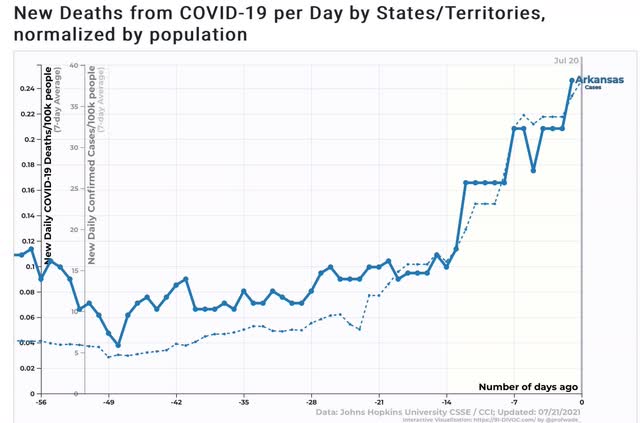 Deaths have risen just as fast as cases, and started to rise very quickly after cases did. So, brace yourselves. Cases have nearly tripled in the US over the past 2 weeks. Deaths are likely to increase to nearly 1000/day over the next 2 to 4 weeks.
At a summer camp north of New York City, 31 children test positive for the virus. – The outbreak at Camp Pontiac, a sleep-away camp in upstate New York, started in the girls’ dormitories. Nurses, worried that young campers were showing symptoms of Covid-19, began administering tests. Last Saturday, one came back positive.More followed: As of Thursday morning, 31 of the camp’s 550 campers had tested positive for the virus, said Jack Mabb, the health director of Columbia County, where the camp is located.All 31 children are under the age of 12 and none of them were seriously ill, Mr. Mabb said.The New York outbreak is one of a spate of recent camp-related Covid-19 clusters across the United States this summer. In Texas,more than 125 teenagers and adults at a church-run camp tested positive after an indoor event. Kansas’s health department has reported multiple outbreaks tied to camps in and around the state. Illinois reported more than 80 cases, most of them among teens, at a summer camp there.Those outbreaks, by and large, have come in states with lower vaccination rates than New York State, where 74 percent of adults and 62 percent of all residents have received at least one dose of a vaccine. Camp Pontiac will not close despite the outbreak, Mr. Mabb said.
Rise in COVID-19 cases among children surge in major US hotspots – Florida, Missouri and Arkansas have become major hotspots of the fourth wave of the coronavirus pandemic in the US. The severity of the Delta variant, expressed in a rise in cases, hospitalizations and deaths has not spared children and youth ages 0-17, who have been placed in grave danger as schools across the country have fully reopened for summer school and the upcoming fall semester. Data from the Centers for Disease Control and Prevention (CDC) and Human Health Services (HHS) shows the seven-day national average of cases has risen 52 percent, deaths have increased 18 percent and hospitalizations have increased by 20 percent. The dominance of the Delta variant coupled with low vaccination rates has caused cases to surge in recent weeks across the country, reaching levels not seen since the spring. Vaccinations have stagnated across the country, with many states reporting well under 50 percent of their populations fully vaccinated. Florida is currently the epicenter of the pandemic in the US. On Thursday, the Florida Department of Health reported 12,647 new infections and 86 deaths. Between July 15 and July 21, the state reported 45,449 new cases of coronavirus, far surpassing other states. It has seen a major surge with over 3,000 cases among children reported from July 8 through July 15, resulting in a greater than 80 percent increase among youth age groups from the two weeks prior. Significantly, the Florida Department of Health stopped reporting hospitalizations among children on June 24 obscuring the severity of cases among the thousands of children who have tested positive throughout the state in recent days. Despite the alarming situation, Republican Governor Ron DeSantis continues to downplay the dangers of the pandemic. In a statement Thursday, DeSantis vowed there would be no mask mandates in schools or COVID-related lockdowns this fall. In response to the recommendation by the American Academy of Pediatrics (AAP) earlier this week that all students two or older and school staff wear masks, DeSantis said, “We’re not doing that in Florida. Ok? We need our kids to breathe.” In Missouri, on Wednesday health officials recorded over 2,000 new COVID-19 cases for the second time in seven days, as well as eight new deaths. More than 1,500 hospitalizations have been reported, up almost 50 percent over two weeks ago and remaining inpatient hospital bed capacity hovers around 21 percent. Among children in Missouri, 1,356 cases were reported during the week of July 8 through July 15. A group of 100 Kansas City-area physicians signed a letter calling on school districts to require masks for all students under the age of 12, who are not currently eligible for the vaccine. Districts can decide whether to mandate masks, but regardless, full reopening plans with entirely inadequate mitigation and crowded classrooms will continue. In Arkansas, 1,875 new cases were reported on Tuesday bringing the current number of active cases throughout the state to 11,475. Hospitalizations have also been on the rise, increasing by 49 since Monday. On Saturday, the University of Arkansas for Medical Sciences in Little Rock announced that its hospital, a public facility ranked among the best in the state, was full. On Tuesday, Arkansas Children’s Hospital reported 12 COVID-19 hospitalizations among children, with half in critical condition diagnosed with COVID-pneumonia or on ventilation support. In an interview with CNN on Tuesday, Dr. Rick Barr, Chief Clinical Officer at Arkansas Children’s Hospital, remarked on the virulence of the Delta variant among children. He said, “The Delta variant is different than what we were seeing. We have 12 children admitted to the hospital now with COVID, that’s triple our usual numbers we saw during the previous months of the pandemic, and they seem to be much sicker.”
In Florida, some hospitals have more Covid patients than ever before. – A month ago, the number of Covid-19 patients admitted at two University of Florida hospitals in Jacksonville was down to 14. Now more than 140 people are hospitalized with the virus, a tenfold increase over five weeks – and the highest number of Covid patients this system has seen since the start of the pandemic.Higher than last summer, when the coronavirus slammed Florida. Higher than over the winter, when the virus surged to devastating levels across the nation.A national uptick in coronavirus cases has led, in sudden and concerning fashion, to a steep rise in hospitalizations in some spots around the country where people have been slower to get vaccinated, a predicament experts hoped might be avoided because the people contracting the infection tend to be younger and healthier.Nationally, hospitalizations remain relatively low, nowhere near earlier peaks of the pandemic. But in some regions with lagging vaccination rates and rising virus cases – such as Northeast Florida, Southwest Missouri, Southern Nevada – the highly contagious Delta variant has flooded intensive care units and Covid wards that, not long ago, had seen their patient counts shrink.“It’s very frustrating,” said Dr. Leon L. Haley Jr., the chief executive of UF Health Jacksonville. “Each day we continue to go up. There’s no sense of when things are going to curtail themselves. People are stretched thin.”The situation is worrying across Northeast Florida. The Mayo Clinic in Jacksonville is on track to match or exceed its earlier record. Wolfson Children’s Hospital has its second-highest number of admissions, 45, after reaching 57 in January. About 90 miles south, in Daytona Beach, an AdventHealth hospital has more Covid patients than ever before.About a fifth of all national cases over the past two weeks have originated in Florida, which has emerged as a microcosm of the nation’s mounting Covid worries. The state has the fourth-highest hospitalization rate, behind Nevada, Missouri and Arkansas.
Alabama governor on rising COVID-19 cases: ‘Time to start blaming the unvaccinated folks’ – Alabama Gov. Kay Ivey (R) declared that it’s “time to start blaming the unvaccinated” for the surge in coronavirus infections in her state.The governor, visibly exasperated while discussing the need to get a COVID-19 vaccination shot, was asked by local reporters Thursday what more can be done to boost vaccination rates.“I don’t know, you tell me!” Ivey said. “Folks supposed to have common sense.”“But it’s time to start blaming the unvaccinated folks, not the regular folks. It’s the unvaccinated folks that are letting us down,” she continued.Ivey’s comments come as her state grapples with one of the lowest vaccination rates in the country.Only 48.7 percent of the population age 12 and up has received one dose of a coronavirus vaccine, while 39.6 percent have been fully inoculated,according to the Centers for Disease Control and Prevention.There were 6,118 vaccine doses administered in Alabama on Wednesday, according to state data, a considerable drop from the more than 45,000 administered at the peak in April.Ivey was vaccinated in December.The state has seen a 70 percent increase in daily coronavirus infections over the past week and its highest hospitalization rate, according to The Washington Post. Ivey said it should be “crystal clear” that the new cases and hospitalizations are being reported among unvaccinated.“These folks are choosing a horrible lifestyle and self-inflicted pain,” Iveytold reporters. “You know we’ve got to get folks to take the shot. The vaccine is the greatest weapon we have to fight COVID, there’s not question about that, the data proves it.”
The C.D.C. director warns the U.S. is ‘not out of the woods’ in the pandemic. – The director of the Centers for Disease Control and Prevention warned on Thursday that the United States was “not out of the woods yet” on the pandemic and was once again at a “pivotal point” as the highly infectious Delta variant is ripping through unvaccinated communities.Just weeks after President Biden threw a Fourth of July party on the South Lawn of the White House to declare independence from the virus, the director, Dr. Rochelle P. Walensky, called the now dominant variant “one of the most infectious respiratory viruses” known to scientists.The renewed sense of urgency inside the administration was aimed at tens of millions of people who have not yet been vaccinated and therefore are most likely to be infected and become sick. Dr. Walensky’s grim message came at a time of growing anxiety and confusion, especially among parents of young children who are still not eligible to take the shot. And it underscored how quickly the pandemic’s latest surge had unsettled Americans who had begun to believe the worst was over, sending politicians and public health officials scrambling to recalibrate their responses. “This is like the moment in the horror movie when you think the horror is over and the credits are about to roll,” said Representative Jamie Raskin, Democrat of Maryland. “And it all starts back up again.”The choice by millions to reject the vaccine has had the consequences that public health officials predicted: The number of new cases in the country has shot up almost 250 percent since the beginning of the month, with an average of more than 45,000 infections being diagnosed each day during the past week – up from 12,800 on July 1.The disease caused by the virus is claiming about 250 lives each day – far fewer than during the peaks last year, but still 42 percent higher than two weeks ago. More than 97 percent of those hospitalized are unvaccinated, Dr. Walensky said last week.
Large majority of unvaccinated say they don’t intend to get the shot: poll – A large majority of Americans that are not vaccinated against the coronavirus say they do not intend on getting inoculated, according to a poll released Friday. Sixty-seven percent of respondents in The Associated Press-NORC Center for Public Affairs Research poll said they had received at least one dose of a vaccine, while 32 percent had not. Of those who said they had not received a COVID-19 shot, 81 percent said they would not get a vaccine. This includes 45 percent who said they would “definitely” not get inoculated and 35 percent who said they “probably” would not. Only 19 percent said they would likely get vaccinated, including 3 percent who said they definitely would and 16 percent who said they probably would take the shot. The survey comes as the U.S. grapples with a rise in cases fueled by the spread of the delta variant of the coronavirus, which now accounts for 83 percent of new infections. Last week, Centers for Disease Control and Prevention (CDC) Director Rochelle Walensky described the rise in new infections as “a pandemic of the unvaccinated.” The states with the worst outbreaks have lower vaccination rates. Twenty-eight percent of respondents said they were “extremely” or “very” confident that the vaccines would be effective against variants of the coronavirus. Forty-one percent said they were somewhat confident, while 30 percent said they were “not very” confident or “not at all confident.” Those not vaccinated were more likely to say they were not confident in the vaccine’s ability to protect against variants, with 64 percent expressing no confidence.
Spiralling COVID infections in UK schools a warning to the world – The UK education system is on the verge of collapse as schools break up for the summer term this week. Across the country, in every region, hundreds of thousands of school children and staff have been forced to isolate due to either having made close contact with someone with COVID or testing positive for virus themselves, as the Conservative government’s “let it rip” pandemic policy takes effect. Almost 840,000 children (11.2 percent) in England’s state schools were not in class on July 8 because of COVID, according to the latest official figures. This was the highest level since March and a 31 percent increase on the week prior. Of those off school, 39,000 pupils had tested positive and 35,000 had a suspected infection. A further 630,000 were absent for other reasons. The situation will have worsened dramatically since then. The vast majority of infections are the highly transmissible and more deadly Delta variant, which is overwhelmingly dominant in Britain. Hundreds of schools have been forced to close for the summer early, due to the lack of staff or multiple cases of the virus across several class and year group “bubbles”. About 18,000 children were at home because their schools were closed on July 8 and many thousands of parents, alarmed at the rapid rise of infections, have voted with their feet and kept children at home. This dire situation was worsening even before the July 19 lifting of all containment measures by Prime Minister Boris Johnson’s Conservative government in its cynically named “Freedom Day”. The current surge among children will massively contribute to the wave of COVID-19 in the general population in the coming weeks. Johnson said bluntly earlier this month that the UK “must reconcile [itself] to more deaths” and that infections could rise to 50,000 a day. That total has already been reached. Health Secretary Sajid Javid, who has now tested positive for the virus, also demanded the population “learn to live with the existence of Covid” and admitted that daily case totals could reach 100,000 before the end of summer. The Guardian estimated that there could be two million cases in the remaining six weeks of summer, but this was based on a conservative estimate of an average 35,000 cases a day until July 19 and 60,000 from then until August 16. Hospitalisations from COVID are now at over 4,000, a rise of 26 percent in one week. The schools most impacted by the surge are in the north of England, where pupils in secondary schools are three times more likely to miss classes as their peers in London. A massive 37 percent of sessions were missed in the week to July 9, with 27 percent missed due to COVID isolation and quarantine.
Covid 19: More than one third of Londoners unvaccinated – BBC News – More than one third of Londoners have not had their first vaccine dose making it the area with the lowest uptake in England, latest figures show.The data from NHS England also shows 55% have not had a second dose. Across England, 88% of people have had a first dose and 68% the second.Figures also show the city has one of the lowest rates of Covid-19 cases, with 298 per 100,000.Sadiq Khan said “everything possible” was being done to vaccinate everyone.Pop-up vaccination centres are being held across London, including in the Tate Modern and football stadiums. There are 300 locations in the city where people can be vaccinated.The government set a target for all adults to be offered a first dose, and two thirds their second by Monday when all of the social distancing restrictions are being lifted.NHS London did not confirm how many Londoners have been offered the vaccine but have declined.
- ‘Perfect storm could lead to Covid-19 increase’ in London
- How many people have been vaccinated so far?
- What do over-18s need to know about the vaccine?
- How are Covid rules changing on Monday?
The city has a high proportion of young people – with 35 being the average age – meaning many have only been eligible for a vaccine for a short period of time, according to the mayor’s office.
In England, concerns grow about a ‘notable gender split’ in COVID-19 Delta infections – For the English, today marks a kind of Independence Day over COVID-19 as monthslong lockdown restrictions are eased across the country. And yet to see how the outbreak continues to divide the nation, look no further than Twitter. Hashtags like “Freedom Day,” “Plague Island,” and “The Purge” have been trending throughout the day.The country holds the bragging rights of one of the highest vaccination rates in the world. It also has one of the highest numbers of active COVID-19 cases in the world – and the latest wave is hitting the young and males particularly hard.In the last week of June, men made up 55% of the COVID-19 deaths in the United Kingdom, according to the country’s Office of National Statistics. The week before, males made up 70% of all COVID-19 deaths.Cases have also been considerably growing in males ages 15 to 40 over the past few weeks – the first time there’s been “a notable gender split” in the disease, Deutsche Bank analysts said in a research note to investors on Monday morning. The investment bank put in words the big fear that Europe may be glimpsing a kind of soccer-led spike in cases a week after the Euro Cup final match, pitting England against Italy. The gender split, Deutsche Bank analysts wrote, “strongly hints at the impact of millions of football fans watching the Euro football final.”The big culprit is the Delta variant, which has become the dominant strain in not just the U.K., but globally. Britain has becomes a new epicenter for the disease, recording 54,600 daily new cases on Saturday.So far, that hasn’t slowed down the Boris Johnson government’s Freedom Day reopening plan.From today onward, English immune systems will be further tested as the U.K. opens nightclubs, ends lawful requirements for face coverings, and drops all limits on the number of people who can hang out indoors.The masks may be dropping, but the government’s far-reaching test-and-trace program, which requires people to self-isolate when they come into contact with someone who has COVID-19, will remain in place.The program has been in the spotlight lately as U.K. Health Secretary Sajid Javid, who was fully inoculated, tested positive for COVID-19, setting off a chain reaction in the highest circles of power. On Sunday, Prime Mister Boris Johnson and Chancellor of the Exchequer Rishi Sunak confirmed they would self-isolate for 10 days, as is required, after being “pinged” by the National Health Service (NHS) COVID tracing app.
Concern grows about vaccine effectiveness against COVID Beta variant – Amid growing concerns about the effectiveness of vaccines against the Beta variant of the coronavirus, the UK will require all travelers from France – including those who are fully vaccinated – to isolate for 10 days when they return to England and Wales.The Beta variant, first identified in South Africa, is spreading in France, though mostly in the Indian Ocean territories of Reunion and Mayotte, the BBC reported.Circulation of the variant in mainland France is low, just 3.4 percent of total cases in June, the Independent reported.CDC data shows the Beta variant accounts for just 0.2 percent of cases in the U.S.The Beta variant is thought to be less infectious than the Delta variant – the strain first seen in India that now accounts for 31% of cases in the US. “Where it has an advantage is that it is able to escape the immune response to a better extent,” Professor John Edmunds of the London School of Hygiene and Tropical Medicine told the BBC. Growing immunity to other variants creates better conditions for the Beta variant to get an advantage, Edmunds said. “There is some good evidence from South Africa that it can evade the immune response generated by the AstraZeneca vaccine more efficiently.” The Beta variant may also be deadlier than other strains, Reuters reported. Researchers in South Africa found that people infected in the wave in that country where Beta was dominant were more likely to require hospitalization. Hospitalized COVID-19 patients during that time had a 31 percent greater chance of death.
More Than 50% Of Australians On Lockdown As Delta Fears Spread -What started as a two-week lockdown in Sydney three weeks ago has expanded to cover more than half of Australia’s 25 million people as of Tuesday as a third state adopted the strict anti-COVID measures as the intense ‘delta’-induced paranoia continued to swell. South Australia has ordered a ‘snap lockdown’ of (at least) seven days, joining neighboring Victoria and New South Wales,Reuters reports. Even though Australia’s daily new COVID cases and deaths are well below other developed nations, authorities started again with the lockdowns after its ‘drawbridge’ strategy failed to keep COVID cases at the country’s target level of ‘0’. Now, they’re desperately trying to vaccinate as many Australians as possible during the coming weeks. The lockdown in South Australia started at 1800 on Tuesday.Premier Steven Marshall defended his decision to impose the lockdown measures, saying “we hate to put these restrictions in place, but we have just one chance to get this right”. The alternative, he suggested, would be a lengthier freeze. But as the lockdowns spread, the Australian people have grown increasingly irritated, and the politicians are taking notice as their polling numbers plummet.Under the rules of the new lockdown, all South Australian residents are required to remain at home unless they are essential workers or need to purchase groceries or other necessities, or attend medical appointments. Individuals are allowed outside to exercise for a maximum of 90 minutes and within a 2.5km (1.5 mile) radius of their home. Schools will be closed and students will transition to online learning.The decision to impose a strict snap lockdown comes after five coronavirus cases were reported, with the fifth being an isolated incident from the other four cases.All of the cases have been confirmed to be caused by the Delta variant, which is 60% more transmissible than most other variants, with an R0 of 8, putting it on par with measles, according to certain public health authorities. Authorities also warned that hospitalizations have risen alarmingly. Authorities say people with COVID-19 have been hospitalized with COVID in the state, 27 of them in intensive care and 11 on ventilators. The state’s five deaths in the latest outbreak take the national toll to 915, with a tally of just over 32,000 infections.
India’s pandemic death toll could be in the millions – How many people have died of COVID-19 since the pandemic began? The official global total as of this week: 4.1 million.But everyone agrees the true toll is far greater. A study released on Tuesday looks at how much of a disparity there may be in India, one of the epicenters of the pandemic.The analysis, from the Center for Global Development, a think tank in Washington, D.C., looks at the number of “excess deaths” that occurred in India between January 2020 and June 2021 – in other words, how many more people died during that period than during a similar period of time in 2019 or other recent years.Drawing death data from civil registries and other sources, the report came up with three estimates for undercounts. The conclusion is that between 3.4 and 4.7 million more people died in that pandemic period than would have been predicted. That’s up to 10 times higher than the Indian government’s official death toll of 414,482.The researchers looked at India in particular because, says study co-author Justin Sandefur, the country has been hit so hard by COVID-19. “The second wave in particular led to heart-wrenching stories from friends and colleagues – and a sense that official numbers are not capturing the true scale of that toll.” But COVID death undercounts are happening almost everywhere. In the United States, the official toll is 500,000 but the real number is closer to 700,000, says Ali Mokdad of the Institute for Health Metrics and Evaluation (IHME). The group’s website has a global rundown that estimates “excess mortality” in many countries during the pandemic. When counting “excess deaths,” the cause of death is not part of the data set. But during a health crisis like the pandemic, the assumption is that these additional deaths are part of the COVID-19 toll, says Mokdad. They reflect not only those who died of the virus but those who might have died, say, of heart disease or diabetes because they were afraid to seek treatment during lockdowns, and those who killed themselves due to pandemic stresses, he adds.There are various reasons for the death toll discrepancies in India, as NPR’s Lauren Frayer and Sushmita Pathak reported earlier this year. Dr. Aniket Sirohi, a municipal health official in south Delhi, told NPR he counted 702 deaths on a day in mid-April and passed those numbers up the chain of command. But the death figures the government has published for his region have been at least 20% lower than what he’s seeing on the ground, he said.He attributed this disparity to administrative chaos. People from neighboring states flock to Delhi for medical treatment. Some die in Delhi and are cremated there but remain registered as residents somewhere else. They don’t get counted anywhere, he said. “Somehow the numbers are not getting recorded or not shown or getting missed,” Sirohi said. “India always had a poor record of maintaining these things. We have a lot of population. So there’s a bit of a problem with coordination – especially in times like this [pandemic second wave], when 50% of my staff is sick.”
Israel’s COVID outbreak is mostly fully vaccinated people. What’s going on? – – About a month ago, Israel celebrated what seemed like the end of its domestic pandemic. The country dropped all coronavirus restrictions, including mask mandates and social distancing requirements, reported Reuters. Unfortunately, the celebration was premature. COVID-19 cases have begun to rise in Israel over the last few weeks, reported Reuters. The outbreaks started in schools among unvaccinated children then began spreading to vaccinated adults.
- Last week, Israel recorded an average of 775 new daily cases last week, according to data from Reuters.
- This is Israel’s highest number of daily new infections since March, Reuters reported.
- The average number of weekly hospital admissions is currently 120 people, according to The Washington Post.
- The country has reimposed mask mandates, social distancing requirements and quarantines for everyone arriving in Israel.
Just like in many other countries, the recent outbreak has been driven by the more contagious and “more vaccine-resistant” delta variant, reported The Washington Post. Unlike in many other countries, most of the people testing positive in Israel are vaccinated, reported The Washington Post. But this should not be surprising, according to epidemiologist Katelyn Jetelina, per The Washington Post. “The more vaccinated a population, the more we’ll hear of the vaccinated getting infected,” she said.And Israel has one of the most vaccinated populations in the world. About 60% of the nation’s entire population of 9.3 million has received at least one vaccine dose, reported Reuters. Among adults, about 85% have been vaccinated which means that Israel’s vaccinated community is five times larger than its unvaccinated community.
Singapore reports its highest daily count of new infections in almost a year. – Singapore reported 163 new locally transmitted cases of the coronavirus on Monday, its highest daily tally since August, as a growing cluster of infections has stalled the city-state’s return to normal life. Of the 163 cases, 106 were linked to the Jurong Fishery Port, and 19 were tied to karaoke bars. Ong Ye Kung, Singapore’s health minister, said in a Facebook post on Monday that the two clusters were linked. The Health Ministry says the number is likely to rise in coming days. The outbreak has delayed Singapore’s reopening plans just a week after it eased some restrictions, some of which have been restored. In addition, the port was closed for two weeks, and the authorities temporarily shut down more than 400 nightlife establishments that had been serving food and beverages to remain in business under pandemic restrictions. The Health Ministry said several of those businesses had “abused the system by operating clandestine and illegal activities,” contributing to the infections. “Unfortunately, there are a few who have flouted the rules,” Lawrence Wong, Singapore’s finance minister, said in a video released on Friday. He added, “We will take firm action against them.”
Russia passes 6 million virus cases. – A summer surge of new coronavirus cases in Russia pushed the country’s total reported number of infections since the start of the pandemic above six million, government news sitesreported on Tuesday.The milestone highlighted the authorities’ struggle to vaccinate the Russian population. When they announced eleven months ago that the country was the first in the world to develop an effective vaccine, other vaccines were in fact further along in trials at the time.As of Tuesday, 14 percent of the Russian population was fully vaccinated. A mix of vaccine hesitancy caused by mistrust of the government and lack of supply because of glitches producing the Russian vaccine, called Sputnik, slowed the rollout.Over the last seven days, Russia has reported a daily average of 17 cases per 100,000 people according to the Center for Systems Science and Engineering at Johns Hopkins University. Scientists and officials have blamed the spread of the more contagious Delta variant of the virus for the uptick in cases that began in June. For comparison, the United States has reported a daily average of 11 coronavirus cases per 100,000 people, according to a New York Times database.The new surge came despite months of assurances from President Vladimir V. Putin’s government that the worst of the pandemic had passed. Instead, Russia followed the path of India and several other countries that had seemed to squelch the outbreak, only tosee a resurgence with the spread of virus variants in a partially vaccinated population. As of Tuesday, Russia had reported a total death toll from Covid-19 of 149,922, but statistics showing excess mortality over the period of the pandemic suggest the real number is far higher.
World health officials call for urgent vaccine donations to stem Covid in Central America and the Caribbean. -Covid-19 cases are increasing in many Central American and Caribbean countries, officials from the World Health Organization warned on Wednesday as they called on richer nations to step up vaccine donations to a region where immunization rates remain perilously low.The Americas have become “a region divided by vaccine access,” said Dr. Carissa Etienne, the director of the Pan American Health Organization, which is part of the W.H.O.Countries with higher rates of vaccination, including Costa Rica, Uruguay and Chile, are seeing sharp drops in cases, while others are experiencing vastly different realities.Only 15 percent of people across Central America and the Caribbean have been fully vaccinated against Covid-19, and in some countries, including Honduras and Haiti, the figure is less than 1 percent.Several Caribbean nations are seeing a rise in cases, including Cuba, where infections and deaths have been soaring and which saw a recent outbreak of street protests against the government,the largest in decades.“Cuba is currently seeing the highest number of confirmed cases of Covid-19″ in the region, said Ciro Ugarte, the director of health emergencies at the Pan American Health Organization. In a population of less than 12 million, more than 43,000 new cases were reported for the current week, up 21 percent from the week before, and the authorities have confirmed that the highly contagious Delta variant is circulating in several provinces.Other Caribbean nations are also reporting surges. Cases in Martinique, for example, have tripled over the past week, many involving “young people in their 20s,” Dr. Etienne said.Most Central American countries are also seeing a sharp rise in coronavirus cases, with Guatemala reporting high rates of hospitalizations and neighboring Honduras seeing a spike in cases along its border. There are also hot spots in Amazonian states in Colombia and Peru.“Covid-19 remains entrenched within our region, particularly in countries with low vaccination coverage, and the spread of variants only makes matters worse,” Dr. Etienne said.
EU countries have donated just a fraction of surplus vaccines: report – Countries from the European Union have donated just a fraction of surplus coronavirus vaccines to poorer countries, according to a European Union document viewed by Reuters. The countries have donated less than 3 percent of their coronavirus vaccines, fewer than 4 million shots, according to the internal document. Most of the donated shots have been from AstraZeneca, according to the wire service. The AstraZeneca vaccine has not been approved by the federal government for emergency use in the U.S., and its distribution in other countries was paused after a rare blood clot risk was associated with the vaccine. However, it was reinstated for use in European countries earlier this year. EU countries have received almost 500 million coronavirus doses since the pandemic began, and are set to reach 1 billion doses from drugmakers by September, Reuters noted. The combined adult population among all EU countries is 365 million. The EU Commission put out a statement Thursday that did not specify how many doses have been shipped to the underserved countries, but said it is expected to exceed the 200 million doses promised to send to other countries this year, according to Reuters. The statement comes as the EU and other wealthy countries have been subject to criticism for not sharing vaccine doses with poorer countries who are struggling with vaccination efforts due to lack of supply. “We are very far away from our target,” the head of the Africa Centers for Disease Control and Prevention, John Nkengasong, said at the beginning of July. “We don’t want to be seen as the continent of COVID … [In Europe] the stadiums are full of young people shouting and hugging. We can’t do that in Africa.”
The European Union’s drug regulator authorizes the Moderna vaccine for children 12 and older.The European Medicines Agency, the European Union’s main drug regulator, on Friday authorized the use of Moderna’s Covid vaccinefor children age 12 and older, clearing the way for final approval by the bloc. The agency approved the vaccine for those older than age 18 in January. The vaccine is also licensed for those 18 and older in the United States, Canada and Britain.The protocol for children will be the same as for adults – two shots four weeks apart – the regulator said. Sore arms, headache and fatigue were the side effects most commonly reported among teenagers receiving the vaccine, it said, similarly to adults.The agency’s recommendation will go to the European Commission, the bloc’s administrative arm, for a final approval. Deciding if and when to begin using the vaccine on children is up to the E.U.’s 27 national governments.Until now, the only vaccine approved for those 12- to 17-years-old in Europe and North America has been the one from Pfizer-BioNTech. The bloc’s drug regulator recommended it for children in late May, and the European Commission swiftly approved it.More than a dozen E.U. countries have since begun vaccinating children.The E.U. vaccination campaign has accelerated considerably in recent weeks, and even overtook the immunization level in the United States, with over 67 percent of the population now inoculated with at least one dose, and 53 percent fully immunizedaccording to data gathered by the European Center for Disease Prevention and Control. Fifty-six percent of the U.S. population has received at least one dose, and 49 percent are fully vaccinated.The bloc has obtained enough doses to reach its goal of fully vaccinating 70 percent of the adult population by the end of July,the commission said earlier this month. But despite the overall high level of immunization, important divergences remain between the bloc’s member nations. The European Center for Disease Prevention and Control warned on Friday in a joint statement with the World Health Organization that the Delta variant is now dominant in the majority of the bloc’s nations, and urged the “fast rollout of vaccinations,” highlighting that full inoculation significantly reduces the risk of severe disease and death.
Exponential rise in Germany of new coronavirus infections —The number of reported new coronavirus infections is again rising dramatically in Germany. On Thursday, the Robert Koch Institute (RKI) – the German federal government agency and research institute responsible for disease control and prevention – reported almost 2,000 new cases and the nationwide seven-day incidence rate rose to over 12 per 100,000. The reproductive number (R) is 1.19, which means a strong exponential increase. The development reflects the perilous dynamics of the highly contagious delta variant. According to the RKI figures, active cases nationwide have increased by more than 42 percent compared to the previous week. The seven-day average of new infections was already around 67 percent higher on Tuesday than the previous week – the relative increase is thus higher than at any time during the so-called “third wave.” As an analysis by the newspaper Die Welt shows, the doubling period of active coronavirus cases, averaging 12 days, is only one-fifth of the previous week’s figure. It is thus only a matter of time before the infection rates in this country will also be at the level of the most affected countries in Europe currently. In Britain, Spain and France, tens of thousands are being infected with the virus every day. On Thursday, there were 43,907 new infections in the UK, 30,587 in Spain, 21,539 in France. The seven-day incidence rate rose to 496 in Britain, 378 in Spain and 122 in France. On Thursday, at her annual summer press conference in Berlin, Chancellor Angela Merkel (Christian Democratic Union, CDU) warned that Germany was on its way to a fourth coronavirus wave. Earlier, Federal Health Minister Jens Spahn (CDU) told the press that 400 new weekly infections per 100,000 inhabitants could be exceeded as early as September, followed by a seven-day incidence of 800 in October. German governments at federal and state levels are pursuing a deliberate herd immunity policy that puts profits before lives. By doing so, as happened last autumn, they are helping to produce a massive new coronavirus wave with hundreds of thousands of infected and dead.
.


