


from The Conversation
— this post authored by Patricia Fitzpatrick, University College Dublin
Taiwan has been widely applauded for its management of the pandemic, with one of the lowest per capita COVID-19 rates in the world and life on the island largely returning to normal.

Please share this article – Go to very top of page, right hand side, for social media buttons.
Just 11 people have died from COVID-19 in Taiwan since the pandemic began, an impressive feat for a country that never went into lockdown.
At the start of the pandemic, Taiwan was considered a high-risk country for COVID-19 due to its proximity to China and the frequent travel that takes place between the two countries.
With a history of SARS in 2003, which was not considered to be handled particularly well, the Taiwanese government acted quickly to close its borders this time around. It set up a Central Epidemic Command Centre on January 20 2020 to coordinate cooperation across different government ministries and agencies, and between government and businesses.
A new study in the Journal of the American Medical Association has examined further just why Taiwan did so well at conquering COVID-19. The study’s authors, from a range of health institutes and hospitals in Taiwan and the US, compared the estimated effectiveness of two types of COVID-19 policy in the early months of the pandemic: case-based and population-based measures.
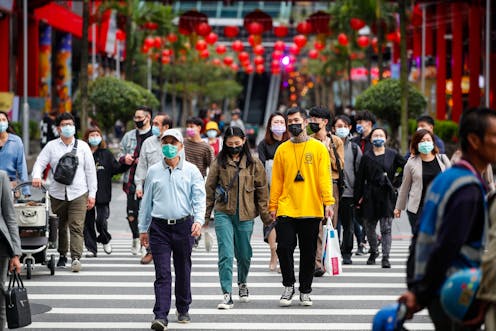
Life is almost back to normal in Taiwan. Ritchie B. Tongo/EPA
Case-based measures include the detection of infected people through testing, isolation of positive cases, contact tracing and 14-day quarantining of close contacts. The population-based measures included face mask policies, personal hygiene and social distancing.
The effects of these policies were quantified by estimating the effective reproduction number (R number).
The R number is a way of rating an infectious disease’s ability to spread – it represents the average number of people that one infected person will pass a virus onto. An R number of greater than 1 means the virus will continue to spread and outbreaks will continue. An R number below 1 means that case numbers will start to reduce.
While previous studies in other countries have simulated hypothetical scenarios, this paper combined transmission modelling with detailed real data to estimate effectiveness.

Taiwan combined case-based policies like quarantine with population polices like masking to fight COVID-19. David Chang
The authors collected data on 158 cases between January 10 and June 1 2020 from the Taiwan Centers for Disease Control, and all cases were confirmed by PCR testing. The data related to locally acquired cases, confirmed clusters, and imported cases in people who entered Taiwan before March 21 2020.
They then compared the outcomes they found in Taiwan with an estimated R number of 2.5, based on the estimated equivalent number in nearby China at the beginning of its COVID-19 outbreak.
The winning combination
The study found that the case-based policies alone, like contact tracing and quarantining, could lower the R number from 2.5 to 1.53. Quarantine contributed the most to lowering the R number.
Case-based interventions could not substantially prevent transmission from one person to another, but could reduce transmission onwards from those secondary cases to a third or fourth person, as long as close contacts quarantined.
Population-based policies like social distancing and face masks, meanwhile, reduced the R number from 2.5 to 1.3.
The authors concluded that it was the combination of case-based and population-based policies, along with widespread adherence, that led to Taiwan’s success in containing COVID. Combining both approaches led to an R number estimated using two different methods to be 0.82 and as low as 0.62. They also found that considerable population-based policies were needed to achieve containment even though the number of circulating infections was small.
Neither approach would have been sufficient alone, even in a country with an effective public health system and sophisticated contact tracing.
What does this mean for other countries?
Acknowledging that all models make assumptions, and this analysis is no different, this paper does confirm that the full suite of public health measures we have been using fairly consistently across the world – to varying degrees of length and stringency – have been necessary. Though it’s worth noting that the results in the study reflects a time when new variants with greater transmissibility were not a problem.

Taiwan was reporting zero COVID cases as early as April 2020. David Chang/EPA
The authors assumed that testing and isolation occurred simultaneously. This was the case in Taiwan, but not in other countries, for example England, where delays between testing, results and isolation diminish the effectiveness of case-based measures.
Taiwan is an island nation with the ability to control the introduction of new cases through border control, and the authors acknowledge the findings of this study may not be fully applicable to other countries. This is the reason the authors focused on the effectiveness of case-based and population-based interventions on local transmission, rather than on border controls on the number of introductions of COVID-19.
The authors conclude that intensive contact tracing is not possible when public health systems are overwhelmed. This never happened in Taiwan due to the success of its strategies, but it did, for example, take place in Ireland in January 2021, which experienced a damaging third wave of COVID-19.
This paper also found similar results for seven-day and 14-day quarantine and suggest that the quarantine period could be shortened. This is being considered by some countries, including the USA, but it has not been introduced on a widespread basis to date.
We already knew there was much to be learned from Taiwan’s success in preventing COVID-19 from taking hold. Now, as vaccines roll out and new variants emerge, we have more information about the comparative and combined contributions of public health measures.
Patricia Fitzpatrick, Full Professor of Epidemiology & Biomedical Statistics, University College Dublin
This article is republished from The Conversation under a Creative Commons license. Read the original article.
.


