


from The Conversation
— this post authored by Benjamin Fernando, University of Oxford
As I write this, Nasa’s Perseverance Rover is hurtling toward Mars at a speed of more than 80,000 km/h and is set to land at the Red Planet on February 18. Landing on Mars is no mean feat – the spacecraft will have to decelerate from more than 30 times the speed of sound to stationary in a matter of minutes, while it’s heated to more than 1,000°C by friction with the atmosphere.

Please share this article – Go to very top of page, right hand side, for social media buttons.
Just over 3,000kms away from Perseverance’s landing site, another Nasa mission, InSight, will be keeping an ear out. InSight’s primary goal is the seismic exploration of Mars, and it has been listening for “marsquakes” since November 2018.
Two years ago, the InSight team announced the first successful detection of a quake on another planet – 30 years after this had first been attempted. The quakes look very different to the ones here on Earth, but exactly why this is the case remains a mystery.
On Earth, a network of thousands of seismic stations record vibrations from earthquakes which travel through the interior of the planet. Using data from the global seismic network, we can rapidly work out how big a quake was, and where and when it happened. As different types of seismic waves propagate in different directions and at different speeds, this also allows us to build up a picture of the Earth’s interior.
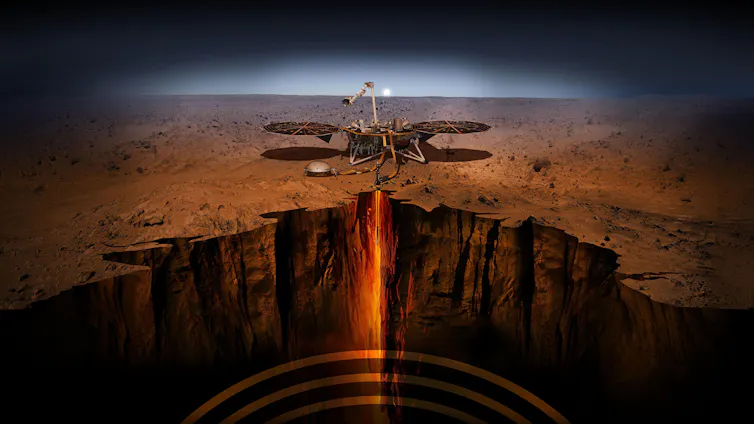
Artist impression of Mars Insight. NASA/JPL-Caltech
On Mars, where we have only a single seismic station, this is much more challenging to do. InSight recently celebrated its first Martian birthday (which actually amounts to 687 Earth days). In that time it has detected hundreds of quake events. But we’ve been unable to work out the parameters for the source of any of these – such as how large they were or where they occurred. It would be invaluable to have a source with known properties, which would offer us a chance to “calibrate” the apparatus so that we have a point of reference for other measurements. This can then help us to create precise models of the Martian interior.
Calibration experiment
So because earthquakes are common and we have plenty of seismic station it is relatively straightforward to set up a calibration experiment on Earth. But on Mars, seismic events are much rarer. Luckily, the entry, descent and landing of the Perseverance rover is so energetic that it produces signals that are detectable by seismometers. And we will know the parameters for it, such as where the rover will land, how much it weighs, its landing velocity and so forth. So could we use it as a source for calibration? We recently evaluated this.
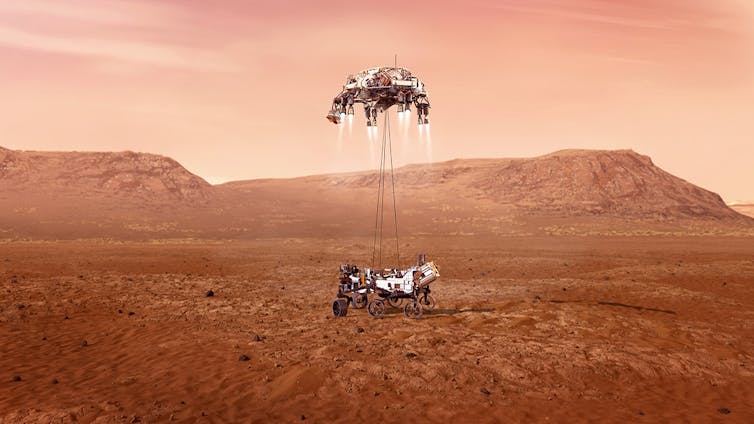
Will the landing be loud enough? NASA
There are three types of seismic signals produced by landing events. First, the rapid deceleration of the spacecraft produces a sonic boom. This shockwave propagates down toward the ground, where there are two processes which may produce detectable signals. Some of the energy from the sonic boom can get trapped by wind layers in the atmosphere, which channel it in a very efficient manner over great distances. The sonic boom may also strike the surface, creating seismic waves which propagate in the ground. We evaluated the likely amplitudes of both of these signals at the location of InSight, but found that they were unlikely to be detectable.
But the third type of signal is more promising. During the landing sequence, Perseverance will eject two large weights. These Cruise Mass Balance Devices (CMBDs) are used to control the spacecraft’s trajectory on its journey from Earth to Mars, but are jettisoned more than a thousand kilometres above the surface. Because of this, they are not slowed down by the deceleration of the rest of the spacecraft, but are expected to hit the surface at thousands of kilometres per hour, producing craters several metres in radius.
This will transmit a huge amount of energy into the ground, which will produce seismic waves. We estimated that these signals will be “loud” enough to be detected by InSight’s seismometers about 40% of the time in the best-case scenario. The uncertainties of our estimates are significant, mainly because no one has ever tried to detect an impact event at these distances before (though fans of the Netflix series Away will recall a similar storyline using InSight in that programme).
Our results will nevertheless help work out how Mars’ interior is structured and how seismic waves propagate through it. This is the first time that anyone has tried using a spacecraft on the surface of another planet to detect another spacecraft arriving – so it really is unprecedented. Wish us luck in keeping an ear to the ground, as it were.
You can hear more about the three Mars missions arriving at the red planet in February in the first episode of our new podcast, The Conversation Weekly – the world explained by experts. Subscribe wherever you get your podcasts.
Benjamin Fernando, PhD candidate and college lecturer, University of Oxford
This article is republished from The Conversation under a Creative Commons license. Read the original article.


