


from The Conversation
— this post authored by Adil Najam, Boston University
Back in March, my colleagues at the Frederick S. Pardee Center for the Study of the Longer-Range Future at Boston University thought that it might be useful to begin thinking about “the day after coronavirus.” For a research center dedicated to longer-term thinking, it made sense to ask what our post-COVID-19 world might look like.

Please share this article – Go to very top of page, right hand side, for social media buttons.
In the months that followed, I learned many things. Most importantly, I learned there is no “going back to normal.”
My season of learning
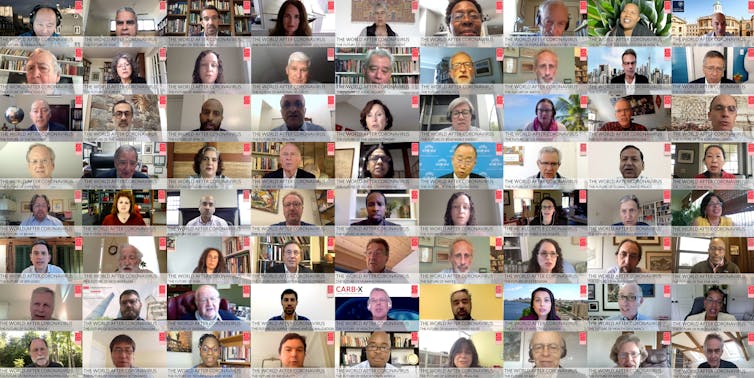
The project took on a life of its own. Over 190 days, we released 103 videos. Each was around five minutes long, with one simple question: How might COVID-19 impact our future? Watch the full video series here.
I interviewed leading thinkers on 101 distinct topics – from money to debt, supply chains to trade, work to robots, journalism to politics, water to food, climate change to human rights, e-commerce to cybersecurity, despair to mental health, gender to racism, fine arts to literature, and even hope and happiness.
Adil Najam, international relations professor at Boston University, interviewed 99 experts about what the post-pandemic future will bring. Pardee Center/Boston University, CC BY-SA
My interviewees included the president of the U.S. National Academy of Sciences, a former CIA director, a former NATO supreme allied commander, a former prime minister of Italy and Britain’s astronomer royal.
I “Zoomed” – the word had become a verb almost overnight – with Kishore Mahbubani in Singapore, Yolanda Kakabadse in Quito, Judith Butler in Berkeley, California, Alice Ruhweza in Nairobi and Jeremy Corbyn in London. For our very last episode, former U.N. Secretary General Ban Ki-moon joined from Seoul.
For me, it was truly a season of learning. Among other things, it helped me understand why COVID-19 is not a storm that we can just wait out. Our pre-pandemic world was anything but normal, and our post-pandemic world will not be like going back to normal at all. Here are four reasons why.
Disruption will accelerate
Just as people with preexisting medical conditions are most susceptible to the virus, the global impact of the crisis will accelerate preexisting transitions. As Eurasia Group President Ian Bremmer highlights, a year of a global pandemic can pack in a decade or more of disruption as usual.
For example, Phil Baty from “Times Higher Education” warns that universities will change “profoundly [and] forever,” but mostly because the higher education sector was already screaming for change.
Pulitzer Prize-winning editor Ann Marie Lipinski arrives at the same prognosis for journalism, and Princeton economist Atif Mian worries similarly for structural global debt.
At Harvard, trade policy expert Dani Rodrik thinks the pandemic is hastening the “retreat from hyperglobalization” that was already in train before COVID-19. And Pardee School economist Perry Mehrling is convinced that “society will be transformed permanently … and returning to status quo ante is, I think, not possible.”
Politics will become more turbulent
While the clouds over the global economy are ominous – with even the usually optimistic Nobel Prize-winning economist Sir Angus Deaton worrying we might be entering a dark phase that takes “20 to 30 years before we see progress” – it is political commentators who seem most perplexed.
Stanford University’s political theorist Francis Fukuyama confesses he has “never seen a period in which the degree of uncertainty as to what the world will look like politically is greater than it is today.”
COVID-19 has underscored fundamental questions about government competence, the rise of populist nationalism, sidelining of expertise, decline of multilateralism and even the idea of liberal democracy itself. None of our experts – not one – expects politics anywhere to become less turbulent than it was pre-pandemic.
Geopolitically, this manifests itself in what the founding dean of Harvard’s Kennedy School, Graham Allison, calls an “underlying, fundamental, structural, Thucydidean rivalry” in which a rapidly rising new power, China, threatens to displace the established power, the United States. COVID-19 accelerated and intensified this great power rivalry with ramifications across Asia, Europe, Africa, Latin America and the Middle East.
Pandemic habits will persist
Not all turbulence, however, is unwelcome.
Across sectors, expert after expert told me that habits developed during the pandemic won’t go away – and not just the habits of Zoom and working from home.
Robin Murphy, engineering professor at Texas A&M University, is convinced that “we are going to have robots everywhere” as a result of COVID-19. That’s because they became so pervasive during the pandemic for deliveries, COVID-19 tests, automated services and even home use.
We hear from both Karen Antman, dean of Boston University’s School of Medicine, and Adil Haider, dean of medicine at Aga Khan University in Pakistan, that telemedicine is here to stay.
Vala Afshar, chief digital evangelist at Salesforce software company, goes even further. He argues that in the post-COVID-19 world “every business will be[come] a digital business” and will have to take a great deal of its commerce, interactions and workforce online.
[Deep knowledge, daily. Sign up for The Conversation’s newsletter.]
Crisis will create opportunities
Science journalist Laurie Garrett, who has warned about global epidemics for decades, imagines an opportunity to address the injustices of our economic and societal systems. Because “there will not be a single activity that goes on as it once did,” she says, there is also the possibility of fundamental restructuring in the upheaval.
Environmentalist Bill McKibben says the pandemic could become a wake-up call that makes people realize that “crisis and disaster are real possibilities” but can be averted.
They are not alone in this thinking. Economist Thomas Piketty recognizes the dangers of rising nationalism and inequality, but hopes we learn “to invest more in the welfare state.” He says “COVID will reinforce the legitimacy for public investments in [health systems] and infrastructure.”
Former Environmental Minister of Ecuador Yolanda Kakabadse similarly believes that the world will recognize that “ecosystem health equals human health,” and focus new attention on the environment. And military historian Andrew Bacevich would like to see a conversation about “the definition of national security in the 21st century.”
Achim Steiner, administrator of the United Nations Development Programme, is awestruck at the extraordinary amount of money that was mobilized to respond to this global crisis. He wonders if the world might become less stingy about the much smaller amounts needed to combat climate change before it is irreversible and catastrophic.
Ultimately, I think Noam Chomsky, one of the most important public intellectuals of our times, summed it up best. “We need to ask ourselves what world will come out of this,” he said. “What is the world we want to live in?”
John Prandato, communications specialist at the Frederick S. Pardee Center for the Study of the Longer-Range Future, was series editor for the video project and contributed to this essay.
Adil Najam, Dean, Frederick S. Pardee School of Global Studies, Boston University
This article is republished from The Conversation under a Creative Commons license. Read the original article.
.


