


from The Conversation
— this post authored by Kevin L. Young, Bernhard Leidner, and Stylianos Syropoulos, University of Massachusetts Amherst
The Research Brief is a short take about interesting academic work.
The big idea
When the scientific establishment gets involved in partisan politics, it decreases people’s trust in science, especially among conservatives, according to our recent research.

Please share this article – Go to very top of page, right hand side, for social media buttons.
In the lead-up to the 2020 presidential election, several prestigious scientific journals took the highly unusual step of either endorsing Joe Biden or criticizing Donald Trump in their pages.
In September, the editor-in-chief of the journal Science wrote a scathing article titled “Trump lied about science,” which was followed by other strong critiques from both the New England Journal of Medicine and the cancer research journal Lancet Oncology.
Several other top publications – including Nature and Scientific American – soon followed, with overt endorsements of Biden. The statements focused on each candidate’s impact on scientific knowledge and science-based decision-making.
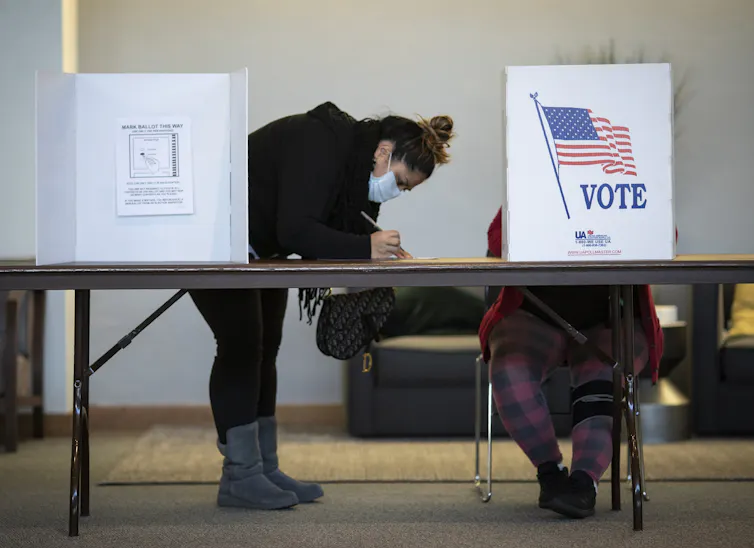
People lose faith in science when it takes a political side. AP Photo/Wong Maye-E
To evaluate whether political endorsements like these might influence people’s attitudes toward science, we ran an online survey experiment.
We asked one group of respondents to read a news article about a scientific journal or magazine. We asked a second group of people to read an article that contained the same description of the publication but with additional details about the political position it took and quotes from its actual statements regarding Biden and Trump. Then we asked respondents about their trust in scientists, scientific journals and science as an institution.

We found that trust in science declined among respondents who learned about a publication’s partisan statement. The magnitude of the observed effects is small but statistically significant, holds across a range of controls and is persistent across different ways of measuring trust in science. The finding was most pronounced for conservatives, likely because the endorsements were all supportive of Biden and against Trump.
Furthermore, we also found an interesting indirect effect. As trust in science decreased, so did the reported likelihood of complying with scientific recommendations about health behaviors related to COVID-19 – for example, wearing face masks.
Why it matters
There’s a lot of new research in the area of trust in science, including large polls of the public. Some findings suggest that there is still confidence in scientific expertise – but this declines as soon as science mixes with policy recommendations in people’s minds.
Public policy issues have become highly polarized, reflecting larger political trends. While scientific research itself has not driven such polarization, some areas of scientific research, such as climate change, have become very politicized.
Further, while public trust in scientists and science has remained largely stable over the years, the American public is divided along party lines in terms of trust in, and perceived impartiality of, science. Even more concerning, trust in science and medicine has been on the decline since the beginning of the COVID-19 pandemic.
Our findings suggest there may be costs when scientific institutions take partisan stances on electoral politics.
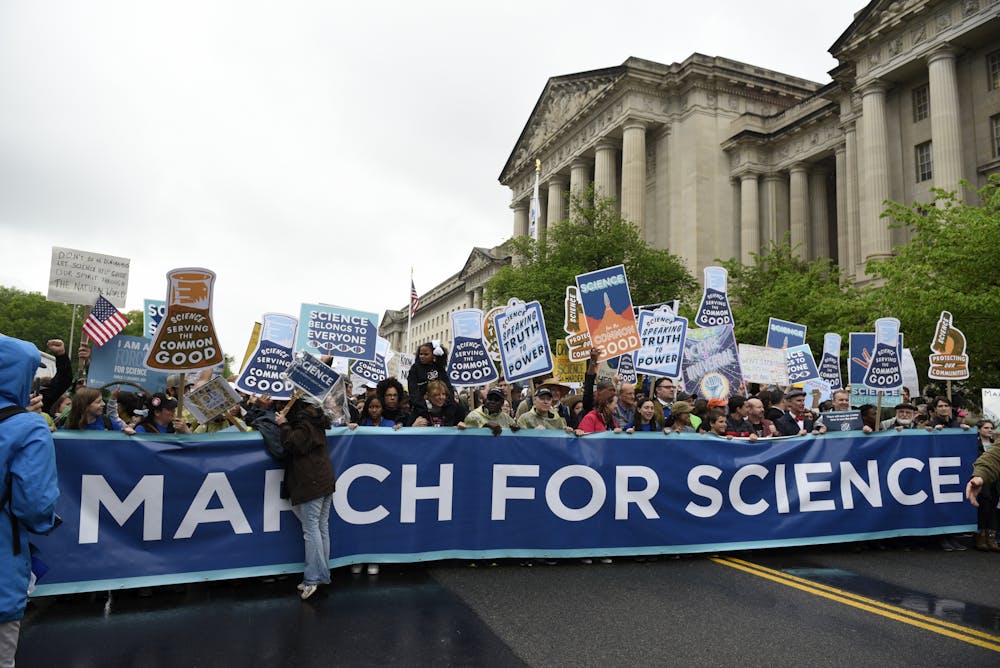
Science supporters – like these at a 2017 March for Science – risk looking like just another advocacy group. AP Photo/Sait Serkan Gurbuz
How we did our work
Because a single survey – even with a sample as large as our initial group of 2,975 demographically diverse Americans – could be a fluke, we ran a second survey. We configured a new sample of 1,000 people to be representative of the U.S. population, allowing us to generalize our findings better. The results lined up with those from the first study, indicating that our findings were not a fluke but robust. We will submit our full analysis to a peer-reviewed journal soon.
Because of the experimental design of our study, the effects we have identified can’t be due to people’s initial views coming into the survey. That’s because participants were randomly assigned to treatment and control groups, no matter what their prior beliefs on science or partisan positions.
As with any experimental study, we don’t know whether these effects will last or not. The highly partisan environment of the 2020 election may make some of our results specific to this time and place.
Kevin L. Young, Associate Professor of Economics, University of Massachusetts Amherst; Bernhard Leidner, Associate Professor of Psychological and Brain Sciences, University of Massachusetts Amherst, and Stylianos Syropoulos, PhD Student in Psychological and Brain Sciences, University of Massachusetts Amherst
This article is republished from The Conversation under a Creative Commons license. Read the original article.
.


