


from the Dallas Fed
— this post authored by Emma Marshall and Pia Orrenius
After absorbing a big hit from the COVID-19 pandemic, the energy sector may take until 2022 to recover. An upswing in petroleum consumption provides hope that the worst has passed, as economic activity gradually increases from April lows.

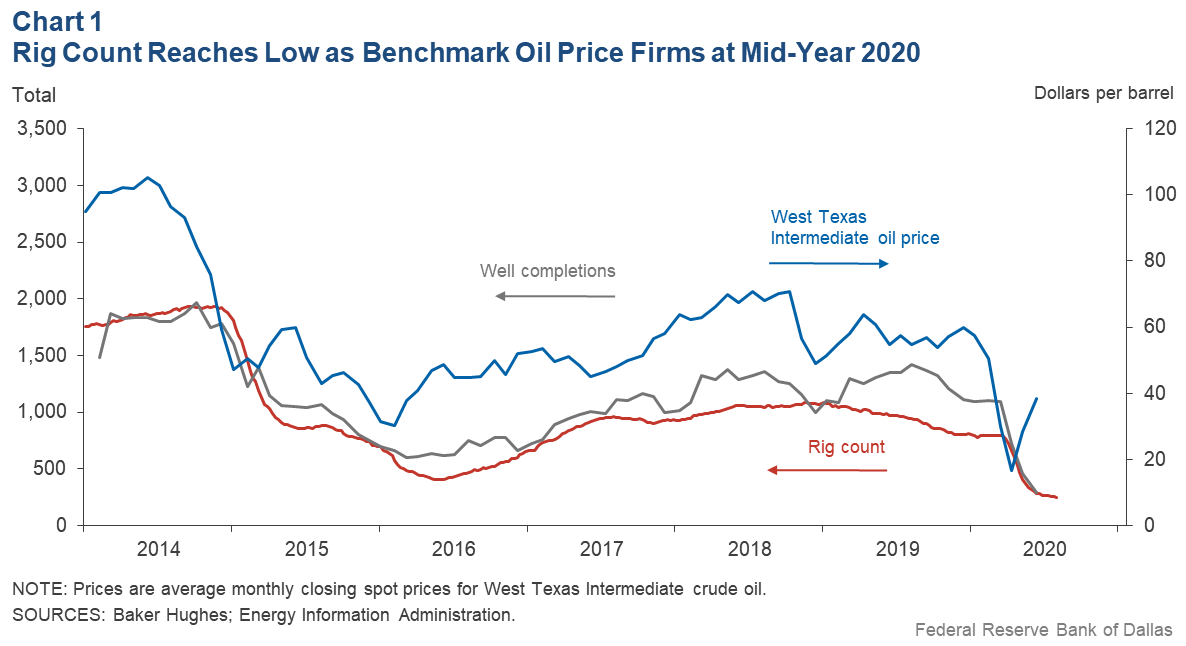
While crude oil prices have bounced back, they aren’t sufficiently high to spur new drilling. The price of benchmark West Texas Intermediate crude oil has stabilized at near $40 per barrel after averaging $38 in June and $17 in April. The demand slump was most notable on April 20, when producers were forced to pay buyers $38 per barrel as the price of the expiring near-term oil contract price collapsed on worries that there was no place to store deliveries.
Even at current levels, prices barely cover operating expenses. The average price per barrel needed to cover operating costs is $23 – $36, while profitably drilling a well requires prices of $46 – $52, according to the Dallas Fed Energy Survey in early 2020.[1]
With improved prices, the drop in exploration has slowed, as evidenced by the rig count decline, and well completions are expected to rise in coming months (Chart 1). The number of rigs declined across the U.S. at a rate of 12 percent per week at the end of April. The pace slowed to less than 1 percent per week in June, with around 260 rigs in service. Well completions dropped to 290 completions per month from January to June – a 73 percent decline. Completions are expected to pick up as producers, who have reopened shut-in wells, resume work on new wells.
Rising Supplies amid Glut
Crude oil demand fell faster than drilling and completion activity during the COVID-19 pause in U.S. economic activity from late March through April. In a one-month period from mid-March to mid-April, consumption of diesel fuel declined 37 percent, while gasoline fell 48 percent, and jet fuel tumbled 80 percent.[2]
In April, during the lowest point of consumption, Americans used only 14.7 million barrels of oil per day, 73 percent of forecasted levels. Consumption has since risen, reaching 85 percent of previously predicted levels in June.
During the demand decline, a price war between Saudi Arabia and Russia flooded global oil markets, pushing U.S. crude inventories 20 percent higher from January to June and prompting the worries of inadequate storage capacity.[3] Storage capacity never ran out, as producers quickly shut in wells, OPEC cut production and demand picked up in May and June.
The U.S. energy sector is still reckoning with widespread market uncertainty. Total U.S. crude oil and petroleum product exports – many of them handled through Texas ports – decreased 15 percent from January to June, to an average of 7.4 million barrels per day. Sixty energy companies sought bankruptcy protection from January through June. Relief is difficult given the industry’s limited access to new capital.
In response, energy companies are cutting workers, even as some other sectors of the economy are showing signs of recovery. Texas oil and gas companies laid off 61,000 employees through June, approximately 26 percent of the workforce they employed before the impact of COVID-19. Further cuts are likely, as evidenced by oilfield services company Schlumberger of Houston, which announced plans to dismiss approximately one-fifth of its 100,000 global workforce.
Looking Toward 2022
Before the pandemic, the U.S. energy sector had been expected to produce more than 13 million barrels per day. It may not reach 11 million barrels per day by year-end 2021. However, with supply so greatly curtailed, a return to more normal demand levels could aid a price recovery in 2022.
Notes
- Dallas Fed Energy Survey, Federal Reserve Bank of Dallas, March 2020.
- “Go Figure: COVID-19 Tanks U.S. Fuel Consumption, Prices,” by Olu Eseyin and Jesse Thompson, Federal Reserve Bank of Dallas Southwest Economy, Second Quarter, 2020.
- “How the Saudi Decision to Launch a Price War Is Reshaping the Global Oil Market,” by Lutz Kilian, Federal Reserve Bank of Dallas Dallas Fed Economics, April 2, 2020.
About the Authors
Emma Marshall is an economic programmer / analyst in the Research Department at the Federal Reserve Bank of Dallas. |
Pia Orrenius is a vice president and senior economist in the Research Department at the Federal Reserve Bank of Dallas. |


