


from The Conversation
— this post authored by Luke Montrose, Boise State University
If I dare to give the coronavirus credit for anything, I would say it has made people more conscious of the air they breathe.

Please share this article – Go to very top of page, right hand side, for social media buttons.
A friend texted me this week after going for a jog in the foothills near Boise, Idaho, writing:
“My lungs are burning … explain what’s happening!!!”
A wildfire was burning to the east of town – one of dozens of fires that were sending smoke and ash through communities in hot, dry western states. As an environmental toxicologist, I research how air pollution, particularly wood smoke, impacts human health and disease.
I gave my friend the short answer: The state had issued a yellow, or moderate, air quality index warning due in part to wildfires. The high temperature for the day was expected to reach 100 degrees Fahrenheit, and it was already approaching 90. That combination of high temperatures and elevated levels of particles from a fire can affect even healthy lungs. For someone with lung damage or respiratory illness, moderate levels of smoke particulate can exacerbate respiratory problems.
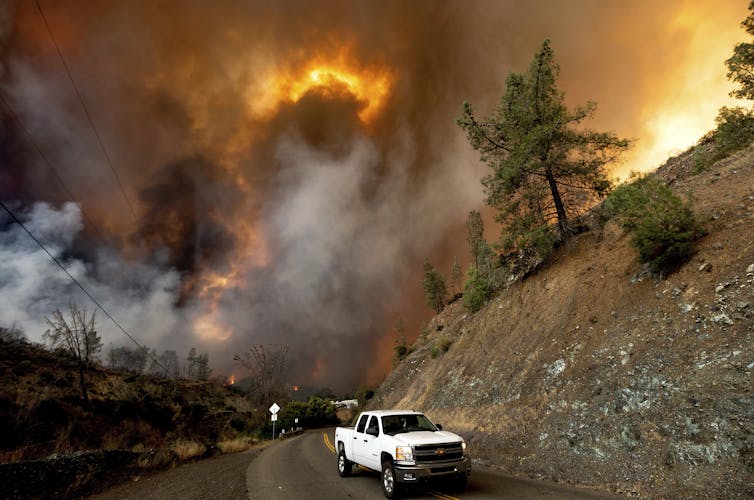
The health impact of wildfire exposure depends in part on the fire itself and how much smoke a person breathes in, how often and for how long. AP Photos/Noah Berger
That’s only the start of the story of how wildfire smoke affects humans who breathe it. The rest, and how to stay healthy, is important to understand as the western wildfire season picks up.
What’s in wildfire smoke?
What exactly is in a wildfire’s smoke depends on a few key things: what’s burning – grass, brush or trees; the temperature – is it flaming or just smoldering; and the distance between the person breathing the smoke and the fire producing it.
The distance affects the ability of smoke to “age,” meaning to be acted upon by the sun and other chemicals in the air as it travels. Aging can make it more toxic. Importantly, large particles like what most people think of as ash do not typically travel that far from the fire, but small particles, or aerosols, can travel across continents.
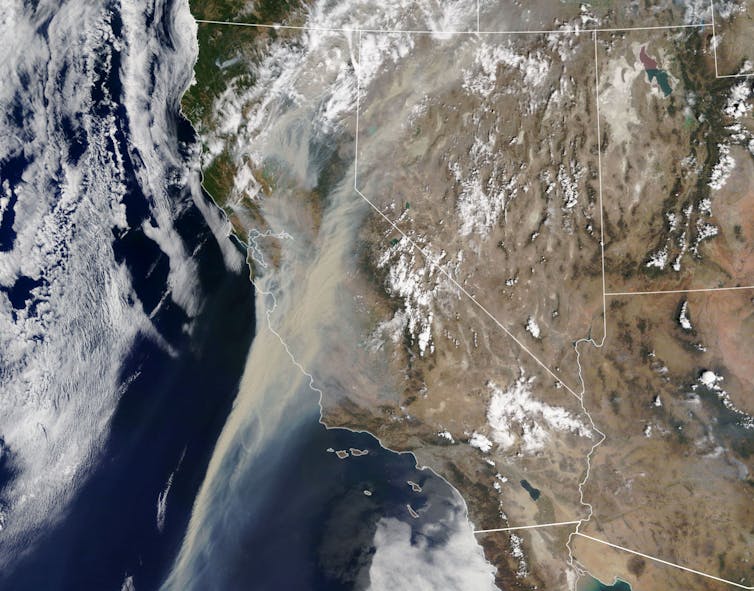
Smoke from wildfires obscures the California sky on Aug. 19, 2020. Lauren Dauphin/NASA Earth Observatory
Smoke from wildfires contains thousands of individual compounds, including carbon monoxide, volatile organic compounds (VOCs), carbon dioxide, hydrocarbons and nitrogen oxides. The most prevalent pollutant by mass is particulate matter less than 2.5 micrometers in diameter, roughly 50 times smaller than a grain of sand. Its prevalence is one reason health authorities issue air quality warnings using PM2.5 as the metric.
What does that smoke do to human bodies?
There is another reason PM2.5 is used to make health recommendations: It defines the cutoff for particles that can travel deep into the lungs and cause the most damage.
The human body is equipped with natural defense mechanisms against particles bigger than PM2.5. As I tell my students, if you have ever coughed up phlegm or blown your nose after being around a campfire and discovered black or brown mucus in the tissue, you have witnessed these mechanisms firsthand.
The really small particles bypass these defenses and disturb the air sacks where oxygen crosses over into the blood. Fortunately, we have specialized immune cells present in the air sacks called macrophages. It’s their job to seek out foreign material and remove or destroy it. However, studies have shown that repeated exposure to elevated levels of wood smoke can suppress macrophages, leading to increases in lung inflammation.
What does that mean for COVID-19 symptoms?
Dose, frequency and duration are important when it comes to smoke exposure. Short-term exposure can irritate the eyes and throat. Long-term exposure to wildfire smoke over days or weeks, or breathing in heavy smoke, can raise the risk of lung damage and may also contribute to cardiovascular problems. Considering that it is the macrophage’s job to remove foreign material – including smoke particles and pathogens – it is reasonable to make a connection between smoke exposure and risk of viral infection.
Recent evidence suggests that long-term exposure to PM2.5 may make the coronavirus more deadly. A nationwide study found that even a small increase in PM2.5 from one U.S. county to the next was associated with a large increase in the death rate from COVID-19.
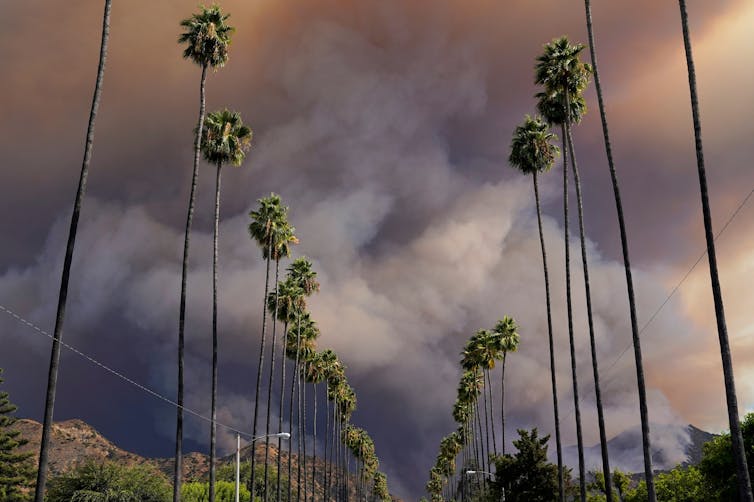
Wildfire smoke pours over palm trees lining a street in Azusa, Calif., on Aug. 13, 2020. AP Images/Marcio Jose Sanchez
What can you do to stay healthy?
The advice I gave my friend who had been running while smoke was in the air applies to just about anyone downwind from a wildfire.
Stay informed about air quality by identifying local resources for air quality alerts, information about active fires, and recommendations for better health practices.
If possible, avoid being outside or doing strenuous activity, like running or cycling, when there is an air quality warning for your area.
Be aware that not all face masks protect against smoke particles. In the context of COVID-19, the best data currently suggests that a cloth mask benefits public health, especially for those around the mask wearer, but also to some extent for the person wearing the mask. However, most cloth masks will not capture small wood smoke particles. That requires an N95 mask in conjunction with fit testing for the mask and training in how to wear it. Without a proper fit, N95s do not work as well.
[Deep knowledge, daily. Sign up for The Conversation’s newsletter.]
Establish a clean space. Some communities in western states have offered “clean spaces” programs that help people take refuge in buildings with clean air and air conditioning. However, during the pandemic, being in an enclosed space with others can create other health risks. At home, a person can create clean and cool spaces using a window air conditioner and a portable air purifier.
The EPA also advises people to avoid anything that contributes to indoor air pollutants. That includes vacuuming that can stir up pollutants, as well as burning candles, firing up gas stoves and smoking.
Luke Montrose, Assistant Professor of Community and Environmental Health, Boise State University
This article is republished from The Conversation under a Creative Commons license. Read the original article.


